
Amazon's Government Contracts
Amazon has been in the headlines recently — massive AI infrastructure investment announcements, investor debate about hyperscale cloud spending, and questions about long-term return on capital.
Government contracts represent a small portion of Amazon’s total revenue, but the data provides a clear view into how large-scale federal technology sales actually operate in practice.
We ran Amazon and its subsidiaries through the GovClose road mapping tool to look at FY22 through FY25 federal contract awards.
Amazon Web Services absolutely dominated the spending that we analyzed.
Below is a breakdown of that spending.
Note: the below data is publicly available through USAspending.gov, sam.gov, and FPDS. This does not account for subcontracts where Amazon is not the prime or contract data not reported publicly. Finally, our analysis focuses on obligated amounts versus often bloated contract ceiling -award numbers.
The Numbers: $798M Across 527 Contracts
Total federal spending on Amazon (FY22-FY25):$798,077,440
Number of awards:527
Average contract value:$1.5M
Growth trajectory:
FY22: $35.2M (70 awards)
FY23: $101.7M (89 awards) —+189% growth
FY24: $256.6M (154 awards) —+152% growth
FY25: $372.8M (206 awards) —+45% growth
For context on FY26: We’re only a few months into the fiscal year with typical reporting lag, so we won’t know if the growth trend continues until next year. But the pattern through FY25 is clear—rapid expansion followed by sustained high volume.
Where the Money Actually Flows
Public federal data systems — including USAspending, FPDS, and SAM — still classify spending under theDepartment of Defense (DoD)vs Department of War (DOW).
For clarity and consistency with the data, this analysis uses DoD naming when referencing spending
DoD Dominates Federal Amazon Spending
DoD Total:~$598.8M (~75%)
Awards:317
Inside DoD:
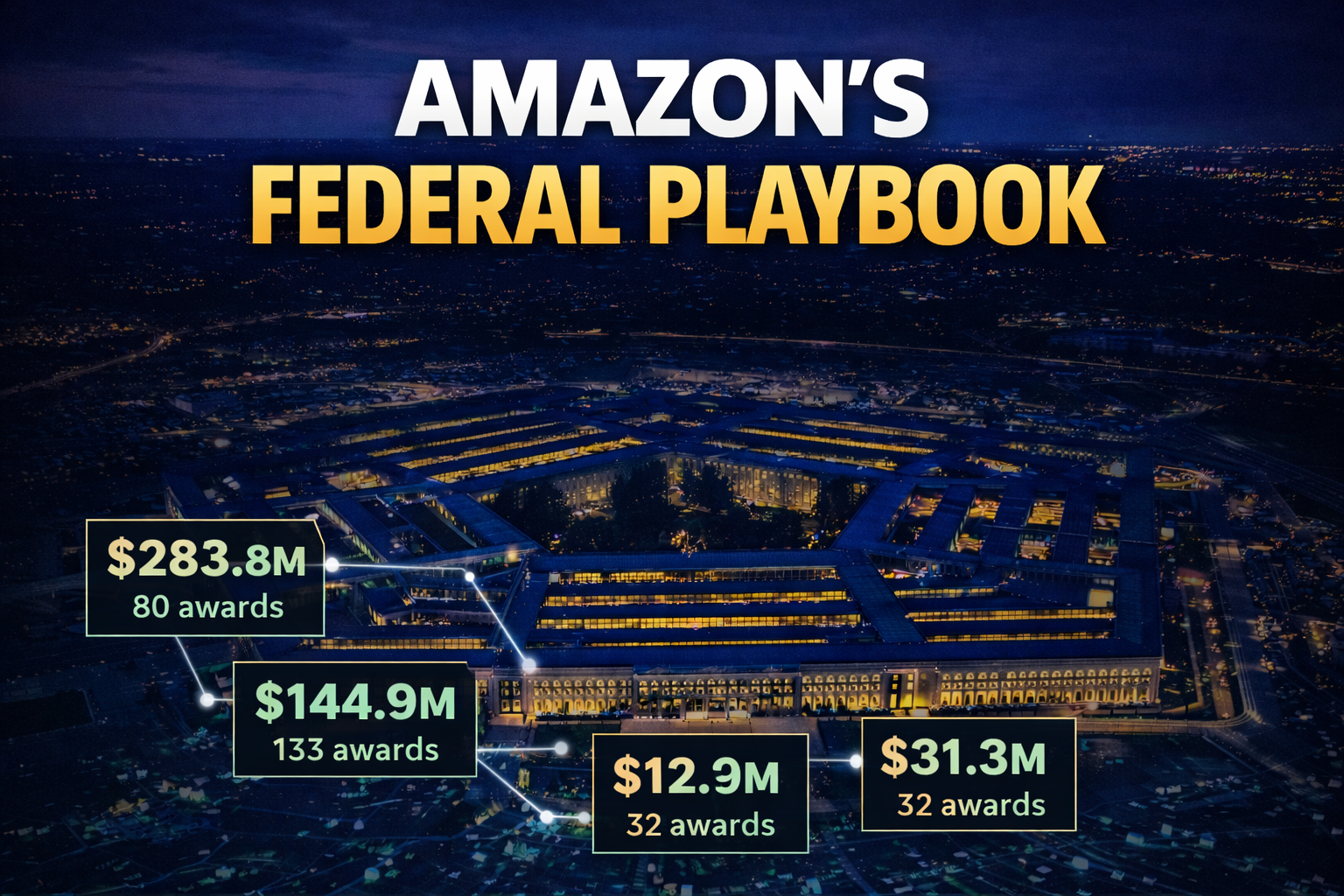
Navy: $283.8M | 80 awards
DISA: $144.9M | 133 awards
Army: $72.6M | 32 awards
Air Force: $31.3M | 32 awards
This shows strong concentration inside defense technology buyers rather than broad civilian distribution.
Top Buying Offices
When we look at how the government buys a certain or specific product or service, it is essential not just to identify the agency or sub-agency. We want to know the actual office where real people are working with companies and figuring out how to put them on contract.
This is how we can identify specifically how that office makes purchases, which can tell me if I need a contract vehicle or a GSA schedule. If the office I am selling to doesn’t use GSA, I probably don’t need it. If it does, then I am definitely going to need it. This is also how we can identify who we should be setting up meetings with.
Pro tip:If you identify a competitor that’s actively and successfully selling to the US federal government, you can look at all of the public information to reverse engineer how they did it.
Looking at the top buying offices in Amazon’s federal data, a clear pattern emerges: each office relies heavily on a specific contract vehicle or contracting pathway.
NIWC Atlantic
21 awards totaling $150.5M
Primary contracting pathway:NIWC Atlantic (N65236)
All observed awards flowed through this vehicle structure.NIWC Pacific
18 awards totaling $39.8M
Primary contracting pathway:NIWC Pacific (N66001)
All observed awards flowed through this vehicle structure.DISA PL8
131 awards totaling $144.6M
Primary contracting pathway:USSOCOM (H98210)
All observed awards in this dataset flowed through this acquisition path.Army – ACC-RI (W6QK)
31 awards totaling $72.2M
Primary contracting pathway:Army IDIQAir Force – Kessel Run (AFLCMC)
5 awards totaling $19.2M
Primary contracting pathway:Air Force IDIQDepartment of Justice – JMD Procurement Services Staff
66 awards totaling $65.5M
Primary contracting pathway:DOJ IDIQ
What This Means for Federal Sellers
At the office level, procurement behavior is highly consistent.
Rather than spreading purchases across dozens of vehicles, major buying offices often rely on a small number of repeat contract pathways.
For companies targeting federal markets, this reinforces a critical reality:
Winning federal business requires understanding:
Which offices buy your category
Which contract vehicles those specific offices actually use
Where competition occurs inside those vehicles
Being on the right vehicle matters.
Being aligned to the right buying office matters more.
Possible Take Aways
Major federal tech buying offices often standardize on one dominant contract pathway
Office behavior is more predictive than agency-level behavior
Vehicle strategy should be office-driven, not agency-driven
Minimal Competitive Pressure
Federal contract data includes a field for the number of offers received. Not all awards report this value, but enough do to establish clear patterns.
Of the 317 Department of Defense awards in this dataset, 255 reported offer counts.
Among those awards, the average number of offers received was1.58.
Across all agencies, Amazon’s overall average was approximately1.7 offers per award.
Minimal competition (1 offer or non-competed): ~75.7%
Higher competition (3+ offers): <1%
In practical terms, on roughly three-quarters of awards, Amazon faced one or zero competitors at the time of award.
How Contract Vehicles Influence Competition
One of the structural drivers of low offer counts is how federal contract vehicles work.
Many federal purchases occur through pre-competed contract vehicles such as IDIQs, agency-specific vehicles, or government-wide vehicles like GSA Schedules. Once a company is awarded a spot on a vehicle, future task orders are typically competed only among vendors already on that vehicle.
Even in cases like GSA Schedules — where thousands of vendors may hold contracts — competition is still limited to companies already approved for that vehicle, rather than the full open market.
In this dataset, major buying offices consistently relied on specific contract pathways. That pattern naturally narrows the vendor pool competing at the task order level.
Competition Environment by Award Type (FY22–FY25)
Full & Open After Exclusion of Sources
$317.5M | 206 awards | Avg 1.2 offers
Full & Open Competition
$354.6M | 176 awards | Avg 2.3 offers
Not Competed Under SAP
$54.0M | 68 awards
Not Competed
$51.4M | 32 awards
Competed Under SAP
$20.6M | 45 awards | Avg 3.5 offers
Overall, most awards occurred in environments where the number of competitors was limited at the time of award.
What Amazon Actually Sells to the Federal Government: Cloud Infrastructure
One complexity in analyzing large public companies in federal contracting is that they often sell through multiple subsidiaries, each with its own UEI (Unique Entity Identifier).
Looking across all Amazon-associated UEIs in this dataset, the overwhelming majority of federal contract value aligns with Amazon Web Services–related cloud infrastructure activity. While multiple Amazon legal entities appear in the data, the federal revenue profile is heavily concentrated in AWS-aligned service categories.
Top Product Service Codes (PSC)
Product Service Codes are four-character alphanumeric codes used by the federal government to classify what was purchased in each contract. PSCs describe the specific product or service acquired and are maintained in the GSA Product and Service Codes Manual.
DB10 — Cloud Computing and Storage Services
$446.5M | 229 awards | 55.9%DA01 — IT Professional Services
$93.5M | 49 awards | 11.7%DA10 — IT Software and Data Processing Services
$25.9M | 6 awards | 3.2%DB02 — Systems Development Services
$45.6M | 8 awards | 5.7%R608 — Translation and Interpreting Services
$34.0M | 3 awards | 4.3%
Combined cloud and core IT infrastructure categories (DB10 + DA01 + DA10) representover 70% of total federal revenuein this dataset.
Top NAICS Codes
NAICS codes classify businesses by industry sector. Unlike PSCs, which describe what was purchased, NAICS codes describe the industry classification of the contractor performing the work.
518210 — Data Processing, Hosting, and Related Services
$722.5M | 411 awards | 90.5%541512 — Computer Systems Design Services
$68.2M | 61 awards | 8.5%
Remaining NAICS categories represent minimal share of total revenue.
What the Data Shows
The federal revenue profile is highly concentrated in cloud infrastructure and related hosting services.
NAICS 518210 alone represents over90%of observed federal contract value. Combined with cloud-aligned PSC categories, this strongly indicates that Amazon’s federal contracting footprint is primarily driven by cloud infrastructure services delivered through AWS-aligned entities.
How Others Can Use This Data
For IT Infrastructure Vendors
Federal sales success depends heavily on identifying the right buying offices — and understanding how those specific offices put vendors on contract.
USSOCOM (H98210):
$195.6M across 149 awards
This reflects sustained Special Operations demand for cloud and IT infrastructure services. Companies aligned with SOCOM mission requirements should analyze the contract pathways commonly used by SOCOM-aligned buying organizations.
Navy Warfare Centers (NIWC Atlantic + Pacific):
$200.5M across 41 awards
These offices support defense communications, cyber, and mission IT environments. The data shows repeat procurement activity concentrated within these organizations.
DISA PL8:
131 awards totaling $144.6M
High award volume indicates recurring procurement demand within defense IT infrastructure environments.
Contract Vehicle Reality: Why Vehicles Matter Beyond One Office
Contract vehicles function as access control points. Once a company is awarded onto a contract vehicle, future task order competition is typically limited to vendors already on that vehicle.
In this dataset, major buying offices consistently rely on specific contract pathways. In some cases, contract vehicles support multiple buying organizations — meaning access to a single vehicle can enable competition across multiple offices and sometimes across agency boundaries.
For vendors, this means vehicle strategy should be driven by where target buying offices actually place awards, not simply by which vehicles are most widely known.
For Federal Market Analysts
The concentration metrics reveal clear procurement patterns:
• ~75% of spend flows through DoD despite purchases occurring across many agencies
• ~55% of revenue flows through a small number of dominant contract pathways
• ~56% of spend occurs in a single cloud infrastructure PSC category
• ~90% of spend occurs in a single cloud infrastructure NAICS category
Federal procurement often concentrates at the office and contract pathway level more than aggregate agency statistics suggest.
For Procurement and Capture Professionals
Competition data shows:
• ~75.7% of awards occurred in minimal competition environments (1 offer or non-competed)
• Average offers per award ≈ 1.7
This dataset indicates that successful positioning often occurs prior to award stage — through vehicle access, technical positioning, and early engagement with buying organizations.
Applying This at a Professional Level
Understanding federal procurement data is one thing.
Executing inside federal sales cycles is another.
The GovClose Certification Program is a one-year professional development program focused on teaching both the analytical and execution sides of federal sales, including:
• How agencies and offices actually buy
• How to identify and qualify real opportunities
• How to build and manage federal pipelines
• How to execute meetings, positioning, and capture strategy
Graduates typically go on to:
• Sell directly to federal customers
• Launch federal consulting practices
• Move into public-sector sales roles
If you want to explore whether GovClose aligns with your goals, you can schedule a call with our enrollment team.
The Bottom Line
From FY22 through FY25, Amazon generated approximately$798M in federal contract revenuethrough a highly concentrated set of buyers, contract pathways, and technical service categories.
The data shows consistent patterns:
• Buyer concentration — roughly 75% of revenue flowed through Department of Defense customers, with Navy and DISA organizations driving the largest share
• Contract pathway concentration — more than half of total revenue flowed through a small number of dominant contract vehicles and ordering pathways
• Technical concentration — cloud infrastructure and hosting services dominate both PSC and NAICS distributions
• Competition structure — average offer counts remain low, with most awards occurring in limited-competition environments at time of award
When aggregated across Amazon subsidiaries and UEIs, the federal revenue profile is overwhelmingly driven by AWS-aligned cloud infrastructure services.
The broader takeaway isn’t about Amazon specifically. The data illustrates how large-scale federal technology sales often work in practice: concentrated buying offices, repeat contract pathways, focused technical categories, and competitive environments shaped long before award.
For companies, analysts, and procurement professionals studying federal markets, this provides a clear model of how federal technology procurement operates at scale.
Rick Howardis a retired USAF Lieutenant Colonel and former DoD acquisitions officer. He managed over $82 billion in federal contracts during his 20-year military career,. He founded GovClose, a government contracting certification program, and operates Federalytics, a federal spending analysis platform.
Methodology:This analysis uses Amazon’s complete federal contracting data (FY22-FY25) from USAspending.gov, processed through Federalytics’ roadmapping system. UEIs (Unique Entity Identifiers) tracked include Amazon Web Services Inc. and subsidiaries selling to the U.S. federal government.
Is your company in need of government contract help? Get matched with one of our trained and vetted GovClose certified graduates through GovClose Match.
Disclosure:The Fed200 index and related model portfolios may include positions in companies discussed in this analysis, including Amazon. This analysis is for informational and educational purposes only and is not investment advice.