From VR Headsets to Weapons Systems: How Anduril Cracked the Defense Market Code
If you love this content (please share it), but also check out my YouTube & connect with me on LinkedIn
Palmer Luckey sold his virtual reality company to Facebook for $2 billion, then did something unexpected: he decided to build weapons. Six years later, his defense startup Anduril Industries isn't just another Silicon Valley disruption story—it's American warships in the Red Sea using Anduril systems to shoot down enemy drones in active combat.
Since their first government contract in March 2019—a modest $50,000 Air Force award—Anduril has secured $1.456 billion in prime contracts, making them one of the fastest-growing defense contractors in modern history. But the real story isn't just the growth. It's how they systematically solved the defense market's biggest barrier: access.
What You'll Get in This Intelligence Report
This analysis provides defense investors and industry stakeholders with actionable intelligence on Anduril's market position and growth trajectory:
The Numbers That Matter: Contract data revealing $1.26 billion in awards and Anduril's true market penetration—just 1% of their addressable sampled market
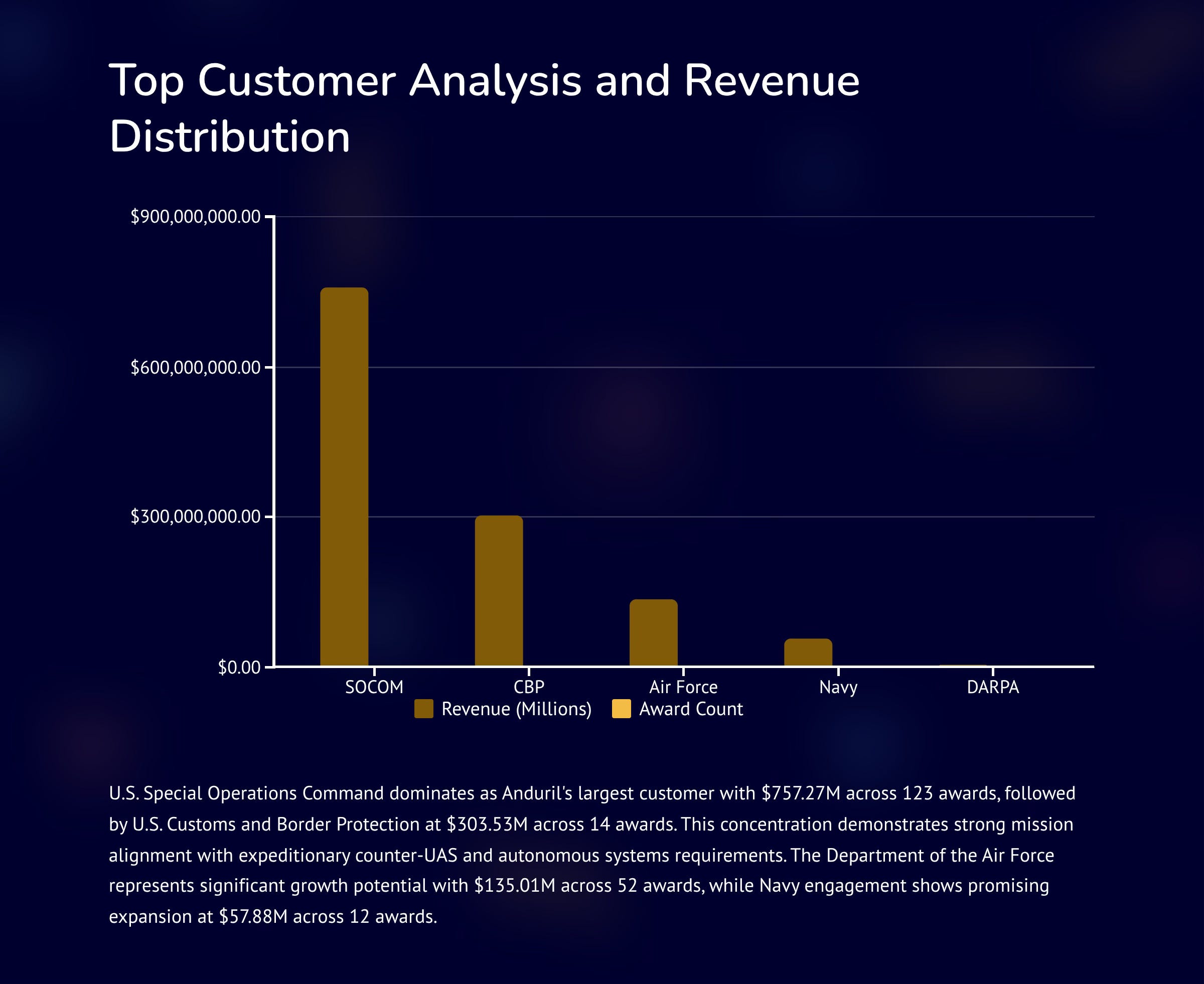
The Systematic Strategy That Worked: How Anduril methodically built relationships across SOCOM ($757M), Border Patrol ($304M), and Air Force ($135M) contracts
Breaking Through the Access Barrier: The contract vehicles worth billions that Anduril now controls—and why this infrastructure took competitors decades to build
BONUS: See the exact Acquisitions offices Anduril targets for business development.
Past Performance Drives Current Contracts: Real-world performance data from Red Sea operations and Australia's $1.7 billion submarine commitment
The Funding Tailwinds Are Massive: Pentagon's $13.4 billion FY26 autonomy budget breakdown and what it means for Anduril's addressable market
The Execution Challenge Ahead: Specific growth constraints across Air Force, Navy, and Army channels—and the $656 million Army gap they need to close
Each section includes proprietary contract analysis, competitive positioning data, and forward-looking budget intelligence unavailable in public defense reporting.
The Numbers That Matter
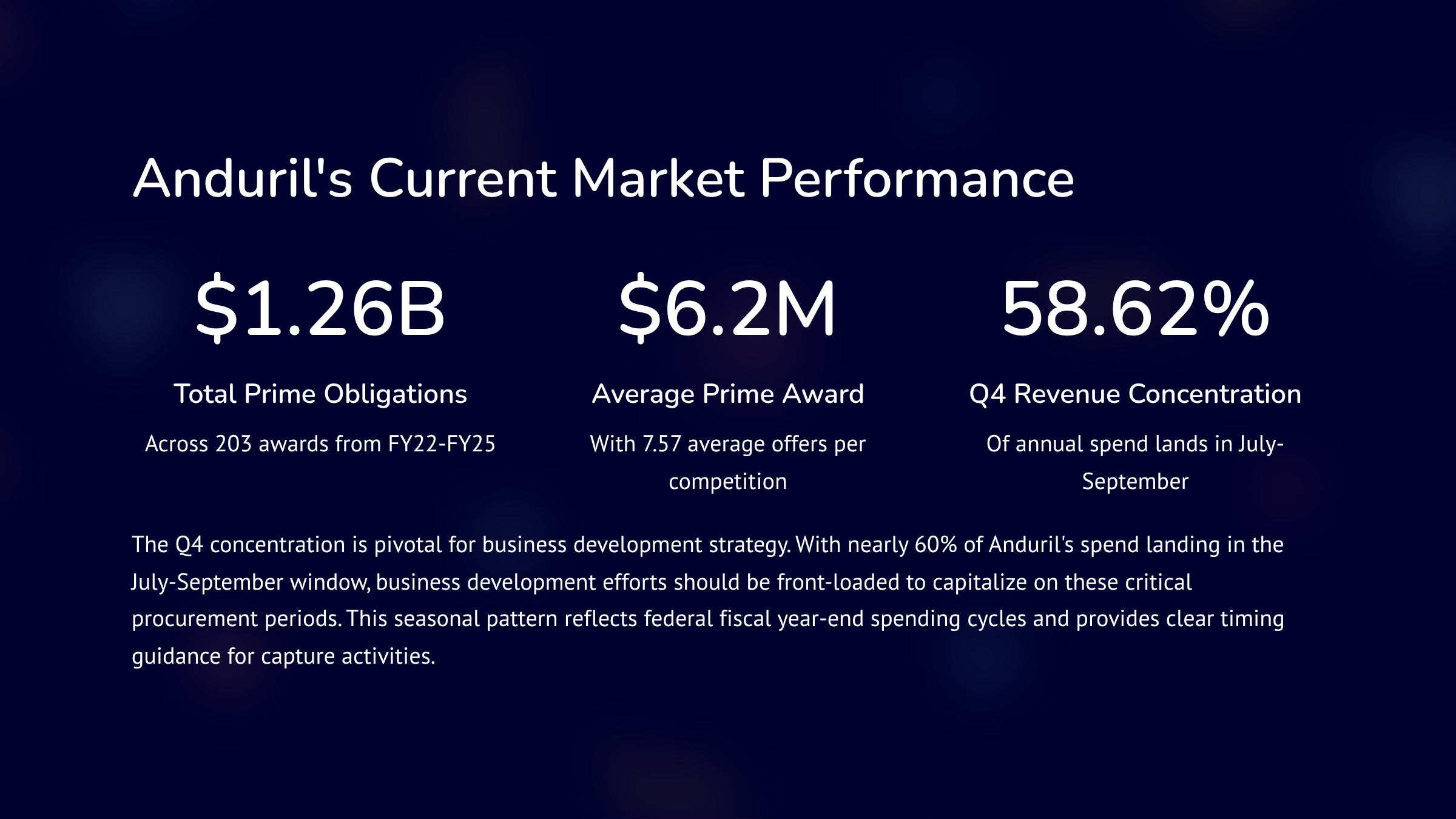
From fiscal years 2022-2025, Anduril recorded $1.26 billion in prime contract awards across 203 individual contracts. Their average contract size of $6.2 million significantly exceeds typical defense deals, and they're winning genuinely competitive procurements—averaging 7.6 competing bids per contract they pursue.
To understand their market opportunity, we analyzed government spending using keywords that match both Anduril's capabilities and Pentagon funding priorities: counter-drone systems, autonomous vehicles, and AI-enabled defense platforms. This snapshot revealed $2.3 billion in related government spending across 2,608 contracts.
Within this targeted market segment, Anduril appeared in just 14 contracts worth $97.5 million—barely 1% of the total spending. Meanwhile, traditional defense giants dominated: Raytheon captured $515 million (16.4% of spend), General Dynamics took $270 million from a single massive contract, and L3Harris secured $225 million across multiple awards.
That 1% market share in a segment perfectly aligned with their capabilities represents enormous expansion opportunity.
The Systematic Strategy That Worked
Most defense startups die trying to navigate government procurement. Anduril didn't just survive—they systematically conquered it by understanding a crucial truth: the Pentagon doesn't buy from companies it doesn't trust, and trust takes time to build.
BTW, you can learn how to build a trust with government offices, conduct research like that presented here, and start a career in government contracting with the GovClose Certification Program
Their progression reveals methodical relationship building: first subcontract in November 2018 ($1.8 million through an Air Force squadron), first major prime contract by July 2019 ($10 million Navy award), and by September 2019, their first task order under a larger contract vehicle that enables repeat purchases.
The customer concentration tells the strategic story:
U.S. Special Operations Command: $757 million across 123 contracts. SOCOM operators demand systems that work immediately in the world's most dangerous places—this is the ultimate validation.
U.S. Customs and Border Protection: $304 million across just 14 contracts, proving their technology works beyond traditional military missions.
Department of the Air Force: $135 million across 52 contracts, positioning them within the Air Force's multi-billion-dollar battle network modernization.
But here's what separates Anduril from typical defense contractors: 79% of their contract actions flow through what the government calls "contract vehicles"—pre-approved purchasing mechanisms that let agencies buy quickly without starting the procurement process from scratch each time.
Breaking Through the Access Barrier
Contract vehicles are simultaneously the government's solution and a company's roadblock. Think of them like pre-approved vendor relationships that let agencies purchase rapidly, but getting approved can take six months to years of qualifying processes, security clearances, and technical demonstrations.
Anduril has systematically solved this access problem, securing prime positions on the contract vehicles that control billions in government spending:
Air Force Battle Network Contract: Access to the Air Force's multi-billion-dollar battle management system modernization
Navy SeaPort-NxG: Prime contractor status on the Navy's $50+ billion IT services vehicle
GSA Multiple Award Schedule: Rapid access to civilian agency requirements
These aren't just contract wins—they're procurement infrastructure that typically requires decades of patient investment to achieve.
BONUS: Top Offices Buying From Anduril
Example of Anduril’s top awarding offices (FY22–FY25):
HQ USSOCOM — 123 awards; $757,267,724.70 obligated. Parent: U.S. Special Operations Command (Department of Defense).
Air and Marine Contracting Division — 14 awards; $303,532,562.10 obligated. Parent: U.S. Customs and Border Protection, Air and Marine Operations (Department of Homeland Security).
FA8820 Sustainment SDACP SSC/PKL — 5 awards; $50,461,934 obligated; 3 awards with recorded offers (avg 1). Parent: Space Systems Command (SSC), Contracting Directorate “PKL” (Department of the Air Force / U.S. Space Force).
FA2280 AFRL RGK — 9 awards; $34,711,000 obligated; 7 awards with recorded offers (avg 1). Parent: Air Force Research Laboratory (AFRL), Contracting at Kirtland AFB “RGK” (Department of the Air Force).
FA8730 Kessel Run AFLCMC/HBBK — 10 awards; $15,504,500 obligated; 2 awards with recorded offers (avg 1). Parent: Air Force Life Cycle Management Center, Kessel Run (AFLCMC/HBB), Hanscom AFB/Boston (Department of the Air Force).
NoteThis is not the full list. This is a sample of the offices and are listed to make a point. - And the point is- it is not good enough to know what agency or sub-agency you're selling to. Most people in the military will never be able to buy anything from a company. You have to know the exact office and the points of contact in those offices I have the authority, funding, and requirement to award contracts.
Past Performance Drives Current Contracts
Anduril's growth stems from demonstrated operational performance rather than promises. Their systems are actively defending U.S. naval forces, with two aircraft carrier strike groups in the Middle East deploying Anduril counter-drone capabilities during ongoing operations against enemy-launched threats. The USS Gerald R. Ford's deployment included additional Anduril systems based on operational lessons learned from previous engagements.
This operational track record creates procurement momentum that extends beyond traditional budget cycles. Pentagon acquisition officials prioritize systems with proven battlefield performance, particularly when facing evolving threats like drone swarms that require immediate defensive responses.
Current Customer Base Validates Market Position
Anduril's customer concentration reflects operational trust from the government's most demanding users:
U.S. Special Operations Command represents their largest customer relationship at $757 million across 123 contracts. SOCOM's acquisition approach focuses exclusively on systems that perform reliably in contested environments—making this relationship the strongest possible endorsement for operational effectiveness.
U.S. Customs and Border Protection's $304 million in contracts across 14 awards demonstrates technology transferability beyond traditional military applications. CBP's operational requirements for 24/7 border surveillance in harsh environments parallel military deployment conditions.
International Program of Record Status
Australia's $1.7 billion commitment over five years for Anduril's "Ghost Shark" autonomous submarines represents more than just a contract win—it demonstrates successful navigation of the complex U.S. export control regime.
Selling military systems to partner nations requires Congressional approval and strict adherence to International Traffic in Arms Regulations (ITAR) and Export Administration Regulations (EAR). The State Department's Directorate of Defense Trade Controls must approve each foreign military sale, evaluating technology transfer implications and strategic partnership benefits.
Anduril's ability to secure these approvals for advanced autonomous submarine technology signals several critical validations to Pentagon acquisition officials:
Technology Maturity: Export approval requires demonstrating that systems meet operational requirements without compromising classified capabilities or manufacturing processes.
Industrial Base Depth: The State Department evaluates whether companies can support international programs while maintaining U.S. production capacity—a crucial consideration for Pentagon program managers assessing industrial base resilience.
Strategic Alliance Value: Congressional approval reflects broader strategic partnership priorities, positioning Anduril's technology within the AUKUS framework and Indo-Pacific defense cooperation initiatives.
For U.S. Navy planners, Australia's program of record reduces procurement risk by providing independent operational validation and cost-sharing opportunities for advanced autonomous maritime capabilities.
The Funding Tailwinds Are Massive
Multiple budget signals indicate sustained investment in Anduril's core markets. The Pentagon's fiscal 2026 budget includes the first-ever dedicated autonomy section: $13.4 billion for autonomous systems across all services, with $3.1 billion specifically for counter-drone capabilities.
The breakdown reveals specific growth opportunities:
Navy: $2.2 billion increase above 2025 levels for maritime autonomy, including new unmanned surface and underwater vessels
Army: $1.7 billion in flexible funding for drones and counter-drone systems, designed to "react faster than traditional budgets"
Air Force: Continued investment in battle network systems where Anduril already holds contract positions
Army Chief of Staff Gen. Randy George captured the urgency in his congressional testimony, requesting an additional $581 million for small drones and counter-drone systems because both are "changing faster than our budget can react."
The Execution Challenge Ahead
Despite solving access and proving capabilities, Anduril now faces the challenge of scaling their market share capture from defense industry incumbents who increasingly view them as a serious competitive threat.
From Access to Market Share Capture
Contract vehicles opened the door, but Anduril is now systematically winning business that traditionally went to major primes. Their $757 million in SOCOM contracts and $304 million with Border Patrol represents market share directly taken from established contractors who previously dominated these customers.
The major defense contractors are responding accordingly. Anduril isn't just another small business on contract vehicles—they're a legitimate threat to incumbents' revenue streams in high-growth market segments.
Competing Where the Money Flows
The challenge shifts to scaling systematic wins across the largest spending offices:
Air Force Battle Network Expansion: Anduril holds ABMS contract position alongside major primes, but must convert that access into consistent task order wins from Wright-Patterson AFB and Hanscom AFB program offices where billions in modernization spending flows.
Navy Warfare Center Systematic Wins: SeaPort-NxG prime status positions them to compete for individual task orders across Naval Undersea Warfare Center Newport, Naval Information Warfare Center Pacific, and submarine program offices—each representing hundreds of millions in annual spending.
Army Institutional Penetration: Our analysis reveals $656 million flowing through Army contracts for counter-drone and battle management systems where Anduril barely registers. This represents their largest untapped customer base, but requires overcoming institutional preferences for traditional contractors.
Civilian Agency Systematic Development: GSA positioning enables competition for DHS and state-level requirements, but scaling requires dedicated business development to convert vehicle access into sustained revenue growth.
Anduril has moved beyond seeking access—they're now capturing market share that incumbents consider theirs to lose.
What This Means
Anduril has achieved something most defense startups never do: systematic access to the U.S. defense market with demonstrated product-market fit across demanding customers. Their $1.456 billion in contract awards represents genuine operational validation, not just development contracts or relationship-dependent wins.
But their next growth phase demands operational excellence in government contracting, systematic customer development across multiple agencies, and program execution discipline that can convert contract vehicle access into sustained revenue streams.
The funding outlook strongly supports their core markets, combat validation provides operational credibility that drives procurement urgency, and international program status de-risks their expansion strategy.
Whether Anduril becomes the next great American defense contractor depends on execution discipline, not just innovation. The access problem is solved. The capability question is answered. The execution challenge is just beginning.
About the Author
Richard C. Howard, Lt. Col. (Ret.) is the founder of Federalytics and CEO of GovClose, two platforms delivering actionable market intelligence and hands-on training in federal contracting. As a U.S. Air Force acquisitions officer, he managed an $82 billion portfolio and was recognized as the Air Force Analyst of the Year for his expertise in federal spending analysis.
Richard has produced hundreds of Federal Market Blueprints—deep-dive analyses of agency spending, competition levels, and contract vehicles—guiding hundreds of professionals, companies, and investors in scaling federal revenue. His insights are followed by startups, primes, and Wall Street alike through the GovClose YouTube channel and podcast.
The analysis draws from federal contract data (FY22-FY25), DoD budget materials, and government procurement forecasts through our GovClose/Federalytics data analysis platform. Key Data Sources: Federal prime award data FY22-FY25; DoD FY26 budget materials; service-specific budget justification books; Congressional Research Service reporting; agency procurement forecasts.
Ready to go pro?
The GovClose Professional Training Program is built for people ready to commit to learning a new skill set, implementing that skill set, and working with a community of professionals who are serious about winning in the federal market.
If you think you have what it takes, set up an enrollment interview with the GovClose advisory team.