Selling to the Department of Energy: Win in the $107.7B Opportunity Zone
If you love this content (please share it), but also check out my YouTube & connect with me on LinkedIn
The Department of Energy operates as two parallel economies: a $78.7 billion nuclear weapons oligopoly dominated by five mega-contractors, and a $107.7 billion ecosystem where small businesses can realistically compete and win. Understanding this bifurcation is critical for contractors seeking profitable opportunities in DOE's $186.6 billion contracting universe.
What You'll Get in This Intelligence Report
The Two-Economy Reality (what to chase vs. ignore) • How NNSA's $78.7B nuclear weapons complex operates as a no-entry zone for small business primes • Where the accessible $107.7B in opportunities actually exist across DOE offices
Small Business Success Playbook • $3.4B in set-aside programs with 34% higher competition rates that reward preparation • Which offices generate repeatable opportunities vs. relationship-based contracting
Contract Vehicle Intelligence • Why GSA Schedules fail in 90% of DOE spending but dominate in specific office types • How to access DOE's $37.8B direct contracting channel
The Competition Advantage • NAICS codes with $34B+ spending and minimal competition (1.4 offers per award) • Market death traps where 29 companies fight over $70K contracts
Breaking Into the $74.3B Oligopoly: Subcontracting Pathways to the Big 5
The GAO Compliance Opportunity • How $1.1B in questionable awards creates new verification requirements and competitive advantages
The Two-Economy Reality
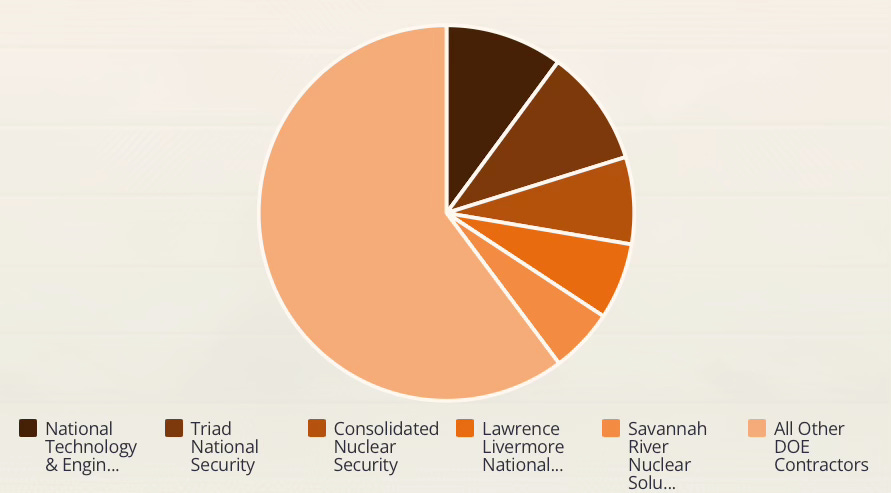
Five companies control $74.3 billion—39.9% of DOE's total budget—creating an impenetrable wall around the nuclear weapons complex while leaving substantial opportunities in DOE's broader mission areas.
Economy #1: The $78.7B No-Entry Zone
NNSA Management & Operating contracts represent the ultimate barrier to small business entry with 580 awards averaging $135.7 million each. These contracts require capabilities that eliminate 99.9% of potential competitors: nuclear quality assurance certification, highest-level security clearances, multi-decade facility operational experience, and multi-billion dollar corporate backing.
The Nuclear Oligopoly:
National Technology & Engineering Solutions (Sandia): $18.9B across 97 awards
Triad National Security (Los Alamos): $18.8B across 92 awards
Consolidated Nuclear Security (Y-12/Pantex): $14.0B across 75 awards
Lawrence Livermore National Security: $12.3B across 93 awards
Savannah River Nuclear Solutions: $10.3B across 55 awards
Despite this concentration, nuclear weapons contracts still generate 3.50 offers per award—demonstrating that even oligopolistic markets can show competitive dynamics when stakes are high enough.
Economy #2: The $107.7B Opportunity Zone
DOE's remaining spending flows through offices that actively utilize small business set-asides and generate manageable competition levels.
Prime Target Offices:
Headquarters Procurement Services: $3.83B across 6,653 awards with 1.92 offers per award
Golden Field Office: $4.76B across 1,362 awards with 2.91 offers per award
National Energy Technology Laboratory: $1.44B across 1,696 awards with 2.32 offers per award
Environmental Management Business Center: $4.42B across 1,568 awards with 3.26 offers per award
Office of River Protection: $4.37B across 106 awards with 2.29 offers per award
The NNSA Exception: Even within NNSA, the Non-M&O Contracting Operations Division manages $3.61B across 2,723 awards with only 2.16 offers per award—representing accessible nuclear-adjacent opportunities.
Small Business Success Playbook
The $3.4B Set-Aside Portfolio
Small business set-aside programs generate 3.64 offers per award versus DOE's 2.72 average—a 34% more competitive landscape.
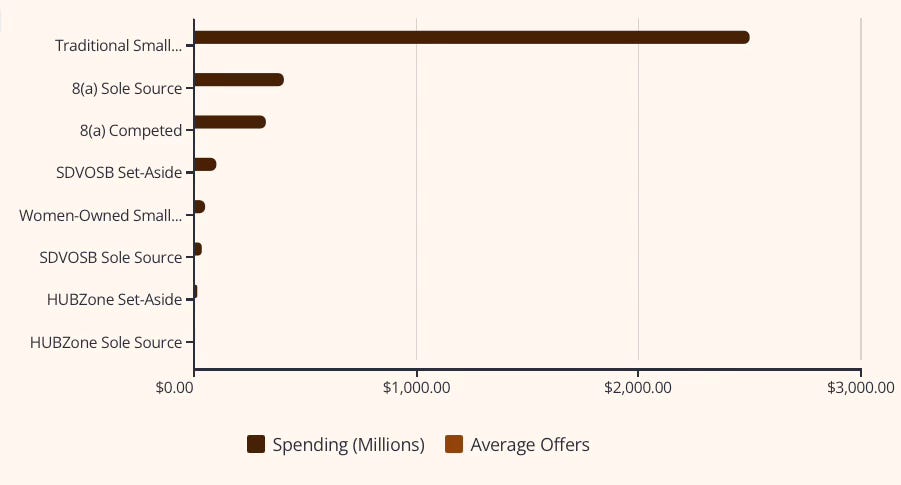
Traditional Small Business Set-Asides: $2.50B across 3,528 awards
Average award size reaches $709,000 with competition level at 4.60 offers per award. Growth through FY24 shows +25.4% from 2022 to 2023, then +5.2% from 2023 to 2024.
8(a) Program Performance: $731M total
Sole Source component: $406M across 1,058 awards with explosive growth of +61.6% then +104.4% through FY24
Competed component: $325M across 411 awards with 3.35 offers, but declining -11.7% then -20.3%
Service-Disabled Veteran Programs: $134M total
Set-Aside awards: $100M across 104 awards with 2.88 offers per award
Sole Source awards: $34M across 46 awards with massive growth of +204% then +52% through FY24
Women-Owned Small Business: $54M total
Competed awards: $50M across 128 awards with 4.26 offers per award
Consistent growth pattern: +59% then +13% through FY24
Proven Success Models
Leading small business contractors demonstrate sustainable growth strategies through focused approaches:
Hanford Laboratory Management & Integration: $391M across 28 awards with 5.0 offers per award
WE2 Support Services 8(a) JV: $159M across 96 awards with 2.0 offers per award
Swift & Staley Inc: $151M across 43 awards with 5.0 offers per award
Unwin Co: $138M across 20 awards with 3.0 offers per award
KBC Energy Solutions: $124M across 86 awards with 4.0 offers per award
These contractors focus on specific DOE offices, develop repeatable capabilities, and avoid the hyper-competitive commodity markets.
Contract Vehicle Intelligence
DOE operates outside traditional federal contracting channels, with minimal reliance on government-wide vehicles that dominate other agencies. This means you don’t need a GSA schedule, NASA SEWP or other contract vehicles to get started at DOE. However, don't mistake not needing a contract vehicle or GWAC with this being easy!
*If you're not familiar with contract vehicles, how to use them, and when they apply to you, check out our training at govclose.com.
Traditional Vehicle Penetration
GSA/GWAC Usage: Only 0.27% of total DOE spending
GSA Schedule (MAS): $296M representing 0.16% of total spending
GSA Alliant/Alliant 2: $94M representing 0.04% of total spending
NASA SEWP: $111M representing 0.06% of total spending
CIO-SP3/4: $516K representing negligible share
DOE's Unique Structure
M&O Contract Dominance: $128.1B representing 68.68% of total spending
Sandia M&O: $44.2B representing 23.71% of total spending
Los Alamos M&O: $20.8B representing 11.14% of total spending
Various DOE Site M&Os: $39.3B representing 21.08% of total spending
Direct DOE Vehicles: $37.8B representing 20.23% of total spending
"Department of Energy / NNSA" category spans 16,829 awards and represents the accessible prime contracting market for small businesses.
Strategic Vehicle Selection by Office Type
Administrative Offices with High GSA Usage:
Federal Energy Regulatory Commission: 18-26% of spending flows through GSA MAS
Western Regional offices: 25-55% reliance on GSA Schedule contracts
Power Marketing Administrations: Heavy SEWP usage for IT procurement needs
Mission-Critical Offices with Zero GSA Usage:
NNSA operations: 100% direct or M&O contract utilization
Science Centers: 100% specialized vehicle reliance
Environmental Management: Direct contracting approach exclusively
Implication: Small businesses should pursue GSA Schedules only for administrative/regulatory DOE offices while focusing on direct opportunities for major spending programs.
The Competition Advantage
Understanding competition levels by industry sector reveals where to compete versus where to avoid entirely.
Golden Opportunities: High Spending, Low Competition
Research & Development (NAICS 541710): $34.4B Market
789 awards generate only 1.40 offers per award. Specialized expertise creates natural barriers to entry that keep competition manageable despite the massive market size.
Engineering Services (NAICS 541715): $11.2B Market
394 awards attract 2.01 offers per award. This professional services niche maintains manageable competition levels through technical requirements.
Administrative Management (NAICS 561110): $64M Market
215 awards receive 1.0 offers per award, creating high frequency opportunities with minimal competition.
Death Trap Markets: Extreme Competition, Minimal Value
The Mathematical Impossibilities:
Electronic Component Manufacturing (335139): 29 offers per award for $70K total market size makes profitable bidding nearly impossible.
Nuclear Equipment Manufacturing (333912): 23 offers per award for $25K total market creates guaranteed losses for most participants.
Manufacturing Commodities across Multiple NAICS codes: 8-15 offers per award for contracts under $500K destroy profitability through excessive bid costs.
The Rule of 5: Avoid any market averaging 5+ offers per award unless you possess unassailable competitive advantages such as specialized clearances, unique IP, or regulatory moats.
Office-Level Competition Intelligence
Low-Competition Targets:
SC Chicago Service Center: 1.38 offers per award across $17.9B in spending
NNSA Naval Reactors: 1.84 offers per award across $7.6B in spending
Headquarters Procurement Services: 1.92 offers per award across $3.83B in spending
Competitive Bloodbaths to Avoid:
EM-Portsmouth/Paducah Project Office: 5.32 offers per award despite $3.51B in spending
Environmental Management offices generally: 3.2+ offers per award even with high spending levels
Breaking Into the $74.3B Oligopoly: Subcontracting Pathways to the Big 5
When prime contracting opportunities disappear behind oligopolistic walls, smart contractors pivot to subcontracting strategies. The Big 5's $74.3 billion in spending flows through extensive supplier networks, creating substantial indirect opportunities for companies willing to navigate their partnership requirements.
Access Levels Vary by Contractor
National Technology & Engineering Solutions (Sandia) – $18.9B
Sandia operates a public Business Opportunities feed and Oracle iSupplier registration system. Start at their Business Opportunities Website to scan current needs, then register in the iSupplier portal via their Supplier Registration page. Sandia also offers monthly 30-minute one-on-one sessions for small businesses—request a slot at [email protected].
Business Opportunities: https://www.sandia.gov/working-with-sandia/prospective-suppliers/business-opportunities/
Supplier Registration: https://www.sandia.gov/working-with-sandia/prospective-suppliers/supplier-registration-clone-2/
Triad National Security (Los Alamos) – $18.8B
LANL requires suppliers to register through SAP Ariba before they can transact. Begin with LANL's Ariba Registration page and their Prospective Suppliers hub. For positioning and teaming, contact the Small Business Program Office at [email protected]. Triad's operating team explicitly integrated three small-business subcontractors when NNSA awarded the LANL M&O contract: Longenecker & Associates, Merrick-SMSI JV, and TechSource.
Ariba Registration: https://www.lanl.gov/engage/business/prospective-suppliers/ariba-registration
Prospective Suppliers: https://www.lanl.gov/engage/business/prospective-suppliers
Business Contacts: https://www.lanl.gov/engage/business/business-contacts
Consolidated Nuclear Security (Y-12 and Pantex) – $14.0B
CNS publishes supplier guidance for each site with dedicated small-business engagement pathways. Start with the Y-12 Suppliers page and CNS's Working with CNS overview. Important note: If targeting Uranium Processing Facility packages at Y-12, you must register through Bechtel's supplier portal because UPF solicitations are released via Bechtel rather than CNS portals.
Y-12 Suppliers: https://www.y12.doe.gov/suppliers
Working with CNS: https://www.cns-llc.us/small-business/working-cns
UPF Forecast: https://www.y12.doe.gov/suppliers/procurement/subcontracting/subcontracting-forecasts/upf-forecast
Bechtel Supplier Portal: https://www.bechtel.com/supplier/
Lawrence Livermore National Security – $12.3B
LLNL offers one of the easier entry points in the nuclear complex. Submit their Prospective Supplier form so buyers can match your capabilities to current needs. LLNL publicly states it spends over $1 billion annually with small businesses making up nearly 40% of that spending.
Prospective Suppliers: https://procurement.llnl.gov/prospective-suppliers
Small Business Program: https://procurement.llnl.gov/Small-Business-Program
Main Procurement Page:
https://procurement.llnl.gov/
Savannah River Nuclear Solutions – $10.3B
SRNS expects suppliers to maintain active SAM registration and complete their Supplier Information Form when requested. Begin at their Doing Business with SRNS page for Supplier Diversity information. For direct outreach, SRNS lists a Supplier Development Team contact at 800-888-7986. SRNS received the 2025 SBA Dwight D. Eisenhower Award for Excellence in Services, confirming their supplier development efforts deliver measurable results.
Doing Business with SRNS: https://www.savannahrivernuclearsolutions.com/opportunities/sup_diversity/doing_busi.htm
Supplier Information Form: https://www.srs.gov/general/busiops/PMMD/pdfs/pf30.pdf
Contact Information: https://www.savannahrivernuclearsolutions.com/contact.htm
Strategic Entry Points
Universal prerequisites remain consistent across all nuclear enterprise sites: maintain active SAM.gov registration and prepare a one-page capability statement mapped to relevant NAICS codes, core past performance, and any facility clearances in place or underway.
Each contractor operates different intake mechanisms. Sandia uses iSupplier and public Business Opportunities feeds. LANL requires Ariba registration. Y-12 and Pantex publish site-specific supplier pages with UPF packages managed through Bechtel's portal. LLNL routes supplier profiles directly to buyers. SRNS runs supplier development using standardized forms across SRS procurement.
DOE's Supply Chain Management Center (SCMC) maintains a supplier profile database shared with authorized NNSA and EM primes for market research. Completing a supplier profile provides visibility beyond single sites and aligns you to multi-site agreements.
SCMC Portal:
https://scmc.energy.gov/
Small Business Resources: https://scmc.energy.gov/small-business-resources/
Supplier Profile: https://scmc.energy.gov/contactus/supplier-profile/
Competitive Advantages
Security clearances remain decisive differentiators at NNSA sites. Geographic positioning matters, particularly around Los Alamos, Livermore, Oak Ridge, Amarillo, and Aiken, where buyer familiarity and fast-response capability translate into contract wins.
Construction megaprojects often operate separate supply chains. Y-12's UPF packages are managed through Bechtel's supplier portal rather than standard CNS channels, requiring separate registration and engagement strategies.
Structured Growth Through Mentor-Protégé Programs
Mentor-Protégé programs provide the most reliable development pathways in this sector. LLNL showcases graduates like GCJ Inc., which grew from a 6-person to 20-person workforce with revenue increasing from $2.5 million to $12 million during their program participation.
SRNS operates a Mentor-Protégé Center of Excellence, and their 2025 SBA Eisenhower Award confirms their supplier development delivers measurable results rather than performative compliance.
Compliance Reality Check
GAO's March 2025 report estimated approximately $1.1 billion of reported NNSA small business awards went to firms that did not qualify as small, with another $1.9 billion lacking sufficient documentation. Expect verification requirements to tighten across primes and subprograms.
GAO Report: https://www.gao.gov/products/gao-25-106820
Bottom Line
Use site-specific portals for immediate visibility, then leverage SCMC for enterprise-wide exposure. Validate your NAICS-mapped capability statement against actual site procurement needs, add clearances or QA credentials that create competitive barriers, and pursue mentor-protégé pathways where available. This relationship market has formal entry gates, but once you engage the supplier development teams, the oligopoly transforms from an impenetrable wall into predictable opportunity channels.
The GAO Compliance Opportunity
The Government Accountability Office's March 2025 audit of NNSA small business contracting revealed systematic compliance failures that create market-shifting opportunities for prepared contractors.
$1.1B in Questionable Awards
GAO's findings across the broader DOE ecosystem reveal significant problems. $1.1B went to businesses that didn't qualify as small under SBA size standards. An additional $1.9B lacked sufficient documentation to verify small business status. Three primary causes drive these errors: no verification requirements, procurement system errors, and business misrepresentation.
Enhanced Oversight Creates Competitive Advantages
Companies with robust verification systems will benefit from reduced competition as non-compliant firms face increased scrutiny. Enhanced credibility with contracting officers implementing new verification requirements becomes a significant advantage. Streamlined award processes for properly verified small businesses create operational efficiencies. Market share recovery from improperly awarded contracts provides growth opportunities.
Strategic Compliance Investment
Smart contractors should invest now in documentation and verification systems that exceed current requirements, positioning for the inevitable tightening of oversight across all DOE small business programs.
Strategic Recommendations
For Small Business Contractors
Target the Right Offices: Focus business development on Headquarters Procurement Services, Golden Field Office, NETL, and Environmental Management offices. Avoid NNSA nuclear weapons programs entirely as prime contractor opportunities.
Leverage Competition Intelligence: Pursue NAICS codes with 1.0-2.5 offers per award, especially in R&D (1.40 offers) and professional services (2.01 offers). Avoid manufacturing sectors with 5+ offers.
Build Compliance Advantages: Invest in verification systems and documentation processes that exceed current requirements, preparing for enhanced oversight requirements.
Size Strategically: Target the $500K-$2M contract range where competition is manageable and opportunities are frequent. Avoid both micro-contracts (high bid costs) and mega-contracts (oligopoly territory).
Vehicle Selection: Focus on direct DOE opportunities rather than traditional GSA/GWAC vehicles, except for administrative offices like FERC and Western regions.
Subcontracting: Target the Big Five for potential subcontracting opportunities in NNSA, as well as other offices within the Department of Energy.
For Investors
Small businesses with consistent DOE awards represent acquisition targets, particularly those in environmental services with multi-site capabilities, R&D services with security clearance depth, and professional services with specialized DOE knowledge.
The coming compliance crackdown will create consolidation opportunities as smaller, less-prepared contractors exit markets or seek acquisition by better-capitalized firms.
For Large Contractors
Subcontracting partnerships with specialized small businesses offer access to set-aside opportunities while maintaining prime positions on large contracts. The Big 5's dominance creates substantial pass-through opportunities for firms that can navigate the complex joint venture requirements.
Methodology
This analysis examines 27,513 Department of Energy contract awards totaling $186.6 billion from fiscal years 2022-2025, focusing on contracts where DOE serves as both awarding and funding agency. Data processed through GovClose intelligence platform with competition information available for 69% of awards. Analysis excludes incomplete FY2025 data from trend calculations due to federal spending seasonality and reporting delays.
Data Sources: Federal procurement data from USASpending.gov, DOE contract vehicle databases, Small Business Administration set-aside classifications, and Government Accountability Office audit reports.
Limitations: Competition data reflects reported offers only. Small business classifications based on contractor self-certification may include errors identified in GAO audits. Joint venture structures identified through legal entity names may not capture all partnership arrangements.
About the Author
Richard C. Howard, Lt. Col. (Ret.) is the founder of Federalytics and CEO of GovClose, two platforms delivering actionable market intelligence and hands-on training in federal contracting. As a U.S. Air Force acquisitions officer, he managed an $82 billion portfolio and was recognized as the Air Force Analyst of the Year for his expertise in federal spending analysis.
Richard has produced hundreds of Federal Market Blueprints—deep-dive analyses of agency spending, competition levels, and contract vehicles—guiding hundreds of professionals, companies, and investors in scaling federal revenue. His insights are followed by startups, primes, and Wall Street alike through the GovClose YouTube channel and podcast.
This analysis represents the most comprehensive examination of Department of Energy small business contracting opportunities and competitive dynamics. For questions about specific findings or additional data analysis, contact Federalitics Intelligence.
Ready to go pro?
The GovClose Professional Training Program is built for people ready to commit to learning a new skill set, implementing that skill set, and working with a community of professionals who are serious about winning in the federal market.
If you think you have what it takes, set up an enrollment interview with the GovClose advisory team.