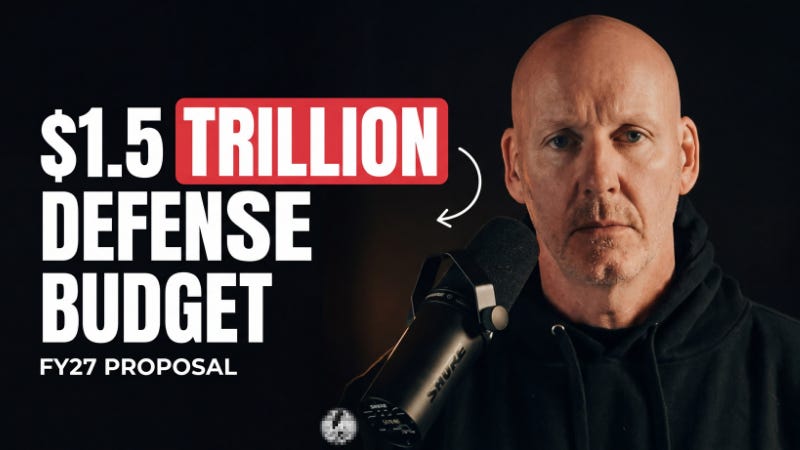
Watch the original Substack video, or listen below while you read.
In the midst of military operations in the Middle East, The White House quietly released its proposed budget for FY27. And it contains a number I don’t think most people in government contracting have fully processed yet.Depending on how you calculate it, this is a roughly 40% increase over last year’s defense spending. If you isolate just the Pentagon budget, you’re looking at closer to 28% . Either way — that is the largest defense budget request in American history.
I broke down the full picture in this week’s YouTube video. But here’s the intelligence brief version.
Subscribe now
Important caveat: this is a proposal . The president’s budget still has to go through Congress. It will change. It usually does. But the direction of travel is clear — and has been for years. We spend more on defense every year, almost without exception.
The shift that matters here isn’t just the dollar amount. It’s what they’re buying. The budget is explicitly targeting the defense industrial base — expanding it, modernizing it, and moving away from legacy systems toward next-generation capability. That has major implications for small businesses, consultants, and account executives who know how to read the signal.
SPENDING PRIORITIES BY TIER
TIER 1 — HIGHEST PRIORITY
AI & data decision systems
Drones & counter-drone tech
Missile defense & sensors
Shipbuilding ($65.8B proposed)
Munitions production
TIER 2 — SIGNIFICANT GROWTH
Space systems & launch infrastructure
Industrial base manufacturing
Nuclear modernization
Next-gen air dominance (F-47)
TIER 3 — MEANINGFUL OPPORTUNITY
WHAT THIS ACTUALLY MEANS FOR SMALL BUSINESSES
I know the instinct when you see numbers like $65.8 billion for shipbuilding is to think — that’s Huntington Ingalls territory, not mine. But that’s the wrong read.
Every major contract that goes to a prime has a mandatory small business subcontracting plan attached to it. The large primes have their own small business offices actively looking for suppliers. Engineering services, software, logistics, navigation systems, electronics — the subcontracting ecosystem on something like a shipbuilding program is enormous. Same goes for the F-47 and missile defense.
The bigger opportunity signal here is in AI and unmanned systems. The government is spending aggressively in these areas — and they’re using faster acquisition pathways to do it. Other Transaction Authority. SBIR. Commercial Solutions Openings. These are mechanisms designed to bring non-traditional companies in the door without the full FAR gauntlet. If you’re an AI company or a drone technology company trying to figure out how to access federal money, this is your environment.
One thing I want to flag directly: there was a new executive order on equity-based contracting and subcontracting. If set-asides or certifications have been your primary strategy for winning work, you need to rethink that approach. I’ve said this for years — I never awarded a contract because a company had a certification. It was always about capability and fit. Build your strategy around that, and you’ll be positioned regardless of how the policy landscape shifts.
The mindset shift I’d recommend: stop thinking about legacy sustainment and start positioning around next-gen capability . The budget is explicitly cutting funding for old systems and redirecting it toward new ones. Where are you on that spectrum?
For consultants, I'll say it plainly: this is a once-in-a-generation moment. There is a historic amount of money flowing into federal contracting, and almost nobody who can help companies access it competently. That gap is where your value lives.
I recommend watching the attached video for the full breakdown. If you’re interested in truly learning the art of government contracting and how to build a profitable business with this expertise, check out an overview of the GovClose 1-year certification and implementation program.
GovClose Overview
","truncated_body_text":"In the midst of military operations in the Middle East, The White House quietly released its proposed budget for FY27. And it contains a number I don’t think most people in government contracting have fully processed yet.","wordcount":621,"post_preview_limit":null,"language":"en","postTags":[{"id":"6e9d7fd4-64f0-414e-a273-0b78654e8f50","publication_id":5812328,"name":"Government Contract","slug":"government-contract","hidden":false},{"id":"99bb7dd4-6f77-48a1-ad8c-60ce2a50146a","publication_id":5812328,"name":"defense spending increase","slug":"defense-spending-increase","hidden":false},{"id":"af571c05-79bc-48b5-a33b-12aa6ae9e8d3","publication_id":5812328,"name":"GovClose","slug":"govclose","hidden":false},{"id":"bb1915ba-b1c1-45ad-9331-8fb5a3301ac7","publication_id":5812328,"name":"presidents budget","slug":"presidents-budget","hidden":false}],"postCountryBlocks":[],"headlineTest":null,"coverImagePalette":{"Vibrant":{"rgb":[220,52,52],"population":1},"DarkVibrant":{"rgb":[97,27,34],"population":9},"LightVibrant":{"rgb":[228,124,130],"population":4},"Muted":{"rgb":[148,108,92],"population":1},"DarkMuted":{"rgb":[80,49,40],"population":67},"LightMuted":{"rgb":[202,176,178],"population":39}},"publishedBylines":[{"id":35591915,"name":"FEDERALYTICS","handle":"federalytics","previous_name":"Federalytics","photo_url":"https://substack-post-media.s3.amazonaws.com/public/images/c789daa1-ac02-4d33-9dd5-4cca1fb48731_768x768.jpeg","bio":"Government contract intelligence for companies selling to the federal government. Market analysis & competitive insights from Lt. Col. (Ret.) Richard Howard, former DoD acquisitions officer. For training: GovClose.com","profile_set_up_at":"2025-07-28T18:53:07.132Z","reader_installed_at":"2025-08-24T02:10:45.143Z","publicationUsers":[{"id":5928686,"user_id":35591915,"publication_id":5812328,"role":"admin","public":true,"is_primary":true,"publication":{"id":5812328,"name":"FEDERALYTICS","subdomain":"federalytics","custom_domain":null,"custom_domain_optional":false,"hero_text":"Federalytics provides competitive intelligence and market analysis for companies selling to the federal government.","logo_url":"https://substack-post-media.s3.amazonaws.com/public/images/73d2d823-534c-48f9-b0e6-53764d820657_256x256.png","author_id":35591915,"primary_user_id":35591915,"theme_var_background_pop":"#FF6719","created_at":"2025-07-28T18:59:27.519Z","email_from_name":"FEDERALYTICS from GovClose","copyright":"Richard C. Howard","founding_plan_name":"Founding Member","community_enabled":true,"invite_only":false,"payments_state":"paused","language":null,"explicit":false,"homepage_type":"newspaper","is_personal_mode":false,"logo_url_wide":null}}],"is_guest":false,"bestseller_tier":null,"status":{"bestsellerTier":null,"subscriberTier":null,"leaderboard":null,"vip":false,"badge":null,"paidPublicationIds":[],"subscriber":null}}],"reaction":null,"reaction_count":3,"comment_count":0,"child_comment_count":0,"is_geoblocked":false,"hasCashtag":false},"comments":null,"canonicalUrl":"https://federalytics.substack.com/p/the-largest-defense-budget-request","inlineComments":true,"readerIsSearchCrawler":false,"ogUrl":"https://federalytics.substack.com/p/the-largest-defense-budget-request","bannedFromNotes":false,"themeVariables":{"color_theme_bg_pop":"#ef4d2a","background_pop":"#ef4d2a","color_theme_bg_web":"#020617","cover_bg_color":"#020617","cover_bg_color_secondary":"#111525","background_pop_darken":"#ed3912","print_on_pop":"#ffffff","color_theme_bg_pop_darken":"#ed3912","color_theme_print_on_pop":"#ffffff","color_theme_bg_pop_20":"rgba(239, 77, 42, 0.2)","color_theme_bg_pop_30":"rgba(239, 77, 42, 0.3)","print_pop":"#ef4d2a","color_theme_accent":"#ef4d2a","cover_print_primary":"#ffffff","cover_print_secondary":"#d9d9d9","cover_print_tertiary":"#d9d9d9","cover_border_color":"#ffffff","home_hero":"feature-media","home_posts":"list","home_show_top_posts":true,"web_bg_color":"#020617","background_contrast_1":"#111525","background_contrast_2":"#242836","background_contrast_3":"#494c58","background_contrast_4":"#6e707a","background_contrast_5":"#afb0b6","color_theme_bg_contrast_1":"#111525","color_theme_bg_contrast_2":"#242836","color_theme_bg_contrast_3":"#494c58","color_theme_bg_contrast_4":"#6e707a","color_theme_bg_contrast_5":"#afb0b6","color_theme_bg_elevated":"#111525","color_theme_bg_elevated_secondary":"#242836","color_theme_bg_elevated_tertiary":"#494c58","color_theme_detail":"#1b1f2e","background_contrast_pop":"rgba(239, 77, 42, 0.4)","color_theme_bg_contrast_pop":"rgba(239, 77, 42, 0.4)","theme_bg_is_dark":"1","print_on_web_bg_color":"hsl(228.57142857142856, 21.00000000000007%, 90.49019607843137%)","print_secondary_on_web_bg_color":"#9a9ba2","background_pop_rgb":"239, 77, 42","color_theme_bg_pop_rgb":"239, 77, 42","color_theme_accent_rgb":"239, 77, 42"},"recentEpisodes":[{"id":198321901,"editor_v2":false,"publication_id":5812328,"title":"SAM.gov Inactive? Here's the Exact Renewal Process (2026)","social_title":"SAM.gov Inactive? Here's the Exact Renewal Process (2026)","search_engine_title":null,"search_engine_description":null,"type":"podcast","slug":"samgov-inactive-heres-the-exact-renewal","post_date":"2026-05-22T14:10:25.819Z","audience":"everyone","podcast_duration":1416.1501,"video_upload_id":"af183dc6-16c4-4351-8b75-7999996727c3","podcast_upload_id":"0b3829e1-dfe2-4d58-b0ab-ef5698115475","write_comment_permissions":"everyone","should_send_free_preview":false,"free_unlock_required":false,"default_comment_sort":null,"canonical_url":"https://federalytics.substack.com/p/samgov-inactive-heres-the-exact-renewal","section_id":null,"top_exclusions":[],"pins":[],"is_section_pinned":false,"section_slug":null,"section_name":null,"reactions":{"❤":1},"restacks":0,"restacked_post_id":null,"restacked_post_slug":null,"restacked_pub_name":null,"restacked_pub_logo_url":null,"subtitle":"","cover_image":"https://substack-video.s3.amazonaws.com/video_upload/post/198321901/af183dc6-16c4-4351-8b75-7999996727c3/transcoded-1779225777.png","cover_image_is_square":false,"cover_image_is_explicit":false,"podcast_episode_image_url":"https://substack-post-media.s3.amazonaws.com/public/images/d3f0b008-f5f3-4c68-aa3c-9ffa3e9f6728_1400x1400.png","podcast_episode_image_info":{"url":"https://substack-post-media.s3.amazonaws.com/public/images/d3f0b008-f5f3-4c68-aa3c-9ffa3e9f6728_1400x1400.png","isDefaultArt":false,"isDefault":false},"podcast_url":"https://api.substack.com/api/v1/audio/upload/0b3829e1-dfe2-4d58-b0ab-ef5698115475/src","videoUpload":{"id":"af183dc6-16c4-4351-8b75-7999996727c3","name":"Renew SAM FINAL-2.mp4","created_at":"2026-05-18T21:24:52.966Z","uploaded_at":"2026-05-18T21:26:34.251Z","publication_id":5812328,"state":"transcoded","post_id":198321901,"user_id":35591915,"duration":1416.1298,"height":1080,"width":1920,"thumbnail_id":1779225777,"preview_start":null,"preview_duration":null,"media_type":"video","primary_file_size":807798363,"is_mux":true,"mux_asset_id":"00eCm6Hz672srecYZ8JCiHgM2imLrjcTirbd6V4LN801w","mux_playback_id":"tnGEHC73v9kiN3BWIVObUSDswq4YCObgyh8GL99vQXQ","mux_preview_asset_id":null,"mux_preview_playback_id":null,"mux_rendition_quality":"high","mux_preview_rendition_quality":null,"explicit":false,"copyright_infringement":null,"src_media_upload_id":null,"live_stream_id":null,"transcription":null,"extractedAudio":{"id":"0b3829e1-dfe2-4d58-b0ab-ef5698115475","name":null,"created_at":"2026-05-18T21:26:34.272Z","uploaded_at":"2026-05-18T21:26:34.251Z","publication_id":5812328,"state":"transcoded","post_id":198321901,"user_id":35591915,"duration":1416.1501,"height":null,"width":null,"thumbnail_id":1,"preview_start":null,"preview_duration":null,"media_type":"audio","primary_file_size":22658968,"is_mux":null,"mux_asset_id":null,"mux_playback_id":null,"mux_preview_asset_id":null,"mux_preview_playback_id":null,"mux_rendition_quality":null,"mux_preview_rendition_quality":null,"explicit":false,"copyright_infringement":null,"src_media_upload_id":"af183dc6-16c4-4351-8b75-7999996727c3","live_stream_id":null,"transcription":{"media_upload_id":"0b3829e1-dfe2-4d58-b0ab-ef5698115475","created_at":"2026-05-18T21:27:05.149Z","requested_by":35591915,"status":"transcribed","modal_call_id":"fc-01KRYFRGFDVJWKESR1BKR31MKT","approved_at":"2026-05-18T21:28:21.233Z","transcript_url":"s3://substack-video/video_upload/post/198321901/0b3829e1-dfe2-4d58-b0ab-ef5698115475/1779139627/transcription.json","attention_vocab":null,"speaker_map":null,"captions_map":{"en":{"url":"s3://substack-video/video_upload/post/198321901/0b3829e1-dfe2-4d58-b0ab-ef5698115475/1779139627/en.vtt","language":"en","original":true}},"cdn_url":"https://substackcdn.com/video_upload/post/198321901/0b3829e1-dfe2-4d58-b0ab-ef5698115475/1779139627/transcription.json?Expires=1780351482&Key-Pair-Id=APKAIVDA3NPSMPSPESQQ&Signature=lfiZzE83aScKbQpb4GckMWxGar7~0jKIrDt3CrVf~n2xoyeC2wzWJxfIBM7u7yz4hI3FAptcJgqsR8R4XiU0GXBbTeZ4BOiwRV-EZ8-xthkXRnfqUFaZoTME3L8~T7wT3Zv1NBcqsA0AQm-cwsAuac6a0YhIBW9~n1q0ghSyFnigToR5GODnIudgXTQyQbxKE5JNxPR57ejWZs3nS2pzE38B9-1YAyEO3~sg0Pkw3QFDbJab6sE3GZ22q14QqXl3jlWSxxwkFSPlembkyWK9t~kQSKULhv-KcdLm9l23oV07acffoh5YhPkHnEogq-qJDr7U5YG2XUIC~Px~u2YMEw__","cdn_unaligned_url":"https://substackcdn.com/video_upload/post/198321901/0b3829e1-dfe2-4d58-b0ab-ef5698115475/1779139627/unaligned_transcription.json?Expires=1780351482&Key-Pair-Id=APKAIVDA3NPSMPSPESQQ&Signature=RHJLIe6V~2cWxa8tzGT65rSMD4gHljLTg2Kk5egy3cqmDQNI2pmpt7KKPNOPaPeyJ3aG8OebAYnhYjWpYjQy6BXOXvkffyLJLKbCQ7G5fkZU9h9wj3spCbJ6cVl39lvw8PiXUEcqoYnj6n6WNLWBOJUBgj2tFlNw8O2oCVUkw63V8J6T-BVt~BVsjB84xkpRfDWHMlVrAjhqldQZVMCmkWePyeP4W4yS4d~VayRjy7o-Gx4vg6-riRrwfao3q8JO-UjkazodaLu1AkksQMbGufwucp8ytxpdvAQBq5Qp6sEbnkeB1GOnNDYBiZgROHIW~QzHVRo9oRrx2ymZKfxD4Q__","signed_captions":[{"language":"en","url":"https://substackcdn.com/video_upload/post/198321901/0b3829e1-dfe2-4d58-b0ab-ef5698115475/1779139627/en.vtt?Expires=1780351482&Key-Pair-Id=APKAIVDA3NPSMPSPESQQ&Signature=MU-rMo4sEmj9kIKon3ZpOpG6F-lsOWxOe48StETF71TR4HjDXU~NvJf9v3ZjS~N~qEK0ERnfF3nenCEFsruqPn4QwmSBm9qCnOY8Myi48S9HiikpXyT4NBo2zgekYwwZlHaocwj99aMANScpPIDSx63oKilKxgfYSHnOHJ1EgWBwNZdzCzdSfttWE~n6zMT6esaTIbsabYWB4l9HL46H~n~YucHEvS7jp6RMT19xvtfUfJQo85uvDlSVhsoGnTo47NNt7DosMe5q~IKcuIuF85hZjGN1b5VkRX5A8khgOZGUEbwEpvy2SUfoTw2FwbpnOHLAghmhi8bI7Rt667R1Pw__","original":true}]}}},"podcastFields":{"post_id":198321901,"podcast_episode_number":null,"podcast_season_number":null,"podcast_episode_type":null,"should_syndicate_to_other_feed":null,"syndicate_to_section_id":null,"hide_from_feed":false,"free_podcast_url":null,"free_podcast_duration":null,"preview_contains_ad":false,"was_imported_self_serve_sync":false},"podcast_preview_upload_id":null,"podcastUpload":{"id":"0b3829e1-dfe2-4d58-b0ab-ef5698115475","name":null,"created_at":"2026-05-18T21:26:34.272Z","uploaded_at":"2026-05-18T21:26:34.251Z","publication_id":5812328,"state":"transcoded","post_id":198321901,"user_id":35591915,"duration":1416.1501,"height":null,"width":null,"thumbnail_id":1,"preview_start":null,"preview_duration":null,"media_type":"audio","primary_file_size":22658968,"is_mux":null,"mux_asset_id":null,"mux_playback_id":null,"mux_preview_asset_id":null,"mux_preview_playback_id":null,"mux_rendition_quality":null,"mux_preview_rendition_quality":null,"explicit":false,"copyright_infringement":null,"src_media_upload_id":"af183dc6-16c4-4351-8b75-7999996727c3","live_stream_id":null,"transcription":{"media_upload_id":"0b3829e1-dfe2-4d58-b0ab-ef5698115475","created_at":"2026-05-18T21:27:05.149Z","requested_by":35591915,"status":"transcribed","modal_call_id":"fc-01KRYFRGFDVJWKESR1BKR31MKT","approved_at":"2026-05-18T21:28:21.233Z","transcript_url":"s3://substack-video/video_upload/post/198321901/0b3829e1-dfe2-4d58-b0ab-ef5698115475/1779139627/transcription.json","attention_vocab":null,"speaker_map":null,"captions_map":{"en":{"url":"s3://substack-video/video_upload/post/198321901/0b3829e1-dfe2-4d58-b0ab-ef5698115475/1779139627/en.vtt","language":"en","original":true}},"cdn_url":"https://substackcdn.com/video_upload/post/198321901/0b3829e1-dfe2-4d58-b0ab-ef5698115475/1779139627/transcription.json?Expires=1780351482&Key-Pair-Id=APKAIVDA3NPSMPSPESQQ&Signature=lfiZzE83aScKbQpb4GckMWxGar7~0jKIrDt3CrVf~n2xoyeC2wzWJxfIBM7u7yz4hI3FAptcJgqsR8R4XiU0GXBbTeZ4BOiwRV-EZ8-xthkXRnfqUFaZoTME3L8~T7wT3Zv1NBcqsA0AQm-cwsAuac6a0YhIBW9~n1q0ghSyFnigToR5GODnIudgXTQyQbxKE5JNxPR57ejWZs3nS2pzE38B9-1YAyEO3~sg0Pkw3QFDbJab6sE3GZ22q14QqXl3jlWSxxwkFSPlembkyWK9t~kQSKULhv-KcdLm9l23oV07acffoh5YhPkHnEogq-qJDr7U5YG2XUIC~Px~u2YMEw__","cdn_unaligned_url":"https://substackcdn.com/video_upload/post/198321901/0b3829e1-dfe2-4d58-b0ab-ef5698115475/1779139627/unaligned_transcription.json?Expires=1780351482&Key-Pair-Id=APKAIVDA3NPSMPSPESQQ&Signature=RHJLIe6V~2cWxa8tzGT65rSMD4gHljLTg2Kk5egy3cqmDQNI2pmpt7KKPNOPaPeyJ3aG8OebAYnhYjWpYjQy6BXOXvkffyLJLKbCQ7G5fkZU9h9wj3spCbJ6cVl39lvw8PiXUEcqoYnj6n6WNLWBOJUBgj2tFlNw8O2oCVUkw63V8J6T-BVt~BVsjB84xkpRfDWHMlVrAjhqldQZVMCmkWePyeP4W4yS4d~VayRjy7o-Gx4vg6-riRrwfao3q8JO-UjkazodaLu1AkksQMbGufwucp8ytxpdvAQBq5Qp6sEbnkeB1GOnNDYBiZgROHIW~QzHVRo9oRrx2ymZKfxD4Q__","signed_captions":[{"language":"en","url":"https://substackcdn.com/video_upload/post/198321901/0b3829e1-dfe2-4d58-b0ab-ef5698115475/1779139627/en.vtt?Expires=1780351482&Key-Pair-Id=APKAIVDA3NPSMPSPESQQ&Signature=MU-rMo4sEmj9kIKon3ZpOpG6F-lsOWxOe48StETF71TR4HjDXU~NvJf9v3ZjS~N~qEK0ERnfF3nenCEFsruqPn4QwmSBm9qCnOY8Myi48S9HiikpXyT4NBo2zgekYwwZlHaocwj99aMANScpPIDSx63oKilKxgfYSHnOHJ1EgWBwNZdzCzdSfttWE~n6zMT6esaTIbsabYWB4l9HL46H~n~YucHEvS7jp6RMT19xvtfUfJQo85uvDlSVhsoGnTo47NNt7DosMe5q~IKcuIuF85hZjGN1b5VkRX5A8khgOZGUEbwEpvy2SUfoTw2FwbpnOHLAghmhi8bI7Rt667R1Pw__","original":true}]}},"podcastPreviewUpload":null,"voiceover_upload_id":null,"voiceoverUpload":null,"has_voiceover":false,"description":"If you registered your company in SAM.gov, it’s quite possible your entity might be sitting inactive right now.","body_json":null,"body_html":null,"truncated_body_text":"If you registered your company in SAM.gov, it’s quite possible your entity might be sitting inactive right now.","wordcount":518,"post_preview_limit":null,"language":"en","postTags":[{"id":"2c3c8c13-f014-49f0-8d69-0796adfa80c8","publication_id":5812328,"name":"sam.gov","slug":"samgov","hidden":false},{"id":"35cd910f-de6e-4257-afc8-a0edd35f632f","publication_id":5812328,"name":"Sam.gov contracts","slug":"samgov-contracts","hidden":false},{"id":"9ae29aa1-36f6-46ff-8f27-0a3a48bee277","publication_id":5812328,"name":"start a business","slug":"start-a-business","hidden":false},{"id":"ab652e6d-2f6e-460b-90f9-f20d572c5b17","publication_id":5812328,"name":"Sam.gov contract","slug":"samgov-contract","hidden":false}],"teaser_post_eligible":true,"postCountryBlocks":[],"headlineTest":{"post_id":198321901,"starts_at":"2026-05-22T14:10:26.087Z","ended_at":"2026-05-22T15:10:26.248Z","planned_duration_ms":3600000,"test_cohort_percent":20,"test_cohort_emailed":true,"main_cohort_emailed":true,"created_at":"2026-05-22T14:09:50.188Z","updated_at":"2026-05-22T15:11:26.410Z","creator_id":35591915,"ended_early":false,"winner_overridden":false},"coverImagePalette":{"Vibrant":{"rgb":[249,4,5],"population":530},"DarkVibrant":{"rgb":[176,10,10],"population":26},"LightVibrant":{"rgb":[240,79,80],"population":69},"Muted":{"rgb":[143,85,69],"population":531},"DarkMuted":{"rgb":[102,51,44],"population":226},"LightMuted":{"rgb":[198,166,170],"population":109}},"publishedBylines":[{"id":35591915,"name":"FEDERALYTICS","handle":"federalytics","previous_name":"Federalytics","photo_url":"https://substack-post-media.s3.amazonaws.com/public/images/c789daa1-ac02-4d33-9dd5-4cca1fb48731_768x768.jpeg","bio":"Government contract intelligence for companies selling to the federal government. Market analysis & competitive insights from Lt. Col. (Ret.) Richard Howard, former DoD acquisitions officer. For training: GovClose.com","profile_set_up_at":"2025-07-28T18:53:07.132Z","reader_installed_at":"2025-08-24T02:10:45.143Z","publicationUsers":[{"id":5928686,"user_id":35591915,"publication_id":5812328,"role":"admin","public":true,"is_primary":true,"publication":{"id":5812328,"name":"FEDERALYTICS","subdomain":"federalytics","custom_domain":null,"custom_domain_optional":false,"hero_text":"Federalytics provides competitive intelligence and market analysis for companies selling to the federal government.","logo_url":"https://substack-post-media.s3.amazonaws.com/public/images/73d2d823-534c-48f9-b0e6-53764d820657_256x256.png","author_id":35591915,"primary_user_id":35591915,"theme_var_background_pop":"#FF6719","created_at":"2025-07-28T18:59:27.519Z","email_from_name":"FEDERALYTICS from GovClose","copyright":"Richard C. Howard","founding_plan_name":"Founding Member","community_enabled":true,"invite_only":false,"payments_state":"paused","language":null,"explicit":false,"homepage_type":"newspaper","is_personal_mode":false,"logo_url_wide":null}}],"is_guest":false,"bestseller_tier":null,"status":{"bestsellerTier":null,"subscriberTier":null,"leaderboard":null,"vip":false,"badge":null,"paidPublicationIds":[],"subscriber":null}}],"reaction":null,"reaction_count":1,"comment_count":0,"child_comment_count":0,"is_geoblocked":false,"hasCashtag":false},{"id":197258681,"editor_v2":false,"publication_id":5812328,"title":"Why the OTA marketplace is quietly running a parallel acquisition system — and how to vet it before you waste your time","social_title":"Why the OTA marketplace is quietly running a parallel acquisition system — and how to vet it before you waste your time","search_engine_title":null,"search_engine_description":null,"type":"podcast","slug":"why-the-ota-marketplace-is-quietly","post_date":"2026-05-11T23:02:05.258Z","audience":"everyone","podcast_duration":2521.992,"video_upload_id":"9eaf6166-4f1f-49f7-8820-210f1ab4f105","podcast_upload_id":"7c434c5f-8e0e-4919-adc2-f6da27a7af35","write_comment_permissions":"everyone","should_send_free_preview":false,"free_unlock_required":false,"default_comment_sort":null,"canonical_url":"https://federalytics.substack.com/p/why-the-ota-marketplace-is-quietly","section_id":null,"top_exclusions":[],"pins":[],"is_section_pinned":false,"section_slug":null,"section_name":null,"reactions":{"❤":4},"restacks":0,"restacked_post_id":null,"restacked_post_slug":null,"restacked_pub_name":null,"restacked_pub_logo_url":null,"subtitle":"","cover_image":"https://substack-video.s3.amazonaws.com/video_upload/post/197258681/9eaf6166-4f1f-49f7-8820-210f1ab4f105/transcoded-1778528804.png","cover_image_is_square":false,"cover_image_is_explicit":false,"podcast_episode_image_url":"https://substack-post-media.s3.amazonaws.com/public/images/d3f0b008-f5f3-4c68-aa3c-9ffa3e9f6728_1400x1400.png","podcast_episode_image_info":{"url":"https://substack-post-media.s3.amazonaws.com/public/images/d3f0b008-f5f3-4c68-aa3c-9ffa3e9f6728_1400x1400.png","isDefaultArt":false,"isDefault":false},"podcast_url":"https://api.substack.com/api/v1/audio/upload/7c434c5f-8e0e-4919-adc2-f6da27a7af35/src","videoUpload":{"id":"9eaf6166-4f1f-49f7-8820-210f1ab4f105","name":"Hidden Government Contracts .mp4","created_at":"2026-05-11T19:20:15.344Z","uploaded_at":"2026-05-11T19:22:14.178Z","publication_id":5812328,"state":"transcoded","post_id":197258681,"user_id":35591915,"duration":2522.0093,"height":1080,"width":1920,"thumbnail_id":1778528804,"preview_start":null,"preview_duration":null,"media_type":"video","primary_file_size":4235114316,"is_mux":true,"mux_asset_id":"vOzTqLt02XqLMTXD015YtPJu33cBf02cm5DgC9yAnWfcLs","mux_playback_id":"1D4EVhLC743a02MPCEzKMXY90202902VaV4CLF00MuKWojN00","mux_preview_asset_id":null,"mux_preview_playback_id":null,"mux_rendition_quality":"high","mux_preview_rendition_quality":null,"explicit":false,"copyright_infringement":null,"src_media_upload_id":null,"live_stream_id":null,"extractedAudio":{"id":"7c434c5f-8e0e-4919-adc2-f6da27a7af35","name":null,"created_at":"2026-05-11T19:22:14.201Z","uploaded_at":"2026-05-11T19:22:14.178Z","publication_id":5812328,"state":"transcoded","post_id":197258681,"user_id":35591915,"duration":2521.992,"height":null,"width":null,"thumbnail_id":1,"preview_start":null,"preview_duration":null,"media_type":"audio","primary_file_size":40352452,"is_mux":null,"mux_asset_id":null,"mux_playback_id":null,"mux_preview_asset_id":null,"mux_preview_playback_id":null,"mux_rendition_quality":null,"mux_preview_rendition_quality":null,"explicit":false,"copyright_infringement":null,"src_media_upload_id":"9eaf6166-4f1f-49f7-8820-210f1ab4f105","live_stream_id":null,"transcription":null},"transcription":null},"podcastFields":null,"podcast_preview_upload_id":null,"podcastUpload":{"id":"7c434c5f-8e0e-4919-adc2-f6da27a7af35","name":null,"created_at":"2026-05-11T19:22:14.201Z","uploaded_at":"2026-05-11T19:22:14.178Z","publication_id":5812328,"state":"transcoded","post_id":197258681,"user_id":35591915,"duration":2521.992,"height":null,"width":null,"thumbnail_id":1,"preview_start":null,"preview_duration":null,"media_type":"audio","primary_file_size":40352452,"is_mux":null,"mux_asset_id":null,"mux_playback_id":null,"mux_preview_asset_id":null,"mux_preview_playback_id":null,"mux_rendition_quality":null,"mux_preview_rendition_quality":null,"explicit":false,"copyright_infringement":null,"src_media_upload_id":"9eaf6166-4f1f-49f7-8820-210f1ab4f105","live_stream_id":null,"transcription":null},"podcastPreviewUpload":null,"voiceover_upload_id":null,"voiceoverUpload":null,"has_voiceover":false,"description":"If you’re only searching SAM.gov, you’re looking at a percentage of the federal opportunities relevant to you.","body_json":null,"body_html":null,"truncated_body_text":"If you’re only searching SAM.gov, you’re looking at a percentage of the federal opportunities relevant to you. Probably less if you sell anything innovative.","wordcount":1772,"post_preview_limit":null,"language":"en","postTags":[{"id":"0f5898c3-b36d-41e2-b1f0-bf759f3abe51","publication_id":5812328,"name":"B2G","slug":"b2g","hidden":false},{"id":"1c986913-a4ea-43b7-9238-59ca5807e4cb","publication_id":5812328,"name":"One Nation Innovation ONI","slug":"one-nation-innovation-oni","hidden":false},{"id":"23313b48-c885-4141-b367-1c108f8ede62","publication_id":5812328,"name":"OTA","slug":"ota","hidden":false},{"id":"2c3c8c13-f014-49f0-8d69-0796adfa80c8","publication_id":5812328,"name":"sam.gov","slug":"samgov","hidden":false},{"id":"35cd910f-de6e-4257-afc8-a0edd35f632f","publication_id":5812328,"name":"Sam.gov contracts","slug":"samgov-contracts","hidden":false},{"id":"3c2738cb-a276-4f2c-bbd4-35ecc3873c4d","publication_id":5812328,"name":"Rick Howard","slug":"rick-howard","hidden":false},{"id":"44fc6387-1fbb-41ca-bb0a-01744f77e76e","publication_id":5812328,"name":"Other transaction authority","slug":"other-transaction-authority","hidden":false},{"id":"504f7d01-265c-4bc5-aa2b-83ae549e8d59","publication_id":5812328,"name":"Government Contracting","slug":"government-contracting","hidden":false},{"id":"668c3a82-3d9c-46c4-ba6a-d6e2c49d23cf","publication_id":5812328,"name":"Sam.gov bid","slug":"samgov-bid","hidden":false},{"id":"8e36a0a1-95e1-4da4-8a82-09acc5fd79da","publication_id":5812328,"name":"diu","slug":"diu","hidden":false},{"id":"9ea6f3b6-3310-4674-a0d9-8fee9fffc6d8","publication_id":5812328,"name":"Best Government Contract Training","slug":"best-government-contract-training","hidden":false},{"id":"ab652e6d-2f6e-460b-90f9-f20d572c5b17","publication_id":5812328,"name":"Sam.gov contract","slug":"samgov-contract","hidden":false},{"id":"b66e26ca-6f3a-45cb-a3d1-09a54d9179ad","publication_id":5812328,"name":"One Nation Innovation","slug":"one-nation-innovation","hidden":false},{"id":"cc7e3885-c543-43fb-ae72-4d4310a15bec","publication_id":5812328,"name":"venture capital","slug":"venture-capital","hidden":false},{"id":"e6aa8890-e48a-44e8-9692-815d935fe401","publication_id":5812328,"name":"Angel investors Alternative","slug":"angel-investors-alternative","hidden":false}],"teaser_post_eligible":true,"postCountryBlocks":[],"headlineTest":{"post_id":197258681,"starts_at":"2026-05-11T23:02:05.478Z","ended_at":"2026-05-11T23:32:05.655Z","planned_duration_ms":1800000,"test_cohort_percent":20,"test_cohort_emailed":true,"main_cohort_emailed":true,"created_at":"2026-05-11T20:06:29.187Z","updated_at":"2026-05-11T23:33:58.910Z","creator_id":35591915,"ended_early":false,"winner_overridden":false},"coverImagePalette":{"Vibrant":{"rgb":[244,188,4],"population":85},"DarkVibrant":{"rgb":[140,107,6],"population":61},"LightVibrant":{"rgb":[252,188,140],"population":1},"Muted":{"rgb":[124,124,124],"population":15},"DarkMuted":{"rgb":[77,68,63],"population":25},"LightMuted":{"rgb":[198,178,164],"population":9}},"publishedBylines":[{"id":35591915,"name":"FEDERALYTICS","handle":"federalytics","previous_name":"Federalytics","photo_url":"https://substack-post-media.s3.amazonaws.com/public/images/c789daa1-ac02-4d33-9dd5-4cca1fb48731_768x768.jpeg","bio":"Government contract intelligence for companies selling to the federal government. Market analysis & competitive insights from Lt. Col. (Ret.) Richard Howard, former DoD acquisitions officer. For training: GovClose.com","profile_set_up_at":"2025-07-28T18:53:07.132Z","reader_installed_at":"2025-08-24T02:10:45.143Z","publicationUsers":[{"id":5928686,"user_id":35591915,"publication_id":5812328,"role":"admin","public":true,"is_primary":true,"publication":{"id":5812328,"name":"FEDERALYTICS","subdomain":"federalytics","custom_domain":null,"custom_domain_optional":false,"hero_text":"Federalytics provides competitive intelligence and market analysis for companies selling to the federal government.","logo_url":"https://substack-post-media.s3.amazonaws.com/public/images/73d2d823-534c-48f9-b0e6-53764d820657_256x256.png","author_id":35591915,"primary_user_id":35591915,"theme_var_background_pop":"#FF6719","created_at":"2025-07-28T18:59:27.519Z","email_from_name":"FEDERALYTICS from GovClose","copyright":"Richard C. Howard","founding_plan_name":"Founding Member","community_enabled":true,"invite_only":false,"payments_state":"paused","language":null,"explicit":false,"homepage_type":"newspaper","is_personal_mode":false,"logo_url_wide":null}}],"is_guest":false,"bestseller_tier":null,"status":{"bestsellerTier":null,"subscriberTier":null,"leaderboard":null,"vip":false,"badge":null,"paidPublicationIds":[],"subscriber":null}}],"reaction":null,"reaction_count":4,"comment_count":0,"child_comment_count":0,"is_geoblocked":false,"hasCashtag":false},{"id":196459789,"editor_v2":false,"publication_id":5812328,"title":"FPDS Is Dead. SAM.gov Inherited the Job — and It's Better.","social_title":"FPDS Is Dead. SAM.gov Inherited the Job — and It's Better.","search_engine_title":null,"search_engine_description":null,"type":"podcast","slug":"fpds-is-dead-samgov-inherited-the","post_date":"2026-05-04T19:54:28.890Z","audience":"everyone","podcast_duration":1897.4563,"video_upload_id":"8279db80-eb09-4551-80e6-fd36a3b58e1e","podcast_upload_id":"02107f8d-24ee-43f6-ab79-3e4cd9c5bb8c","write_comment_permissions":"everyone","should_send_free_preview":false,"free_unlock_required":false,"default_comment_sort":null,"canonical_url":"https://federalytics.substack.com/p/fpds-is-dead-samgov-inherited-the","section_id":null,"top_exclusions":[],"pins":[],"is_section_pinned":false,"section_slug":null,"section_name":null,"reactions":{"❤":6},"restacks":0,"restacked_post_id":null,"restacked_post_slug":null,"restacked_pub_name":null,"restacked_pub_logo_url":null,"subtitle":"","cover_image":"https://substack-video.s3.amazonaws.com/video_upload/post/196459789/8279db80-eb09-4551-80e6-fd36a3b58e1e/transcoded-1777923190.png","cover_image_is_square":false,"cover_image_is_explicit":false,"podcast_episode_image_url":"https://substack-post-media.s3.amazonaws.com/public/images/d3f0b008-f5f3-4c68-aa3c-9ffa3e9f6728_1400x1400.png","podcast_episode_image_info":{"url":"https://substack-post-media.s3.amazonaws.com/public/images/d3f0b008-f5f3-4c68-aa3c-9ffa3e9f6728_1400x1400.png","isDefaultArt":false,"isDefault":false},"podcast_url":"https://api.substack.com/api/v1/audio/upload/02107f8d-24ee-43f6-ab79-3e4cd9c5bb8c/src","videoUpload":{"id":"8279db80-eb09-4551-80e6-fd36a3b58e1e","name":"Replacing FPDS.mp4","created_at":"2026-05-04T19:00:53.648Z","uploaded_at":"2026-05-04T19:09:58.295Z","publication_id":5812328,"state":"transcoded","post_id":196459789,"user_id":35591915,"duration":1897.476,"height":1080,"width":1920,"thumbnail_id":1777923190,"preview_start":null,"preview_duration":null,"media_type":"video","primary_file_size":3938227183,"is_mux":true,"mux_asset_id":"inNDeaJx00W98sgHgWQPgs8900OHL2RDTdyMhT00OtpxJc","mux_playback_id":"sTPE8jrhVP9lgmb63sp501nMNxT3wGA4JkiD45bpfJvY","mux_preview_asset_id":null,"mux_preview_playback_id":null,"mux_rendition_quality":"high","mux_preview_rendition_quality":null,"explicit":false,"copyright_infringement":null,"src_media_upload_id":null,"live_stream_id":null,"extractedAudio":{"id":"02107f8d-24ee-43f6-ab79-3e4cd9c5bb8c","name":null,"created_at":"2026-05-04T19:09:58.321Z","uploaded_at":"2026-05-04T19:09:58.295Z","publication_id":5812328,"state":"transcoded","post_id":196459789,"user_id":35591915,"duration":1897.4563,"height":null,"width":null,"thumbnail_id":1,"preview_start":null,"preview_duration":null,"media_type":"audio","primary_file_size":30359915,"is_mux":null,"mux_asset_id":null,"mux_playback_id":null,"mux_preview_asset_id":null,"mux_preview_playback_id":null,"mux_rendition_quality":null,"mux_preview_rendition_quality":null,"explicit":false,"copyright_infringement":null,"src_media_upload_id":"8279db80-eb09-4551-80e6-fd36a3b58e1e","live_stream_id":null,"transcription":null},"transcription":null},"podcastFields":{"post_id":196459789,"podcast_episode_number":null,"podcast_season_number":null,"podcast_episode_type":null,"should_syndicate_to_other_feed":null,"syndicate_to_section_id":null,"hide_from_feed":false,"free_podcast_url":null,"free_podcast_duration":null,"preview_contains_ad":false,"was_imported_self_serve_sync":false},"podcast_preview_upload_id":null,"podcastUpload":{"id":"02107f8d-24ee-43f6-ab79-3e4cd9c5bb8c","name":null,"created_at":"2026-05-04T19:09:58.321Z","uploaded_at":"2026-05-04T19:09:58.295Z","publication_id":5812328,"state":"transcoded","post_id":196459789,"user_id":35591915,"duration":1897.4563,"height":null,"width":null,"thumbnail_id":1,"preview_start":null,"preview_duration":null,"media_type":"audio","primary_file_size":30359915,"is_mux":null,"mux_asset_id":null,"mux_playback_id":null,"mux_preview_asset_id":null,"mux_preview_playback_id":null,"mux_rendition_quality":null,"mux_preview_rendition_quality":null,"explicit":false,"copyright_infringement":null,"src_media_upload_id":"8279db80-eb09-4551-80e6-fd36a3b58e1e","live_stream_id":null,"transcription":null},"podcastPreviewUpload":null,"voiceover_upload_id":null,"voiceoverUpload":null,"has_voiceover":false,"description":"If you typed FPDS into Google today, you ended up on SAM.gov.","body_json":null,"body_html":null,"truncated_body_text":"If you typed FPDS into Google today, you ended up on SAM.gov. That’s not a redirect glitch. SAM.gov absorbed FPDS, and the contract-award research most of us used to grind through on that ugly old interface now lives in a tool that’s actually usable. Here’s how to work it.","wordcount":834,"post_preview_limit":null,"language":"en","postTags":[{"id":"1067e2c8-985a-4463-b6ae-c89434c80a6a","publication_id":5812328,"name":"gov tribe","slug":"gov-tribe","hidden":false},{"id":"1c981b52-acd3-4bdb-8718-a9561f7226a7","publication_id":5812328,"name":"Federal contract training","slug":"federal-contract-training","hidden":false},{"id":"2c3c8c13-f014-49f0-8d69-0796adfa80c8","publication_id":5812328,"name":"sam.gov","slug":"samgov","hidden":false},{"id":"44d753e3-87a7-4e03-9cef-d9f490e3a9ea","publication_id":5812328,"name":"government contract training","slug":"government-contract-training","hidden":false},{"id":"5977b424-5f73-43a9-bed2-c61a95608a4d","publication_id":5812328,"name":"Federal Government Contract Training","slug":"federal-government-contract-training","hidden":false},{"id":"81158a89-3025-494d-a4c7-fc973b415a49","publication_id":5812328,"name":"Shipley","slug":"shipley","hidden":false},{"id":"917e3b6e-e6b3-448d-a341-8aba1ef8f71f","publication_id":5812328,"name":"govwiniq","slug":"govwiniq","hidden":false},{"id":"9ea6f3b6-3310-4674-a0d9-8fee9fffc6d8","publication_id":5812328,"name":"Best Government Contract Training","slug":"best-government-contract-training","hidden":false},{"id":"ef7d9b33-ca72-4959-ab9c-1f13246527b6","publication_id":5812328,"name":"fpds","slug":"fpds","hidden":false}],"teaser_post_eligible":true,"postCountryBlocks":[],"headlineTest":{"post_id":196459789,"starts_at":"2026-05-04T19:54:29.177Z","ended_at":"2026-05-04T20:54:29.366Z","planned_duration_ms":3600000,"test_cohort_percent":20,"test_cohort_emailed":true,"main_cohort_emailed":true,"created_at":"2026-05-04T19:54:20.013Z","updated_at":"2026-05-04T20:54:48.834Z","creator_id":35591915,"ended_early":false,"winner_overridden":false},"coverImagePalette":{"Vibrant":{"rgb":[218,6,13],"population":494},"DarkVibrant":{"rgb":[128,86,7],"population":72},"LightVibrant":{"rgb":[230,155,123],"population":261},"Muted":{"rgb":[100,156,84],"population":1},"DarkMuted":{"rgb":[69,50,32],"population":226},"LightMuted":{"rgb":[216,182,164],"population":82}},"publishedBylines":[{"id":35591915,"name":"FEDERALYTICS","handle":"federalytics","previous_name":"Federalytics","photo_url":"https://substack-post-media.s3.amazonaws.com/public/images/c789daa1-ac02-4d33-9dd5-4cca1fb48731_768x768.jpeg","bio":"Government contract intelligence for companies selling to the federal government. Market analysis & competitive insights from Lt. Col. (Ret.) Richard Howard, former DoD acquisitions officer. For training: GovClose.com","profile_set_up_at":"2025-07-28T18:53:07.132Z","reader_installed_at":"2025-08-24T02:10:45.143Z","publicationUsers":[{"id":5928686,"user_id":35591915,"publication_id":5812328,"role":"admin","public":true,"is_primary":true,"publication":{"id":5812328,"name":"FEDERALYTICS","subdomain":"federalytics","custom_domain":null,"custom_domain_optional":false,"hero_text":"Federalytics provides competitive intelligence and market analysis for companies selling to the federal government.","logo_url":"https://substack-post-media.s3.amazonaws.com/public/images/73d2d823-534c-48f9-b0e6-53764d820657_256x256.png","author_id":35591915,"primary_user_id":35591915,"theme_var_background_pop":"#FF6719","created_at":"2025-07-28T18:59:27.519Z","email_from_name":"FEDERALYTICS from GovClose","copyright":"Richard C. Howard","founding_plan_name":"Founding Member","community_enabled":true,"invite_only":false,"payments_state":"paused","language":null,"explicit":false,"homepage_type":"newspaper","is_personal_mode":false,"logo_url_wide":null}}],"is_guest":false,"bestseller_tier":null,"status":{"bestsellerTier":null,"subscriberTier":null,"leaderboard":null,"vip":false,"badge":null,"paidPublicationIds":[],"subscriber":null}}],"reaction":null,"reaction_count":6,"comment_count":0,"child_comment_count":0,"is_geoblocked":false,"hasCashtag":false},{"id":195779944,"editor_v2":false,"publication_id":5812328,"title":"Government Contracts LIVE","social_title":null,"search_engine_title":null,"search_engine_description":null,"type":"podcast","slug":"government-contracts-live","post_date":"2026-04-30T14:06:39.265Z","audience":"everyone","podcast_duration":6861.427,"video_upload_id":"462eb121-cfc1-4afc-ad31-2f59713b61fe","podcast_upload_id":"e83e3ac0-d1d1-457d-8bc7-b8211517d852","write_comment_permissions":"everyone","should_send_free_preview":false,"free_unlock_required":false,"default_comment_sort":null,"canonical_url":"https://federalytics.substack.com/p/government-contracts-live","section_id":null,"top_exclusions":[],"pins":[],"is_section_pinned":false,"section_slug":null,"section_name":null,"reactions":{"❤":4},"restacks":1,"restacked_post_id":null,"restacked_post_slug":null,"restacked_pub_name":null,"restacked_pub_logo_url":null,"subtitle":"A recording from FEDERALYTICS's live video","cover_image":"https://substack-video.s3.amazonaws.com/video_upload/post/195779944/462eb121-cfc1-4afc-ad31-2f59713b61fe/transcoded-1777557899.png","cover_image_is_square":false,"cover_image_is_explicit":false,"podcast_episode_image_url":"https://substack-post-media.s3.amazonaws.com/public/images/d3f0b008-f5f3-4c68-aa3c-9ffa3e9f6728_1400x1400.png","podcast_episode_image_info":{"url":"https://substack-post-media.s3.amazonaws.com/public/images/d3f0b008-f5f3-4c68-aa3c-9ffa3e9f6728_1400x1400.png","isDefaultArt":false,"isDefault":false},"podcast_url":"https://api.substack.com/api/v1/audio/upload/e83e3ac0-d1d1-457d-8bc7-b8211517d852/src","videoUpload":{"id":"462eb121-cfc1-4afc-ad31-2f59713b61fe","name":"government_contracts_live.mp4","created_at":"2026-04-29T16:58:29.158Z","uploaded_at":null,"publication_id":5812328,"state":"transcoded","post_id":195779944,"user_id":35591915,"duration":6861.375,"height":1080,"width":1920,"thumbnail_id":1777557899,"preview_start":null,"preview_duration":null,"media_type":"video","primary_file_size":null,"is_mux":true,"mux_asset_id":"XtOzEYZaI00gQtXyswYTsVWmWbZiFgc01r41RHCM4mTKM","mux_playback_id":"zRwVXr7dJPezsLs7xwc3txjcV88UQekNOLlY9XZl4TQ","mux_preview_asset_id":null,"mux_preview_playback_id":null,"mux_rendition_quality":"high","mux_preview_rendition_quality":null,"explicit":false,"copyright_infringement":null,"src_media_upload_id":null,"live_stream_id":181617,"transcription":null,"extractedAudio":{"id":"e83e3ac0-d1d1-457d-8bc7-b8211517d852","name":null,"created_at":"2026-04-29T17:00:04.808Z","uploaded_at":"2026-04-29T17:00:04.903Z","publication_id":5812328,"state":"transcoded","post_id":195779944,"user_id":35591915,"duration":6861.427,"height":null,"width":null,"thumbnail_id":1,"preview_start":null,"preview_duration":null,"media_type":"audio","primary_file_size":109783396,"is_mux":null,"mux_asset_id":null,"mux_playback_id":null,"mux_preview_asset_id":null,"mux_preview_playback_id":null,"mux_rendition_quality":null,"mux_preview_rendition_quality":null,"explicit":false,"copyright_infringement":null,"src_media_upload_id":"462eb121-cfc1-4afc-ad31-2f59713b61fe","live_stream_id":null,"transcription":{"media_upload_id":"e83e3ac0-d1d1-457d-8bc7-b8211517d852","created_at":"2026-04-29T17:03:05.220Z","requested_by":35591915,"status":"transcribed","modal_call_id":"fc-01KQD33FR5MARJJS15QMW1K401","approved_at":"2026-04-29T17:08:59.509Z","transcript_url":"s3://substack-video/video_upload/post/195779944/e83e3ac0-d1d1-457d-8bc7-b8211517d852/1777482213/transcription.json","attention_vocab":null,"speaker_map":null,"captions_map":{"en":{"url":"s3://substack-video/video_upload/post/195779944/e83e3ac0-d1d1-457d-8bc7-b8211517d852/1777482213/en.vtt","language":"en","original":true}},"cdn_url":"https://substackcdn.com/video_upload/post/195779944/e83e3ac0-d1d1-457d-8bc7-b8211517d852/1777482213/transcription.json?Expires=1780360621&Key-Pair-Id=APKAIVDA3NPSMPSPESQQ&Signature=lKjMJiEdVn01QFtLvmN0Bxw-8qceSjgQ4RK2AIsyo2noTUGc-8h27zKDyAYbVF8yBd-eoemaU7O6Z0lLFBOYo8LNsL09VrQ9cPwwcs6dkXhdeMK0FllLKD2N1J7mhEShRWhlzgxNU0hUQfajofueZRsRubJVUX-P2WSDQiFK1P2FY8fmTXxccFejbJMYJ~6opnZ~SxTmx3StH8W4hk6kbH4j-yvNnyMQkoR8hEbI6Pic19HGPqCsa6A0cNvJsfjaGxkp6yEDB~njoQ3QpyaOrQNcfSC-Mgb1Ur~KKIm7D-yo0k37jTDsp4W7iUuAE~sURCA6tU5HjmocXyI0pYx~Hw__","cdn_unaligned_url":"https://substackcdn.com/video_upload/post/195779944/e83e3ac0-d1d1-457d-8bc7-b8211517d852/1777482213/unaligned_transcription.json?Expires=1780360621&Key-Pair-Id=APKAIVDA3NPSMPSPESQQ&Signature=XfOrCC4uNlB93PNxaVtQsfz8UHXIbGwkktzXtCNTyvRWjCZqJ3~t22CyzTIe91zrkHE6ng2wKkCDo6A5EFUtgJW9WbWBj52aqTcD~i663XaQOBuq8eCjDQBr6DxqREkRk2VWto0izXNHGhki57bESAgZUSyyTPaULQC8GVWCIHCrw4i44UstxJxb0GzeHl4sx1W71F3mnfSakxkjgW-AgPcx30TDMGLoPTHmsDvwbkm8yIx3GpVS5~kPwFVSA7YfM-lx~UDVcCGW5V0yULCUBV1ceeb9UxjsH8BQxiZHL0QM2vyQp4Uz52GwDkKQFn~Jd-kkB4x67kLQHQZwukCtsA__","signed_captions":[{"language":"en","url":"https://substackcdn.com/video_upload/post/195779944/e83e3ac0-d1d1-457d-8bc7-b8211517d852/1777482213/en.vtt?Expires=1780360621&Key-Pair-Id=APKAIVDA3NPSMPSPESQQ&Signature=J9uPqkgGR1cQ~8lzsBLQc5WH2inPY0Q0nGeLwRp7KuHEqlXk7toRwOS18I1euouaRrxXWN3MDGQGodvPfiBK65ZQ~JSzSIm0PBg9sd54lgRvtTz56-2FTCfwbhmq0CY4KQqLXbKpTpTd7GM3vpVuejHo3b2txmX9pJi6~16H8C6j1dPFffUYZ6Mb3uz~lSjjFYhqn52WfDa4Y8SFe8PRtNrlCwTzK908oYPK7oT0adpNDWJJCYrM0OTL3e~M51CQh8U3pjhaSCCYEEf514s7zFA970WVwyRKcBke4uWsbRkBlYdeCebltgWZ6qU9OD8dGZwx4iXatFu8d9LbBONW3Q__","original":true}]}}},"podcastFields":{"post_id":195779944,"podcast_episode_number":null,"podcast_season_number":null,"podcast_episode_type":null,"should_syndicate_to_other_feed":null,"syndicate_to_section_id":null,"hide_from_feed":false,"free_podcast_url":null,"free_podcast_duration":null,"preview_contains_ad":false,"was_imported_self_serve_sync":false},"podcast_preview_upload_id":null,"podcastUpload":{"id":"e83e3ac0-d1d1-457d-8bc7-b8211517d852","name":null,"created_at":"2026-04-29T17:00:04.808Z","uploaded_at":"2026-04-29T17:00:04.903Z","publication_id":5812328,"state":"transcoded","post_id":195779944,"user_id":35591915,"duration":6861.427,"height":null,"width":null,"thumbnail_id":1,"preview_start":null,"preview_duration":null,"media_type":"audio","primary_file_size":109783396,"is_mux":null,"mux_asset_id":null,"mux_playback_id":null,"mux_preview_asset_id":null,"mux_preview_playback_id":null,"mux_rendition_quality":null,"mux_preview_rendition_quality":null,"explicit":false,"copyright_infringement":null,"src_media_upload_id":"462eb121-cfc1-4afc-ad31-2f59713b61fe","live_stream_id":null,"transcription":{"media_upload_id":"e83e3ac0-d1d1-457d-8bc7-b8211517d852","created_at":"2026-04-29T17:03:05.220Z","requested_by":35591915,"status":"transcribed","modal_call_id":"fc-01KQD33FR5MARJJS15QMW1K401","approved_at":"2026-04-29T17:08:59.509Z","transcript_url":"s3://substack-video/video_upload/post/195779944/e83e3ac0-d1d1-457d-8bc7-b8211517d852/1777482213/transcription.json","attention_vocab":null,"speaker_map":null,"captions_map":{"en":{"url":"s3://substack-video/video_upload/post/195779944/e83e3ac0-d1d1-457d-8bc7-b8211517d852/1777482213/en.vtt","language":"en","original":true}},"cdn_url":"https://substackcdn.com/video_upload/post/195779944/e83e3ac0-d1d1-457d-8bc7-b8211517d852/1777482213/transcription.json?Expires=1780360621&Key-Pair-Id=APKAIVDA3NPSMPSPESQQ&Signature=lKjMJiEdVn01QFtLvmN0Bxw-8qceSjgQ4RK2AIsyo2noTUGc-8h27zKDyAYbVF8yBd-eoemaU7O6Z0lLFBOYo8LNsL09VrQ9cPwwcs6dkXhdeMK0FllLKD2N1J7mhEShRWhlzgxNU0hUQfajofueZRsRubJVUX-P2WSDQiFK1P2FY8fmTXxccFejbJMYJ~6opnZ~SxTmx3StH8W4hk6kbH4j-yvNnyMQkoR8hEbI6Pic19HGPqCsa6A0cNvJsfjaGxkp6yEDB~njoQ3QpyaOrQNcfSC-Mgb1Ur~KKIm7D-yo0k37jTDsp4W7iUuAE~sURCA6tU5HjmocXyI0pYx~Hw__","cdn_unaligned_url":"https://substackcdn.com/video_upload/post/195779944/e83e3ac0-d1d1-457d-8bc7-b8211517d852/1777482213/unaligned_transcription.json?Expires=1780360621&Key-Pair-Id=APKAIVDA3NPSMPSPESQQ&Signature=XfOrCC4uNlB93PNxaVtQsfz8UHXIbGwkktzXtCNTyvRWjCZqJ3~t22CyzTIe91zrkHE6ng2wKkCDo6A5EFUtgJW9WbWBj52aqTcD~i663XaQOBuq8eCjDQBr6DxqREkRk2VWto0izXNHGhki57bESAgZUSyyTPaULQC8GVWCIHCrw4i44UstxJxb0GzeHl4sx1W71F3mnfSakxkjgW-AgPcx30TDMGLoPTHmsDvwbkm8yIx3GpVS5~kPwFVSA7YfM-lx~UDVcCGW5V0yULCUBV1ceeb9UxjsH8BQxiZHL0QM2vyQp4Uz52GwDkKQFn~Jd-kkB4x67kLQHQZwukCtsA__","signed_captions":[{"language":"en","url":"https://substackcdn.com/video_upload/post/195779944/e83e3ac0-d1d1-457d-8bc7-b8211517d852/1777482213/en.vtt?Expires=1780360621&Key-Pair-Id=APKAIVDA3NPSMPSPESQQ&Signature=J9uPqkgGR1cQ~8lzsBLQc5WH2inPY0Q0nGeLwRp7KuHEqlXk7toRwOS18I1euouaRrxXWN3MDGQGodvPfiBK65ZQ~JSzSIm0PBg9sd54lgRvtTz56-2FTCfwbhmq0CY4KQqLXbKpTpTd7GM3vpVuejHo3b2txmX9pJi6~16H8C6j1dPFffUYZ6Mb3uz~lSjjFYhqn52WfDa4Y8SFe8PRtNrlCwTzK908oYPK7oT0adpNDWJJCYrM0OTL3e~M51CQh8U3pjhaSCCYEEf514s7zFA970WVwyRKcBke4uWsbRkBlYdeCebltgWZ6qU9OD8dGZwx4iXatFu8d9LbBONW3Q__","original":true}]}},"podcastPreviewUpload":null,"voiceover_upload_id":null,"voiceoverUpload":null,"has_voiceover":false,"description":"A recording from FEDERALYTICS's live video","body_json":null,"body_html":null,"truncated_body_text":"Thank you to everyone who tuned into my live video! Join me for my next live video in the app.","wordcount":20,"post_preview_limit":null,"language":"en","postTags":[],"teaser_post_eligible":true,"postCountryBlocks":[],"headlineTest":null,"coverImagePalette":{"Vibrant":{"rgb":[175,106,78],"population":57},"DarkVibrant":{"rgb":[4,124,84],"population":1},"LightVibrant":{"rgb":[219,167,140],"population":42},"Muted":{"rgb":[164,114,92],"population":5},"DarkMuted":{"rgb":[60,46,86],"population":3},"LightMuted":{"rgb":[204,196,188],"population":1}},"publishedBylines":[{"id":35591915,"name":"FEDERALYTICS","handle":"federalytics","previous_name":"Federalytics","photo_url":"https://substack-post-media.s3.amazonaws.com/public/images/c789daa1-ac02-4d33-9dd5-4cca1fb48731_768x768.jpeg","bio":"Government contract intelligence for companies selling to the federal government. Market analysis & competitive insights from Lt. Col. (Ret.) Richard Howard, former DoD acquisitions officer. For training: GovClose.com","profile_set_up_at":"2025-07-28T18:53:07.132Z","reader_installed_at":"2025-08-24T02:10:45.143Z","publicationUsers":[{"id":5928686,"user_id":35591915,"publication_id":5812328,"role":"admin","public":true,"is_primary":true,"publication":{"id":5812328,"name":"FEDERALYTICS","subdomain":"federalytics","custom_domain":null,"custom_domain_optional":false,"hero_text":"Federalytics provides competitive intelligence and market analysis for companies selling to the federal government.","logo_url":"https://substack-post-media.s3.amazonaws.com/public/images/73d2d823-534c-48f9-b0e6-53764d820657_256x256.png","author_id":35591915,"primary_user_id":35591915,"theme_var_background_pop":"#FF6719","created_at":"2025-07-28T18:59:27.519Z","email_from_name":"FEDERALYTICS from GovClose","copyright":"Richard C. Howard","founding_plan_name":"Founding Member","community_enabled":true,"invite_only":false,"payments_state":"paused","language":null,"explicit":false,"homepage_type":"newspaper","is_personal_mode":false,"logo_url_wide":null}}],"is_guest":false,"bestseller_tier":null,"status":{"bestsellerTier":null,"subscriberTier":null,"leaderboard":null,"vip":false,"badge":null,"paidPublicationIds":[],"subscriber":null}}],"reaction":null,"reaction_count":4,"comment_count":0,"child_comment_count":0,"is_geoblocked":false,"hasCashtag":false},{"id":195284053,"editor_v2":false,"publication_id":5812328,"title":"The Mysterious U.S. Program Pumping Billions Into Small Businesses","social_title":null,"search_engine_title":null,"search_engine_description":null,"type":"podcast","slug":"the-mysterious-us-program-pumping","post_date":"2026-04-23T21:07:25.321Z","audience":"everyone","podcast_duration":877.7143,"video_upload_id":"9e29a3f0-9dc7-44e0-a48e-cc92fb331bb1","podcast_upload_id":"ac2d94ef-aefa-487f-afde-abf5f2a8fd95","write_comment_permissions":"everyone","should_send_free_preview":false,"free_unlock_required":false,"default_comment_sort":null,"canonical_url":"https://federalytics.substack.com/p/the-mysterious-us-program-pumping","section_id":null,"top_exclusions":[],"pins":[],"is_section_pinned":false,"section_slug":null,"section_name":null,"reactions":{"❤":6},"restacks":2,"restacked_post_id":null,"restacked_post_slug":null,"restacked_pub_name":null,"restacked_pub_logo_url":null,"subtitle":"The SBIR Program Is Back — and the Rules Just Changed","cover_image":"https://substack-video.s3.amazonaws.com/video_upload/post/195284053/9e29a3f0-9dc7-44e0-a48e-cc92fb331bb1/transcoded-1776978327.png","cover_image_is_square":false,"cover_image_is_explicit":false,"podcast_episode_image_url":"https://substack-post-media.s3.amazonaws.com/public/images/d3f0b008-f5f3-4c68-aa3c-9ffa3e9f6728_1400x1400.png","podcast_episode_image_info":{"url":"https://substack-post-media.s3.amazonaws.com/public/images/d3f0b008-f5f3-4c68-aa3c-9ffa3e9f6728_1400x1400.png","isDefaultArt":false,"isDefault":false},"podcast_url":"https://api.substack.com/api/v1/audio/upload/ac2d94ef-aefa-487f-afde-abf5f2a8fd95/src","videoUpload":{"id":"9e29a3f0-9dc7-44e0-a48e-cc92fb331bb1","name":"SBIR Revised.mp4","created_at":"2026-04-23T20:54:59.241Z","uploaded_at":"2026-04-23T20:58:36.117Z","publication_id":5812328,"state":"transcoded","post_id":195284053,"user_id":35591915,"duration":877.70935,"height":1080,"width":1920,"thumbnail_id":1776978327,"preview_start":null,"preview_duration":null,"media_type":"video","primary_file_size":2172690184,"is_mux":true,"mux_asset_id":"xDdCx6pu02WZYeHL6O02YEE018BTKrCpNavRFQhmL7pwzM","mux_playback_id":"LzjG8SI2r014p025weJ4ayxob6xFrl9X6Us2CLTGIyDpA","mux_preview_asset_id":null,"mux_preview_playback_id":null,"mux_rendition_quality":"high","mux_preview_rendition_quality":null,"explicit":false,"copyright_infringement":null,"src_media_upload_id":null,"live_stream_id":null,"transcription":null,"extractedAudio":{"id":"ac2d94ef-aefa-487f-afde-abf5f2a8fd95","name":null,"created_at":"2026-04-23T20:58:36.139Z","uploaded_at":"2026-04-23T20:58:36.117Z","publication_id":5812328,"state":"transcoded","post_id":195284053,"user_id":35591915,"duration":877.7143,"height":null,"width":null,"thumbnail_id":1,"preview_start":null,"preview_duration":null,"media_type":"audio","primary_file_size":14044009,"is_mux":null,"mux_asset_id":null,"mux_playback_id":null,"mux_preview_asset_id":null,"mux_preview_playback_id":null,"mux_rendition_quality":null,"mux_preview_rendition_quality":null,"explicit":false,"copyright_infringement":null,"src_media_upload_id":"9e29a3f0-9dc7-44e0-a48e-cc92fb331bb1","live_stream_id":null,"transcription":null}},"podcastFields":null,"podcast_preview_upload_id":null,"podcastUpload":{"id":"ac2d94ef-aefa-487f-afde-abf5f2a8fd95","name":null,"created_at":"2026-04-23T20:58:36.139Z","uploaded_at":"2026-04-23T20:58:36.117Z","publication_id":5812328,"state":"transcoded","post_id":195284053,"user_id":35591915,"duration":877.7143,"height":null,"width":null,"thumbnail_id":1,"preview_start":null,"preview_duration":null,"media_type":"audio","primary_file_size":14044009,"is_mux":null,"mux_asset_id":null,"mux_playback_id":null,"mux_preview_asset_id":null,"mux_preview_playback_id":null,"mux_rendition_quality":null,"mux_preview_rendition_quality":null,"explicit":false,"copyright_infringement":null,"src_media_upload_id":"9e29a3f0-9dc7-44e0-a48e-cc92fb331bb1","live_stream_id":null,"transcription":null},"podcastPreviewUpload":null,"voiceover_upload_id":null,"voiceoverUpload":null,"has_voiceover":false,"description":"The SBIR Program Is Back — and the Rules Just Changed","body_json":null,"body_html":null,"truncated_body_text":"SBIR: A 43-year-old program, a 6-month freeze, a $30M new award category, and what it means for everyone selling into the federal market","wordcount":1602,"post_preview_limit":null,"language":"en","postTags":[{"id":"0addf13a-ea5b-4549-8042-115fae236e28","publication_id":5812328,"name":"small business funding","slug":"small-business-funding","hidden":false},{"id":"2f140c0b-4f33-4fc5-bb97-d0ba79ac18d0","publication_id":5812328,"name":"Small business technology transfer","slug":"small-business-technology-transfer","hidden":false},{"id":"3dc5b4b1-3562-4e3d-88b4-38af91735003","publication_id":5812328,"name":"SBIR","slug":"sbir","hidden":false},{"id":"4b1c4d0c-d035-4622-805f-a2ae307479c4","publication_id":5812328,"name":"angel investor","slug":"angel-investor","hidden":false},{"id":"77d87ffa-a1e5-402e-baa6-db5e9c2cebe7","publication_id":5812328,"name":"STTR","slug":"sttr","hidden":false},{"id":"9ae29aa1-36f6-46ff-8f27-0a3a48bee277","publication_id":5812328,"name":"start a business","slug":"start-a-business","hidden":false},{"id":"a74bf11b-f057-4e11-8dc2-04a8a27bf625","publication_id":5812328,"name":"Small Business Innovation Research","slug":"small-business-innovation-research","hidden":false},{"id":"cc7e3885-c543-43fb-ae72-4d4310a15bec","publication_id":5812328,"name":"venture capital","slug":"venture-capital","hidden":false},{"id":"d55a012c-ce44-421f-9a92-1e6fe2cdaf03","publication_id":5812328,"name":"Small business defense contracts","slug":"small-business-defense-contracts","hidden":false},{"id":"f9992d71-0de1-4ec5-98df-c8144367f20c","publication_id":5812328,"name":"venture funding","slug":"venture-funding","hidden":false}],"teaser_post_eligible":true,"postCountryBlocks":[],"headlineTest":null,"coverImagePalette":{"Vibrant":{"rgb":[220,52,68],"population":200},"DarkVibrant":{"rgb":[102,52,36],"population":3},"LightVibrant":{"rgb":[223,143,140],"population":134},"Muted":{"rgb":[155,121,102],"population":14},"DarkMuted":{"rgb":[80,48,43],"population":57},"LightMuted":{"rgb":[206,170,176],"population":26}},"publishedBylines":[{"id":35591915,"name":"FEDERALYTICS","handle":"federalytics","previous_name":"Federalytics","photo_url":"https://substack-post-media.s3.amazonaws.com/public/images/c789daa1-ac02-4d33-9dd5-4cca1fb48731_768x768.jpeg","bio":"Government contract intelligence for companies selling to the federal government. Market analysis & competitive insights from Lt. Col. (Ret.) Richard Howard, former DoD acquisitions officer. For training: GovClose.com","profile_set_up_at":"2025-07-28T18:53:07.132Z","reader_installed_at":"2025-08-24T02:10:45.143Z","publicationUsers":[{"id":5928686,"user_id":35591915,"publication_id":5812328,"role":"admin","public":true,"is_primary":true,"publication":{"id":5812328,"name":"FEDERALYTICS","subdomain":"federalytics","custom_domain":null,"custom_domain_optional":false,"hero_text":"Federalytics provides competitive intelligence and market analysis for companies selling to the federal government.","logo_url":"https://substack-post-media.s3.amazonaws.com/public/images/73d2d823-534c-48f9-b0e6-53764d820657_256x256.png","author_id":35591915,"primary_user_id":35591915,"theme_var_background_pop":"#FF6719","created_at":"2025-07-28T18:59:27.519Z","email_from_name":"FEDERALYTICS from GovClose","copyright":"Richard C. Howard","founding_plan_name":"Founding Member","community_enabled":true,"invite_only":false,"payments_state":"paused","language":null,"explicit":false,"homepage_type":"newspaper","is_personal_mode":false,"logo_url_wide":null}}],"is_guest":false,"bestseller_tier":null,"status":{"bestsellerTier":null,"subscriberTier":null,"leaderboard":null,"vip":false,"badge":null,"paidPublicationIds":[],"subscriber":null}}],"reaction":null,"reaction_count":6,"comment_count":0,"child_comment_count":0,"is_geoblocked":false,"hasCashtag":false},{"id":194108097,"editor_v2":false,"publication_id":5812328,"title":"The largest defense budget request in U.S. history just dropped. Here's where the money is going.","social_title":null,"search_engine_title":null,"search_engine_description":null,"type":"podcast","slug":"the-largest-defense-budget-request","post_date":"2026-04-14T11:06:38.280Z","audience":"everyone","podcast_duration":993.6457,"video_upload_id":"f8e0f7e7-1f51-4613-9d73-c46828aa70af","podcast_upload_id":"0da44ef2-7ca6-47c0-859c-d6adbdd62712","write_comment_permissions":"everyone","should_send_free_preview":false,"free_unlock_required":false,"default_comment_sort":null,"canonical_url":"https://federalytics.substack.com/p/the-largest-defense-budget-request","section_id":null,"top_exclusions":[],"pins":[],"is_section_pinned":false,"section_slug":null,"section_name":null,"reactions":{"❤":3},"restacks":0,"restacked_post_id":null,"restacked_post_slug":null,"restacked_pub_name":null,"restacked_pub_logo_url":null,"subtitle":"","cover_image":"https://substack-video.s3.amazonaws.com/video_upload/post/194108097/f8e0f7e7-1f51-4613-9d73-c46828aa70af/transcoded-1776106404.png","cover_image_is_square":false,"cover_image_is_explicit":false,"podcast_episode_image_url":"https://substack-post-media.s3.amazonaws.com/public/images/d3f0b008-f5f3-4c68-aa3c-9ffa3e9f6728_1400x1400.png","podcast_episode_image_info":{"url":"https://substack-post-media.s3.amazonaws.com/public/images/d3f0b008-f5f3-4c68-aa3c-9ffa3e9f6728_1400x1400.png","isDefaultArt":false,"isDefault":false},"podcast_url":"https://api.substack.com/api/v1/audio/upload/0da44ef2-7ca6-47c0-859c-d6adbdd62712/src","videoUpload":{"id":"f8e0f7e7-1f51-4613-9d73-c46828aa70af","name":"Trumps $1.5 Trillion US Military Budget (Big Business for Small Business).mp4","created_at":"2026-04-13T18:48:55.389Z","uploaded_at":"2026-04-13T18:50:21.930Z","publication_id":5812328,"state":"transcoded","post_id":194108097,"user_id":35591915,"duration":993.6232,"height":1080,"width":1920,"thumbnail_id":1776106404,"preview_start":null,"preview_duration":null,"media_type":"video","primary_file_size":698938721,"is_mux":true,"mux_asset_id":"hIV8hFrTIS02xYPGZPGtvel8kFvG9kUVBOMUsdeqdVYQ","mux_playback_id":"CdZghBiKeltfyYNVeqNAlZmtMpr7JYA4XBB01onZV6vo","mux_preview_asset_id":null,"mux_preview_playback_id":null,"mux_rendition_quality":"high","mux_preview_rendition_quality":null,"explicit":false,"copyright_infringement":null,"src_media_upload_id":null,"live_stream_id":null,"transcription":null,"extractedAudio":{"id":"0da44ef2-7ca6-47c0-859c-d6adbdd62712","name":null,"created_at":"2026-04-13T18:50:21.949Z","uploaded_at":"2026-04-13T18:50:21.930Z","publication_id":5812328,"state":"transcoded","post_id":194108097,"user_id":35591915,"duration":993.6457,"height":null,"width":null,"thumbnail_id":1,"preview_start":null,"preview_duration":null,"media_type":"audio","primary_file_size":15898989,"is_mux":null,"mux_asset_id":null,"mux_playback_id":null,"mux_preview_asset_id":null,"mux_preview_playback_id":null,"mux_rendition_quality":null,"mux_preview_rendition_quality":null,"explicit":false,"copyright_infringement":null,"src_media_upload_id":"f8e0f7e7-1f51-4613-9d73-c46828aa70af","live_stream_id":null,"transcription":null}},"podcastFields":null,"podcast_preview_upload_id":null,"podcastUpload":{"id":"0da44ef2-7ca6-47c0-859c-d6adbdd62712","name":null,"created_at":"2026-04-13T18:50:21.949Z","uploaded_at":"2026-04-13T18:50:21.930Z","publication_id":5812328,"state":"transcoded","post_id":194108097,"user_id":35591915,"duration":993.6457,"height":null,"width":null,"thumbnail_id":1,"preview_start":null,"preview_duration":null,"media_type":"audio","primary_file_size":15898989,"is_mux":null,"mux_asset_id":null,"mux_playback_id":null,"mux_preview_asset_id":null,"mux_preview_playback_id":null,"mux_rendition_quality":null,"mux_preview_rendition_quality":null,"explicit":false,"copyright_infringement":null,"src_media_upload_id":"f8e0f7e7-1f51-4613-9d73-c46828aa70af","live_stream_id":null,"transcription":null},"podcastPreviewUpload":null,"voiceover_upload_id":null,"voiceoverUpload":null,"has_voiceover":false,"description":"In the midst of military operations in the Middle East, The White House quietly released its proposed budget for FY27.","body_json":null,"body_html":null,"truncated_body_text":"In the midst of military operations in the Middle East, The White House quietly released its proposed budget for FY27. And it contains a number I don’t think most people in government contracting have fully processed yet.","wordcount":621,"post_preview_limit":null,"language":"en","postTags":[{"id":"6e9d7fd4-64f0-414e-a273-0b78654e8f50","publication_id":5812328,"name":"Government Contract","slug":"government-contract","hidden":false},{"id":"99bb7dd4-6f77-48a1-ad8c-60ce2a50146a","publication_id":5812328,"name":"defense spending increase","slug":"defense-spending-increase","hidden":false},{"id":"af571c05-79bc-48b5-a33b-12aa6ae9e8d3","publication_id":5812328,"name":"GovClose","slug":"govclose","hidden":false},{"id":"bb1915ba-b1c1-45ad-9331-8fb5a3301ac7","publication_id":5812328,"name":"presidents budget","slug":"presidents-budget","hidden":false}],"teaser_post_eligible":true,"postCountryBlocks":[],"headlineTest":null,"coverImagePalette":{"Vibrant":{"rgb":[220,52,52],"population":1},"DarkVibrant":{"rgb":[97,27,34],"population":9},"LightVibrant":{"rgb":[228,124,130],"population":4},"Muted":{"rgb":[148,108,92],"population":1},"DarkMuted":{"rgb":[80,49,40],"population":67},"LightMuted":{"rgb":[202,176,178],"population":39}},"publishedBylines":[{"id":35591915,"name":"FEDERALYTICS","handle":"federalytics","previous_name":"Federalytics","photo_url":"https://substack-post-media.s3.amazonaws.com/public/images/c789daa1-ac02-4d33-9dd5-4cca1fb48731_768x768.jpeg","bio":"Government contract intelligence for companies selling to the federal government. Market analysis & competitive insights from Lt. Col. (Ret.) Richard Howard, former DoD acquisitions officer. For training: GovClose.com","profile_set_up_at":"2025-07-28T18:53:07.132Z","reader_installed_at":"2025-08-24T02:10:45.143Z","publicationUsers":[{"id":5928686,"user_id":35591915,"publication_id":5812328,"role":"admin","public":true,"is_primary":true,"publication":{"id":5812328,"name":"FEDERALYTICS","subdomain":"federalytics","custom_domain":null,"custom_domain_optional":false,"hero_text":"Federalytics provides competitive intelligence and market analysis for companies selling to the federal government.","logo_url":"https://substack-post-media.s3.amazonaws.com/public/images/73d2d823-534c-48f9-b0e6-53764d820657_256x256.png","author_id":35591915,"primary_user_id":35591915,"theme_var_background_pop":"#FF6719","created_at":"2025-07-28T18:59:27.519Z","email_from_name":"FEDERALYTICS from GovClose","copyright":"Richard C. Howard","founding_plan_name":"Founding Member","community_enabled":true,"invite_only":false,"payments_state":"paused","language":null,"explicit":false,"homepage_type":"newspaper","is_personal_mode":false,"logo_url_wide":null}}],"is_guest":false,"bestseller_tier":null,"status":{"bestsellerTier":null,"subscriberTier":null,"leaderboard":null,"vip":false,"badge":null,"paidPublicationIds":[],"subscriber":null}}],"reaction":null,"reaction_count":3,"comment_count":0,"child_comment_count":0,"is_geoblocked":false,"hasCashtag":false},{"id":193114549,"editor_v2":false,"publication_id":5812328,"title":"The Rise of Solo Consultants (and Why it Pays So Well)","social_title":"The Rise of Solo Consultants (and Why it Pays So Well)","search_engine_title":null,"search_engine_description":null,"type":"podcast","slug":"the-rise-of-start-up-consulting-and","post_date":"2026-04-04T12:02:00.781Z","audience":"everyone","podcast_duration":818.4163,"video_upload_id":"c0eb3ba5-5b86-4132-a01c-ebfb806b7bdb","podcast_upload_id":"5e934b1b-0d4a-41f0-b7af-742f82b55542","write_comment_permissions":"everyone","should_send_free_preview":false,"free_unlock_required":false,"default_comment_sort":null,"canonical_url":"https://federalytics.substack.com/p/the-rise-of-start-up-consulting-and","section_id":null,"top_exclusions":[],"pins":[],"is_section_pinned":false,"section_slug":null,"section_name":null,"reactions":{"❤":4},"restacks":0,"restacked_post_id":null,"restacked_post_slug":null,"restacked_pub_name":null,"restacked_pub_logo_url":null,"subtitle":"","cover_image":"https://substack-video.s3.amazonaws.com/video_upload/post/193114549/c0eb3ba5-5b86-4132-a01c-ebfb806b7bdb/transcoded-1775250771.png","cover_image_is_square":false,"cover_image_is_explicit":false,"podcast_episode_image_url":"https://substack-post-media.s3.amazonaws.com/public/images/d3f0b008-f5f3-4c68-aa3c-9ffa3e9f6728_1400x1400.png","podcast_episode_image_info":{"url":"https://substack-post-media.s3.amazonaws.com/public/images/d3f0b008-f5f3-4c68-aa3c-9ffa3e9f6728_1400x1400.png","isDefaultArt":false,"isDefault":false},"podcast_url":"https://api.substack.com/api/v1/audio/upload/5e934b1b-0d4a-41f0-b7af-742f82b55542/src","videoUpload":{"id":"c0eb3ba5-5b86-4132-a01c-ebfb806b7bdb","name":"Freelance GovCon Consulting Breakdown.mp4","created_at":"2026-04-03T21:05:10.370Z","uploaded_at":"2026-04-03T21:06:16.494Z","publication_id":5812328,"state":"transcoded","post_id":193114549,"user_id":35591915,"duration":818.3899,"height":1080,"width":1920,"thumbnail_id":1775250771,"preview_start":null,"preview_duration":null,"media_type":"video","primary_file_size":547152362,"is_mux":true,"mux_asset_id":"332KNkoDQNdgKLwGCbDyTovNcSAIEDfoNvuNoD9dX1c","mux_playback_id":"IcE5SfhEgwW2feXgi1ejhwKQmMql3uZ01Luy34pR3bfQ","mux_preview_asset_id":null,"mux_preview_playback_id":null,"mux_rendition_quality":"high","mux_preview_rendition_quality":null,"explicit":false,"copyright_infringement":null,"src_media_upload_id":null,"live_stream_id":null,"transcription":null,"extractedAudio":{"id":"5e934b1b-0d4a-41f0-b7af-742f82b55542","name":null,"created_at":"2026-04-03T21:06:16.510Z","uploaded_at":"2026-04-03T21:06:16.494Z","publication_id":5812328,"state":"transcoded","post_id":193114549,"user_id":35591915,"duration":818.4163,"height":null,"width":null,"thumbnail_id":1,"preview_start":null,"preview_duration":null,"media_type":"audio","primary_file_size":13095319,"is_mux":null,"mux_asset_id":null,"mux_playback_id":null,"mux_preview_asset_id":null,"mux_preview_playback_id":null,"mux_rendition_quality":null,"mux_preview_rendition_quality":null,"explicit":false,"copyright_infringement":null,"src_media_upload_id":"c0eb3ba5-5b86-4132-a01c-ebfb806b7bdb","live_stream_id":null,"transcription":null}},"podcastFields":null,"podcast_preview_upload_id":null,"podcastUpload":{"id":"5e934b1b-0d4a-41f0-b7af-742f82b55542","name":null,"created_at":"2026-04-03T21:06:16.510Z","uploaded_at":"2026-04-03T21:06:16.494Z","publication_id":5812328,"state":"transcoded","post_id":193114549,"user_id":35591915,"duration":818.4163,"height":null,"width":null,"thumbnail_id":1,"preview_start":null,"preview_duration":null,"media_type":"audio","primary_file_size":13095319,"is_mux":null,"mux_asset_id":null,"mux_playback_id":null,"mux_preview_asset_id":null,"mux_preview_playback_id":null,"mux_rendition_quality":null,"mux_preview_rendition_quality":null,"explicit":false,"copyright_infringement":null,"src_media_upload_id":"c0eb3ba5-5b86-4132-a01c-ebfb806b7bdb","live_stream_id":null,"transcription":null},"podcastPreviewUpload":null,"voiceover_upload_id":null,"voiceoverUpload":null,"has_voiceover":false,"description":"If you own a consulting business, your day is not structured like a job.","body_json":null,"body_html":null,"truncated_body_text":"If you own a consulting business, your day is not structured like a job.","wordcount":791,"post_preview_limit":null,"language":"en","postTags":[],"teaser_post_eligible":true,"postCountryBlocks":[],"headlineTest":{"post_id":193114549,"starts_at":"2026-04-04T12:02:01.152Z","ended_at":"2026-04-04T14:02:01.380Z","planned_duration_ms":7200000,"test_cohort_percent":40,"test_cohort_emailed":true,"main_cohort_emailed":true,"created_at":"2026-04-04T01:44:01.880Z","updated_at":"2026-04-04T14:02:49.062Z","creator_id":35591915,"ended_early":false,"winner_overridden":false},"coverImagePalette":{"Vibrant":{"rgb":[188,114,95],"population":14},"DarkVibrant":{"rgb":[120,28,124],"population":4},"LightVibrant":{"rgb":[228,184,158],"population":117},"Muted":{"rgb":[159,102,87],"population":329},"DarkMuted":{"rgb":[40,36,64],"population":2},"LightMuted":{"rgb":[194,191,181],"population":134}},"publishedBylines":[{"id":35591915,"name":"FEDERALYTICS","handle":"federalytics","previous_name":"Federalytics","photo_url":"https://substack-post-media.s3.amazonaws.com/public/images/c789daa1-ac02-4d33-9dd5-4cca1fb48731_768x768.jpeg","bio":"Government contract intelligence for companies selling to the federal government. Market analysis & competitive insights from Lt. Col. (Ret.) Richard Howard, former DoD acquisitions officer. For training: GovClose.com","profile_set_up_at":"2025-07-28T18:53:07.132Z","reader_installed_at":"2025-08-24T02:10:45.143Z","publicationUsers":[{"id":5928686,"user_id":35591915,"publication_id":5812328,"role":"admin","public":true,"is_primary":true,"publication":{"id":5812328,"name":"FEDERALYTICS","subdomain":"federalytics","custom_domain":null,"custom_domain_optional":false,"hero_text":"Federalytics provides competitive intelligence and market analysis for companies selling to the federal government.","logo_url":"https://substack-post-media.s3.amazonaws.com/public/images/73d2d823-534c-48f9-b0e6-53764d820657_256x256.png","author_id":35591915,"primary_user_id":35591915,"theme_var_background_pop":"#FF6719","created_at":"2025-07-28T18:59:27.519Z","email_from_name":"FEDERALYTICS from GovClose","copyright":"Richard C. Howard","founding_plan_name":"Founding Member","community_enabled":true,"invite_only":false,"payments_state":"paused","language":null,"explicit":false,"homepage_type":"newspaper","is_personal_mode":false,"logo_url_wide":null}}],"is_guest":false,"bestseller_tier":null,"status":{"bestsellerTier":null,"subscriberTier":null,"leaderboard":null,"vip":false,"badge":null,"paidPublicationIds":[],"subscriber":null}}],"reaction":null,"reaction_count":4,"comment_count":0,"child_comment_count":0,"is_geoblocked":false,"hasCashtag":false},{"id":192664161,"editor_v2":false,"publication_id":5812328,"title":"How to Win Government Contracts Without Chasing Every Lead","social_title":"How to Win Government Contracts Without Chasing Every Lead","search_engine_title":null,"search_engine_description":null,"type":"podcast","slug":"breaking-into-government-contracting-59d","post_date":"2026-03-30T22:32:04.868Z","audience":"everyone","podcast_duration":521.4302,"video_upload_id":"2f2cc629-23fc-4096-9256-2345f7afc931","podcast_upload_id":"71edbc27-a3b6-4604-8391-05676550c784","write_comment_permissions":"everyone","should_send_free_preview":false,"free_unlock_required":false,"default_comment_sort":null,"canonical_url":"https://federalytics.substack.com/p/breaking-into-government-contracting-59d","section_id":null,"top_exclusions":[],"pins":[],"is_section_pinned":false,"section_slug":null,"section_name":null,"reactions":{"❤":1},"restacks":0,"restacked_post_id":null,"restacked_post_slug":null,"restacked_pub_name":null,"restacked_pub_logo_url":null,"subtitle":"","cover_image":"https://substack-video.s3.amazonaws.com/video_upload/post/192664161/2f2cc629-23fc-4096-9256-2345f7afc931/transcoded-1774909952.png","cover_image_is_square":false,"cover_image_is_explicit":false,"podcast_episode_image_url":"https://substack-post-media.s3.amazonaws.com/public/images/d3f0b008-f5f3-4c68-aa3c-9ffa3e9f6728_1400x1400.png","podcast_episode_image_info":{"url":"https://substack-post-media.s3.amazonaws.com/public/images/d3f0b008-f5f3-4c68-aa3c-9ffa3e9f6728_1400x1400.png","isDefaultArt":false,"isDefault":false},"podcast_url":"https://api.substack.com/api/v1/audio/upload/71edbc27-a3b6-4604-8391-05676550c784/src","videoUpload":{"id":"2f2cc629-23fc-4096-9256-2345f7afc931","name":"GovClose Coaching YT Video.mp4","created_at":"2026-03-30T21:44:07.864Z","uploaded_at":"2026-03-30T21:44:42.964Z","publication_id":5812328,"state":"transcoded","post_id":192664161,"user_id":35591915,"duration":521.40936,"height":1080,"width":1920,"thumbnail_id":1774909952,"preview_start":null,"preview_duration":null,"media_type":"video","primary_file_size":1217561307,"is_mux":true,"mux_asset_id":"SP6XozEc4CMXHlRGgGq00KFOK9Pp00LRbj5MR5QUq00jY00","mux_playback_id":"JeuM02oeEPrrCMNjO3Q7oaCX00ybUE8RMywQcPwin1Pg8","mux_preview_asset_id":null,"mux_preview_playback_id":null,"mux_rendition_quality":"high","mux_preview_rendition_quality":null,"explicit":false,"copyright_infringement":null,"src_media_upload_id":null,"live_stream_id":null,"extractedAudio":{"id":"71edbc27-a3b6-4604-8391-05676550c784","name":null,"created_at":"2026-03-30T21:44:42.985Z","uploaded_at":"2026-03-30T21:44:42.964Z","publication_id":5812328,"state":"transcoded","post_id":192664161,"user_id":35591915,"duration":521.4302,"height":null,"width":null,"thumbnail_id":1,"preview_start":null,"preview_duration":null,"media_type":"audio","primary_file_size":8343475,"is_mux":null,"mux_asset_id":null,"mux_playback_id":null,"mux_preview_asset_id":null,"mux_preview_playback_id":null,"mux_rendition_quality":null,"mux_preview_rendition_quality":null,"explicit":false,"copyright_infringement":null,"src_media_upload_id":"2f2cc629-23fc-4096-9256-2345f7afc931","live_stream_id":null,"transcription":null},"transcription":null},"podcastFields":{"post_id":192664161,"podcast_episode_number":null,"podcast_season_number":null,"podcast_episode_type":null,"should_syndicate_to_other_feed":null,"syndicate_to_section_id":null,"hide_from_feed":false,"free_podcast_url":null,"free_podcast_duration":null,"preview_contains_ad":false,"was_imported_self_serve_sync":false},"podcast_preview_upload_id":null,"podcastUpload":{"id":"71edbc27-a3b6-4604-8391-05676550c784","name":null,"created_at":"2026-03-30T21:44:42.985Z","uploaded_at":"2026-03-30T21:44:42.964Z","publication_id":5812328,"state":"transcoded","post_id":192664161,"user_id":35591915,"duration":521.4302,"height":null,"width":null,"thumbnail_id":1,"preview_start":null,"preview_duration":null,"media_type":"audio","primary_file_size":8343475,"is_mux":null,"mux_asset_id":null,"mux_playback_id":null,"mux_preview_asset_id":null,"mux_preview_playback_id":null,"mux_rendition_quality":null,"mux_preview_rendition_quality":null,"explicit":false,"copyright_infringement":null,"src_media_upload_id":"2f2cc629-23fc-4096-9256-2345f7afc931","live_stream_id":null,"transcription":null},"podcastPreviewUpload":null,"voiceover_upload_id":null,"voiceoverUpload":null,"has_voiceover":false,"description":"Every week inside the GovClose community, we run live coaching calls.","body_json":null,"body_html":null,"truncated_body_text":"Every week inside the GovClose community, we run live coaching calls.","wordcount":786,"post_preview_limit":null,"language":"en","postTags":[{"id":"172553cb-c6d7-40f8-ac36-97e93d6ee6cc","publication_id":5812328,"name":"govcon","slug":"govcon","hidden":false},{"id":"38e83925-2f0d-4d44-8356-bbb642db1026","publication_id":5812328,"name":"Government Contract Consulting","slug":"government-contract-consulting","hidden":false},{"id":"3df76a78-8d07-40df-8fcd-be5b260818bb","publication_id":5812328,"name":"Government contract. Federal Acquisition Regulations.","slug":"government-contract-federal-acquisition","hidden":false},{"id":"4ceffdc7-5509-42c1-a768-4770bdd1081d","publication_id":5812328,"name":"linkedIn","slug":"linkedin","hidden":false},{"id":"5dc25b96-8a57-4c20-9fe3-92c0ff962945","publication_id":5812328,"name":"govcon 101","slug":"govcon-101","hidden":false},{"id":"64138f17-6738-4dd1-bd85-e97f5fd6a88d","publication_id":5812328,"name":"govclose certification","slug":"govclose-certification","hidden":false},{"id":"822f38fe-364d-4ced-a133-15ff5cbfcb8d","publication_id":5812328,"name":"federal contract","slug":"federal-contract","hidden":false},{"id":"8ba6983d-4acc-4ff7-990a-b97a42543de7","publication_id":5812328,"name":"TSA","slug":"tsa","hidden":false},{"id":"b22880bd-dd90-49a8-be05-b8597e1958cd","publication_id":5812328,"name":"executive order","slug":"executive-order","hidden":false},{"id":"b40917b3-8b5c-44d7-ac80-2f80ec28358b","publication_id":5812328,"name":"federalworkers","slug":"federalworkers","hidden":false},{"id":"d1ea3600-ff0d-41f6-a0ea-2895e4a82c0c","publication_id":5812328,"name":"Freelancing","slug":"freelancing","hidden":false},{"id":"de28a1a0-43b0-4244-bf27-087477c49112","publication_id":5812328,"name":"lemlist","slug":"lemlist","hidden":false},{"id":"f8c06202-2536-4f13-9d01-6bd6bbbf6c66","publication_id":5812328,"name":"DHHS","slug":"dhhs","hidden":false}],"teaser_post_eligible":true,"postCountryBlocks":[],"headlineTest":{"post_id":192664161,"starts_at":"2026-03-30T22:32:05.239Z","ended_at":"2026-03-30T23:32:05.523Z","planned_duration_ms":3600000,"test_cohort_percent":20,"test_cohort_emailed":true,"main_cohort_emailed":true,"created_at":"2026-03-30T22:29:48.874Z","updated_at":"2026-03-30T23:32:09.117Z","creator_id":35591915,"ended_early":false,"winner_overridden":false},"coverImagePalette":{"Vibrant":{"rgb":[4,112,170],"population":326},"DarkVibrant":{"rgb":[4,100,156],"population":11},"LightVibrant":{"rgb":[221,150,127],"population":181},"Muted":{"rgb":[173,124,92],"population":7},"DarkMuted":{"rgb":[89,49,42],"population":31},"LightMuted":{"rgb":[213,165,164],"population":13}},"publishedBylines":[{"id":35591915,"name":"FEDERALYTICS","handle":"federalytics","previous_name":"Federalytics","photo_url":"https://substack-post-media.s3.amazonaws.com/public/images/c789daa1-ac02-4d33-9dd5-4cca1fb48731_768x768.jpeg","bio":"Government contract intelligence for companies selling to the federal government. Market analysis & competitive insights from Lt. Col. (Ret.) Richard Howard, former DoD acquisitions officer. For training: GovClose.com","profile_set_up_at":"2025-07-28T18:53:07.132Z","reader_installed_at":"2025-08-24T02:10:45.143Z","publicationUsers":[{"id":5928686,"user_id":35591915,"publication_id":5812328,"role":"admin","public":true,"is_primary":true,"publication":{"id":5812328,"name":"FEDERALYTICS","subdomain":"federalytics","custom_domain":null,"custom_domain_optional":false,"hero_text":"Federalytics provides competitive intelligence and market analysis for companies selling to the federal government.","logo_url":"https://substack-post-media.s3.amazonaws.com/public/images/73d2d823-534c-48f9-b0e6-53764d820657_256x256.png","author_id":35591915,"primary_user_id":35591915,"theme_var_background_pop":"#FF6719","created_at":"2025-07-28T18:59:27.519Z","email_from_name":"FEDERALYTICS from GovClose","copyright":"Richard C. Howard","founding_plan_name":"Founding Member","community_enabled":true,"invite_only":false,"payments_state":"paused","language":null,"explicit":false,"homepage_type":"newspaper","is_personal_mode":false,"logo_url_wide":null}}],"is_guest":false,"bestseller_tier":null,"status":{"bestsellerTier":null,"subscriberTier":null,"leaderboard":null,"vip":false,"badge":null,"paidPublicationIds":[],"subscriber":null}}],"reaction":null,"reaction_count":1,"comment_count":0,"child_comment_count":0,"is_geoblocked":false,"hasCashtag":false}],"trackFrontendVisit":true,"activeLiveStream":null,"freeTrialCoupon":null,"defaultCoupon":null,"isChatActive":false,"publicationPageAlert":null,"features":{},"browser":{},"showCookieBanner":false,"disabledCookies":[],"dd_env":"prod","dd_ti":true}" type="audio/mpeg">
Your browser does not support the audio player. Open the Substack post .
In the midst of military operations in the Middle East, The White House quietly released its proposed budget for FY27. And it contains a number I don’t think most people in government contracting have fully processed yet.
Depending on how you calculate it, this is a roughly 40% increase over last year’s defense spending. If you isolate just the Pentagon budget, you’re looking at closer to 28% . Either way — that is the largest defense budget request in American history.
I broke down the full picture in this week’s YouTube video. But here’s the intelligence brief version.
Important caveat: this is a proposal . The president’s budget still has to go through Congress. It will change. It usually does. But the direction of travel is clear — and has been for years. We spend more on defense every year, almost without exception.
The shift that matters here isn’t just the dollar amount. It’s what they’re buying. The budget is explicitly targeting the defense industrial base — expanding it, modernizing it, and moving away from legacy systems toward next-generation capability. That has major implications for small businesses, consultants, and account executives who know how to read the signal.
SPENDING PRIORITIES BY TIER
TIER 1 — HIGHEST PRIORITY
AI & data decision systems
Drones & counter-drone tech
Missile defense & sensors
Shipbuilding ($65.8B proposed)
Munitions production
TIER 2 — SIGNIFICANT GROWTH
Space systems & launch infrastructure
Industrial base manufacturing
Nuclear modernization
Next-gen air dominance (F-47)
TIER 3 — MEANINGFUL OPPORTUNITY
WHAT THIS ACTUALLY MEANS FOR SMALL BUSINESSES
I know the instinct when you see numbers like $65.8 billion for shipbuilding is to think — that’s Huntington Ingalls territory, not mine. But that’s the wrong read.
Every major contract that goes to a prime has a mandatory small business subcontracting plan attached to it. The large primes have their own small business offices actively looking for suppliers. Engineering services, software, logistics, navigation systems, electronics — the subcontracting ecosystem on something like a shipbuilding program is enormous. Same goes for the F-47 and missile defense.
The bigger opportunity signal here is in AI and unmanned systems. The government is spending aggressively in these areas — and they’re using faster acquisition pathways to do it. Other Transaction Authority. SBIR. Commercial Solutions Openings. These are mechanisms designed to bring non-traditional companies in the door without the full FAR gauntlet. If you’re an AI company or a drone technology company trying to figure out how to access federal money, this is your environment.
One thing I want to flag directly: there was a new executive order on equity-based contracting and subcontracting. If set-asides or certifications have been your primary strategy for winning work, you need to rethink that approach. I’ve said this for years — I never awarded a contract because a company had a certification. It was always about capability and fit. Build your strategy around that, and you’ll be positioned regardless of how the policy landscape shifts.
The mindset shift I’d recommend: stop thinking about legacy sustainment and start positioning around next-gen capability . The budget is explicitly cutting funding for old systems and redirecting it toward new ones. Where are you on that spectrum?
For consultants, I'll say it plainly: this is a once-in-a-generation moment. There is a historic amount of money flowing into federal contracting, and almost nobody who can help companies access it competently. That gap is where your value lives.
I recommend watching the attached video for the full breakdown. If you’re interested in truly learning the art of government contracting and how to build a profitable business with this expertise, check out an overview of the GovClose 1-year certification and implementation program.
Ready to go pro?
The GovClose Professional Training Program is built for people ready to commit to learning a new skill set, implementing that skill set, and working with a community of professionals who are serious about winning in the federal market.
If you think you have what it takes, set up an enrollment interview with the GovClose advisory team.