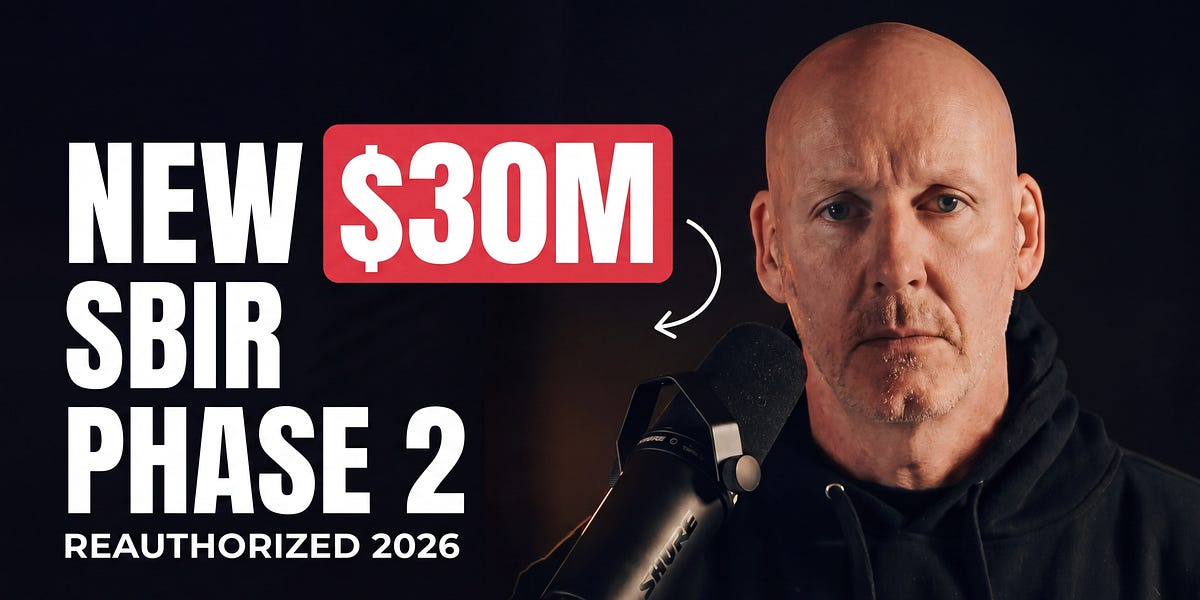
Watch the original Substack video, or listen below while you read.
SBIR: A 43-year-old program, a 6-month freeze, a $30M new award category, and what it means for everyone selling into the federal market
For 43 years, SBIR was the quietest but most consequential public-private partnership in the federal government. It seeded Qualcomm. It funded the autonomous navigation that became the Roomba. The very first SBIR award — a $25,000 Phase I — eventually helped spin up Symantec. Components on the Mars Perseverance rover trace back to eight different SBIR-funded small businesses.
Then, on September 30, 2025, the program’s authorization expired.
What followed was the longest disruption in SBIR’s history: six months, $4 billion in annual funding frozen across 11 agencies, NIH canceling 23 active solicitations, DoD shelving pre-solicitation topics that had taken months to develop, and roughly 6,000 small businesses left with no path forward.
On April 13, the President signed the Innovation and Economic Security Act. SBIR and STTR are now authorized through September 30, 2031 — the longest extension in the program’s history.
But the program that comes back is not the program that went away. Congress used the reauthorization to fix some long-standing complaints, close some loopholes, and — most significantly — create a brand-new $30 million award category that never existed before.
Here’s what changed, and what it means if you’re operating anywhere in this ecosystem.
Quick refresher: what SBIR actually is If you’re new to this corner of the federal market: SBIR stands for Small Business Innovative Research. The government calls it “America’s Seed Fund.” It’s non-dilutive funding — meaning no equity, you keep the IP — aimed at small businesses (fewer than 500 employees) developing and commercializing technology.
Since 1982, the program has deployed over $81 billion into more than 34,000 small businesses , generating 70,000+ patents and spinning out 700+ publicly traded companies.
The structure is three phases:
Phase I — 6 to 12 months, up to ~$275K. Proof of concept. Often just a technical paper demonstrating the idea can work.
Phase II — up to 24 months, up to $1.8M. Build the prototype, prove it to the government.
Phase III — not funded with SBIR dollars. This is where your solution transitions into real federal contracts with program offices that want to buy it.
The gap between Phase II and Phase III has a name in this industry: the Valley of Death. More on that in a minute, because it’s central to what just changed.
The GovClose Certification
Change #1: Foreign security screening has teeth now Every federal agency is now required to evaluate SBIR applicants against a specific threat list. If your company has financial ties, equity arrangements, licensing agreements, joint ventures, or key personnel connected to a “country of concern” — you can be denied.
There’s also a provision that lets agencies deny applicants based on classified risk sources . Meaning: they may know something about your company that they’re not allowed to tell you.
The good news: a denial in one cycle doesn’t permanently bar you from future cycles.
The action item: if you’re planning to apply, audit everything. Investors. Affiliates. Licensing agreements. Individual employees. Supplier relationships. Do the work before you submit, not after you’ve been denied.
Change #2: Proposal caps are coming for the “SBIR mills” If you’ve spent any time in this ecosystem, you’ve heard the term “SBIR mills” or “SBIR farms” — companies that have essentially industrialized the proposal process, flooding agencies with hundreds of submissions and crowding out legitimate small businesses.
Congress is shutting that down.
By October 1, 2027 , every agency will have to publish cap structures limiting how many proposals a single company can submit per cycle. I’d expect the specifics to come out around July of this year, though agency timelines are agency timelines.
If you’ve built your business on volume, it’s time to rethink the model. If you’ve been losing to volume players, you’re about to have a fairer shot.
Change #3: The Valley of Death is finally being addressed This is the one I’ve been waiting years for.
Here’s the problem as it existed: you win a Phase II. You’ve proven your technology works. Now you need a program office to actually buy it — Phase III. But contracting officers and acquisitions professionals often don’t understand SBIR, don’t know the sole-source authorities it unlocks, and don’t have standardized contract vehicles to move quickly.
I’ll say this plainly as someone who spent 20 years in DoD acquisitions: winning an SBIR contract opens a door that almost nothing else in federal contracting opens. It gives acquisitions professionals the authority to award a follow-on sole-source contract — without competition — if you meet the parameters.
The problem is most of them don’t know it. I used to write letters directly to contracting officers on behalf of companies, walking them through exactly how they could legally make the sole-source award.
The new law requires:
Standardized procedures and model contracts for Phase I, Phase II, and Phase III
Direct access mechanisms for SBIR companies to reach the program offices that would buy their technology
Training for government acquisitions professionals on how to actually use SBIR authorities
For consultants reading this: this is your lane. There are companies sitting on Phase II awards right now that have sole-source opportunities available to them and have no idea. That’s a service you can sell.
Change #4: Technical and Business Assistance got upgraded A quieter change, but a useful one.
Phase I recipients can now use up to $6,500 of their award for business and technical assistance
Phase II recipients can use up to $50,000
Eligible uses include cybersecurity, hiring, staff augmentation — essentially anything that helps a technical small business function as a federal contractor. It’s not a headline number, but if you’ve ever tried to win one of these awards, you know how much infrastructure you need to actually execute.
The headline: the new $30M Strategic Breakthrough Award This is the one.
A standard Phase II tops out at $1.8M over two years. The new Strategic Breakthrough Award goes up to $30 million over 48 months . That’s not a bigger Phase II. That’s a different category of program entirely — a genuine bridge across the Valley of Death.
Here’s how it works:
Who can offer them: Only agencies with more than $100M in annual SBIR obligations. That’s DoD (Department of War), Energy, HHS, and NASA. They can allocate up to 0.5% of their R&D budget to these awards.
Who can receive them: The bar is high.
You must have at least one prior Phase II
You must secure 100% matching funds — equal to the full award — from new private capital or qualifying non-SBIR government funding
You must demonstrate your technology is an effective solution, backed by market research
For military applications: you need a commitment from a Program Executive Officer (PEO) or higher — that’s general-officer level, overseeing major acquisition portfolios
20% of the matching funds must come from DoW funding outside of SBIR
And one more detail that matters: agencies must complete contract awards within 90 days of receiving your proposal. For a federal program, that’s lightning fast.
This isn’t for everyone. But if you’ve got a Phase II under your belt, real traction, and the ability to line up private capital, this is probably the most significant new funding mechanism the federal innovation ecosystem has seen in years.
Start modeling matching-fund strategies now. The topics aren’t live on SBIR.gov yet — I’m expecting DoD first, then NIH and NSF around May — but the companies that are ready on day one are the ones that will win.
What to do this week If you’re a small business with innovative technology:
Monitor SBIR.gov for topics to go live (expect DoD first in May)
Audit your foreign relationships, investors, and key personnel before you apply
Plan for the FY27 proposal caps — quality over volume
If you might qualify for the Strategic Breakthrough Award, start building the case now: prior Phase II, private capital commitments, PEO-level sponsorship
If you’re a consultant or account executive:
The SBIR program just got more complex. That’s good news for you. Companies are going to need help navigating foreign-entity screening, positioning for the Strategic Breakthrough Award, and — this is the big one — unlocking the sole-source pathways that Phase II awards make available. Most contracting officers still don’t understand these authorities. Someone has to explain it to them.
Bottom line The SBIR program is back with a 5-year runway to 2031. Stronger national security guardrails. Proposal caps coming. A cleaner pathway to Phase III. And a brand-new $30 million award category that most of the market doesn’t even know exists yet.
If you’ve been waiting on the sidelines for six months wondering whether this program was going to come back — it did. And it came back meaningfully better.
Want to go deeper on any of this? If you want to learn how to win government contracts, build a consulting practice around federal acquisitions, or land a six-figure account executive role in the federal market, that’s what we teach at GovClose
And if you’re a company looking to hire someone who already knows this material, match.govclose.com is where our certified graduates are listed.
I’ll keep tracking the SBIR topics as they drop and update here in Federalytics . If you found this useful, forward it to someone who needs to see it.
— Rick
","truncated_body_text":"SBIR: A 43-year-old program, a 6-month freeze, a $30M new award category, and what it means for everyone selling into the federal market","wordcount":1602,"post_preview_limit":null,"language":"en","postTags":[{"id":"0addf13a-ea5b-4549-8042-115fae236e28","publication_id":5812328,"name":"small business funding","slug":"small-business-funding","hidden":false},{"id":"2f140c0b-4f33-4fc5-bb97-d0ba79ac18d0","publication_id":5812328,"name":"Small business technology transfer","slug":"small-business-technology-transfer","hidden":false},{"id":"3dc5b4b1-3562-4e3d-88b4-38af91735003","publication_id":5812328,"name":"SBIR","slug":"sbir","hidden":false},{"id":"4b1c4d0c-d035-4622-805f-a2ae307479c4","publication_id":5812328,"name":"angel investor","slug":"angel-investor","hidden":false},{"id":"77d87ffa-a1e5-402e-baa6-db5e9c2cebe7","publication_id":5812328,"name":"STTR","slug":"sttr","hidden":false},{"id":"9ae29aa1-36f6-46ff-8f27-0a3a48bee277","publication_id":5812328,"name":"start a business","slug":"start-a-business","hidden":false},{"id":"a74bf11b-f057-4e11-8dc2-04a8a27bf625","publication_id":5812328,"name":"Small Business Innovation Research","slug":"small-business-innovation-research","hidden":false},{"id":"cc7e3885-c543-43fb-ae72-4d4310a15bec","publication_id":5812328,"name":"venture capital","slug":"venture-capital","hidden":false},{"id":"d55a012c-ce44-421f-9a92-1e6fe2cdaf03","publication_id":5812328,"name":"Small business defense contracts","slug":"small-business-defense-contracts","hidden":false},{"id":"f9992d71-0de1-4ec5-98df-c8144367f20c","publication_id":5812328,"name":"venture funding","slug":"venture-funding","hidden":false}],"postCountryBlocks":[],"headlineTest":null,"coverImagePalette":{"Vibrant":{"rgb":[220,52,68],"population":200},"DarkVibrant":{"rgb":[102,52,36],"population":3},"LightVibrant":{"rgb":[223,143,140],"population":134},"Muted":{"rgb":[155,121,102],"population":14},"DarkMuted":{"rgb":[80,48,43],"population":57},"LightMuted":{"rgb":[206,170,176],"population":26}},"publishedBylines":[{"id":35591915,"name":"FEDERALYTICS","handle":"federalytics","previous_name":"Federalytics","photo_url":"https://substack-post-media.s3.amazonaws.com/public/images/c789daa1-ac02-4d33-9dd5-4cca1fb48731_768x768.jpeg","bio":"Government contract intelligence for companies selling to the federal government. Market analysis & competitive insights from Lt. Col. (Ret.) Richard Howard, former DoD acquisitions officer. For training: GovClose.com","profile_set_up_at":"2025-07-28T18:53:07.132Z","reader_installed_at":"2025-08-24T02:10:45.143Z","publicationUsers":[{"id":5928686,"user_id":35591915,"publication_id":5812328,"role":"admin","public":true,"is_primary":true,"publication":{"id":5812328,"name":"FEDERALYTICS","subdomain":"federalytics","custom_domain":null,"custom_domain_optional":false,"hero_text":"Federalytics provides competitive intelligence and market analysis for companies selling to the federal government.","logo_url":"https://substack-post-media.s3.amazonaws.com/public/images/73d2d823-534c-48f9-b0e6-53764d820657_256x256.png","author_id":35591915,"primary_user_id":35591915,"theme_var_background_pop":"#FF6719","created_at":"2025-07-28T18:59:27.519Z","email_from_name":"FEDERALYTICS from GovClose","copyright":"Richard C. Howard","founding_plan_name":"Founding Member","community_enabled":true,"invite_only":false,"payments_state":"paused","language":null,"explicit":false,"homepage_type":"newspaper","is_personal_mode":false,"logo_url_wide":null}}],"is_guest":false,"bestseller_tier":null,"status":{"bestsellerTier":null,"subscriberTier":null,"leaderboard":null,"vip":false,"badge":null,"paidPublicationIds":[],"subscriber":null}}],"reaction":null,"reaction_count":6,"comment_count":0,"child_comment_count":0,"is_geoblocked":false,"hasCashtag":false},"comments":null,"canonicalUrl":"https://federalytics.substack.com/p/the-mysterious-us-program-pumping","inlineComments":true,"readerIsSearchCrawler":false,"ogUrl":"https://federalytics.substack.com/p/the-mysterious-us-program-pumping","bannedFromNotes":false,"themeVariables":{"color_theme_bg_pop":"#ef4d2a","background_pop":"#ef4d2a","color_theme_bg_web":"#020617","cover_bg_color":"#020617","cover_bg_color_secondary":"#111525","background_pop_darken":"#ed3912","print_on_pop":"#ffffff","color_theme_bg_pop_darken":"#ed3912","color_theme_print_on_pop":"#ffffff","color_theme_bg_pop_20":"rgba(239, 77, 42, 0.2)","color_theme_bg_pop_30":"rgba(239, 77, 42, 0.3)","print_pop":"#ef4d2a","color_theme_accent":"#ef4d2a","cover_print_primary":"#ffffff","cover_print_secondary":"#d9d9d9","cover_print_tertiary":"#d9d9d9","cover_border_color":"#ffffff","home_hero":"feature-media","home_posts":"list","home_show_top_posts":true,"web_bg_color":"#020617","background_contrast_1":"#111525","background_contrast_2":"#242836","background_contrast_3":"#494c58","background_contrast_4":"#6e707a","background_contrast_5":"#afb0b6","color_theme_bg_contrast_1":"#111525","color_theme_bg_contrast_2":"#242836","color_theme_bg_contrast_3":"#494c58","color_theme_bg_contrast_4":"#6e707a","color_theme_bg_contrast_5":"#afb0b6","color_theme_bg_elevated":"#111525","color_theme_bg_elevated_secondary":"#242836","color_theme_bg_elevated_tertiary":"#494c58","color_theme_detail":"#1b1f2e","background_contrast_pop":"rgba(239, 77, 42, 0.4)","color_theme_bg_contrast_pop":"rgba(239, 77, 42, 0.4)","theme_bg_is_dark":"1","print_on_web_bg_color":"hsl(228.57142857142856, 21.00000000000007%, 90.49019607843137%)","print_secondary_on_web_bg_color":"#9a9ba2","background_pop_rgb":"239, 77, 42","color_theme_bg_pop_rgb":"239, 77, 42","color_theme_accent_rgb":"239, 77, 42"},"recentEpisodes":[{"id":198321901,"editor_v2":false,"publication_id":5812328,"title":"SAM.gov Inactive? Here's the Exact Renewal Process (2026)","social_title":"SAM.gov Inactive? Here's the Exact Renewal Process (2026)","search_engine_title":null,"search_engine_description":null,"type":"podcast","slug":"samgov-inactive-heres-the-exact-renewal","post_date":"2026-05-22T14:10:25.819Z","audience":"everyone","podcast_duration":1416.1501,"video_upload_id":"af183dc6-16c4-4351-8b75-7999996727c3","podcast_upload_id":"0b3829e1-dfe2-4d58-b0ab-ef5698115475","write_comment_permissions":"everyone","should_send_free_preview":false,"free_unlock_required":false,"default_comment_sort":null,"canonical_url":"https://federalytics.substack.com/p/samgov-inactive-heres-the-exact-renewal","section_id":null,"top_exclusions":[],"pins":[],"is_section_pinned":false,"section_slug":null,"section_name":null,"reactions":{"❤":1},"restacks":0,"restacked_post_id":null,"restacked_post_slug":null,"restacked_pub_name":null,"restacked_pub_logo_url":null,"subtitle":"","cover_image":"https://substack-video.s3.amazonaws.com/video_upload/post/198321901/af183dc6-16c4-4351-8b75-7999996727c3/transcoded-1779225777.png","cover_image_is_square":false,"cover_image_is_explicit":false,"podcast_episode_image_url":"https://substack-post-media.s3.amazonaws.com/public/images/d3f0b008-f5f3-4c68-aa3c-9ffa3e9f6728_1400x1400.png","podcast_episode_image_info":{"url":"https://substack-post-media.s3.amazonaws.com/public/images/d3f0b008-f5f3-4c68-aa3c-9ffa3e9f6728_1400x1400.png","isDefaultArt":false,"isDefault":false},"podcast_url":"https://api.substack.com/api/v1/audio/upload/0b3829e1-dfe2-4d58-b0ab-ef5698115475/src","videoUpload":{"id":"af183dc6-16c4-4351-8b75-7999996727c3","name":"Renew SAM FINAL-2.mp4","created_at":"2026-05-18T21:24:52.966Z","uploaded_at":"2026-05-18T21:26:34.251Z","publication_id":5812328,"state":"transcoded","post_id":198321901,"user_id":35591915,"duration":1416.1298,"height":1080,"width":1920,"thumbnail_id":1779225777,"preview_start":null,"preview_duration":null,"media_type":"video","primary_file_size":807798363,"is_mux":true,"mux_asset_id":"00eCm6Hz672srecYZ8JCiHgM2imLrjcTirbd6V4LN801w","mux_playback_id":"tnGEHC73v9kiN3BWIVObUSDswq4YCObgyh8GL99vQXQ","mux_preview_asset_id":null,"mux_preview_playback_id":null,"mux_rendition_quality":"high","mux_preview_rendition_quality":null,"explicit":false,"copyright_infringement":null,"src_media_upload_id":null,"live_stream_id":null,"transcription":null,"extractedAudio":{"id":"0b3829e1-dfe2-4d58-b0ab-ef5698115475","name":null,"created_at":"2026-05-18T21:26:34.272Z","uploaded_at":"2026-05-18T21:26:34.251Z","publication_id":5812328,"state":"transcoded","post_id":198321901,"user_id":35591915,"duration":1416.1501,"height":null,"width":null,"thumbnail_id":1,"preview_start":null,"preview_duration":null,"media_type":"audio","primary_file_size":22658968,"is_mux":null,"mux_asset_id":null,"mux_playback_id":null,"mux_preview_asset_id":null,"mux_preview_playback_id":null,"mux_rendition_quality":null,"mux_preview_rendition_quality":null,"explicit":false,"copyright_infringement":null,"src_media_upload_id":"af183dc6-16c4-4351-8b75-7999996727c3","live_stream_id":null,"transcription":{"media_upload_id":"0b3829e1-dfe2-4d58-b0ab-ef5698115475","created_at":"2026-05-18T21:27:05.149Z","requested_by":35591915,"status":"transcribed","modal_call_id":"fc-01KRYFRGFDVJWKESR1BKR31MKT","approved_at":"2026-05-18T21:28:21.233Z","transcript_url":"s3://substack-video/video_upload/post/198321901/0b3829e1-dfe2-4d58-b0ab-ef5698115475/1779139627/transcription.json","attention_vocab":null,"speaker_map":null,"captions_map":{"en":{"url":"s3://substack-video/video_upload/post/198321901/0b3829e1-dfe2-4d58-b0ab-ef5698115475/1779139627/en.vtt","language":"en","original":true}},"cdn_url":"https://substackcdn.com/video_upload/post/198321901/0b3829e1-dfe2-4d58-b0ab-ef5698115475/1779139627/transcription.json?Expires=1780351482&Key-Pair-Id=APKAIVDA3NPSMPSPESQQ&Signature=lfiZzE83aScKbQpb4GckMWxGar7~0jKIrDt3CrVf~n2xoyeC2wzWJxfIBM7u7yz4hI3FAptcJgqsR8R4XiU0GXBbTeZ4BOiwRV-EZ8-xthkXRnfqUFaZoTME3L8~T7wT3Zv1NBcqsA0AQm-cwsAuac6a0YhIBW9~n1q0ghSyFnigToR5GODnIudgXTQyQbxKE5JNxPR57ejWZs3nS2pzE38B9-1YAyEO3~sg0Pkw3QFDbJab6sE3GZ22q14QqXl3jlWSxxwkFSPlembkyWK9t~kQSKULhv-KcdLm9l23oV07acffoh5YhPkHnEogq-qJDr7U5YG2XUIC~Px~u2YMEw__","cdn_unaligned_url":"https://substackcdn.com/video_upload/post/198321901/0b3829e1-dfe2-4d58-b0ab-ef5698115475/1779139627/unaligned_transcription.json?Expires=1780351482&Key-Pair-Id=APKAIVDA3NPSMPSPESQQ&Signature=RHJLIe6V~2cWxa8tzGT65rSMD4gHljLTg2Kk5egy3cqmDQNI2pmpt7KKPNOPaPeyJ3aG8OebAYnhYjWpYjQy6BXOXvkffyLJLKbCQ7G5fkZU9h9wj3spCbJ6cVl39lvw8PiXUEcqoYnj6n6WNLWBOJUBgj2tFlNw8O2oCVUkw63V8J6T-BVt~BVsjB84xkpRfDWHMlVrAjhqldQZVMCmkWePyeP4W4yS4d~VayRjy7o-Gx4vg6-riRrwfao3q8JO-UjkazodaLu1AkksQMbGufwucp8ytxpdvAQBq5Qp6sEbnkeB1GOnNDYBiZgROHIW~QzHVRo9oRrx2ymZKfxD4Q__","signed_captions":[{"language":"en","url":"https://substackcdn.com/video_upload/post/198321901/0b3829e1-dfe2-4d58-b0ab-ef5698115475/1779139627/en.vtt?Expires=1780351482&Key-Pair-Id=APKAIVDA3NPSMPSPESQQ&Signature=MU-rMo4sEmj9kIKon3ZpOpG6F-lsOWxOe48StETF71TR4HjDXU~NvJf9v3ZjS~N~qEK0ERnfF3nenCEFsruqPn4QwmSBm9qCnOY8Myi48S9HiikpXyT4NBo2zgekYwwZlHaocwj99aMANScpPIDSx63oKilKxgfYSHnOHJ1EgWBwNZdzCzdSfttWE~n6zMT6esaTIbsabYWB4l9HL46H~n~YucHEvS7jp6RMT19xvtfUfJQo85uvDlSVhsoGnTo47NNt7DosMe5q~IKcuIuF85hZjGN1b5VkRX5A8khgOZGUEbwEpvy2SUfoTw2FwbpnOHLAghmhi8bI7Rt667R1Pw__","original":true}]}}},"podcastFields":{"post_id":198321901,"podcast_episode_number":null,"podcast_season_number":null,"podcast_episode_type":null,"should_syndicate_to_other_feed":null,"syndicate_to_section_id":null,"hide_from_feed":false,"free_podcast_url":null,"free_podcast_duration":null,"preview_contains_ad":false,"was_imported_self_serve_sync":false},"podcast_preview_upload_id":null,"podcastUpload":{"id":"0b3829e1-dfe2-4d58-b0ab-ef5698115475","name":null,"created_at":"2026-05-18T21:26:34.272Z","uploaded_at":"2026-05-18T21:26:34.251Z","publication_id":5812328,"state":"transcoded","post_id":198321901,"user_id":35591915,"duration":1416.1501,"height":null,"width":null,"thumbnail_id":1,"preview_start":null,"preview_duration":null,"media_type":"audio","primary_file_size":22658968,"is_mux":null,"mux_asset_id":null,"mux_playback_id":null,"mux_preview_asset_id":null,"mux_preview_playback_id":null,"mux_rendition_quality":null,"mux_preview_rendition_quality":null,"explicit":false,"copyright_infringement":null,"src_media_upload_id":"af183dc6-16c4-4351-8b75-7999996727c3","live_stream_id":null,"transcription":{"media_upload_id":"0b3829e1-dfe2-4d58-b0ab-ef5698115475","created_at":"2026-05-18T21:27:05.149Z","requested_by":35591915,"status":"transcribed","modal_call_id":"fc-01KRYFRGFDVJWKESR1BKR31MKT","approved_at":"2026-05-18T21:28:21.233Z","transcript_url":"s3://substack-video/video_upload/post/198321901/0b3829e1-dfe2-4d58-b0ab-ef5698115475/1779139627/transcription.json","attention_vocab":null,"speaker_map":null,"captions_map":{"en":{"url":"s3://substack-video/video_upload/post/198321901/0b3829e1-dfe2-4d58-b0ab-ef5698115475/1779139627/en.vtt","language":"en","original":true}},"cdn_url":"https://substackcdn.com/video_upload/post/198321901/0b3829e1-dfe2-4d58-b0ab-ef5698115475/1779139627/transcription.json?Expires=1780351482&Key-Pair-Id=APKAIVDA3NPSMPSPESQQ&Signature=lfiZzE83aScKbQpb4GckMWxGar7~0jKIrDt3CrVf~n2xoyeC2wzWJxfIBM7u7yz4hI3FAptcJgqsR8R4XiU0GXBbTeZ4BOiwRV-EZ8-xthkXRnfqUFaZoTME3L8~T7wT3Zv1NBcqsA0AQm-cwsAuac6a0YhIBW9~n1q0ghSyFnigToR5GODnIudgXTQyQbxKE5JNxPR57ejWZs3nS2pzE38B9-1YAyEO3~sg0Pkw3QFDbJab6sE3GZ22q14QqXl3jlWSxxwkFSPlembkyWK9t~kQSKULhv-KcdLm9l23oV07acffoh5YhPkHnEogq-qJDr7U5YG2XUIC~Px~u2YMEw__","cdn_unaligned_url":"https://substackcdn.com/video_upload/post/198321901/0b3829e1-dfe2-4d58-b0ab-ef5698115475/1779139627/unaligned_transcription.json?Expires=1780351482&Key-Pair-Id=APKAIVDA3NPSMPSPESQQ&Signature=RHJLIe6V~2cWxa8tzGT65rSMD4gHljLTg2Kk5egy3cqmDQNI2pmpt7KKPNOPaPeyJ3aG8OebAYnhYjWpYjQy6BXOXvkffyLJLKbCQ7G5fkZU9h9wj3spCbJ6cVl39lvw8PiXUEcqoYnj6n6WNLWBOJUBgj2tFlNw8O2oCVUkw63V8J6T-BVt~BVsjB84xkpRfDWHMlVrAjhqldQZVMCmkWePyeP4W4yS4d~VayRjy7o-Gx4vg6-riRrwfao3q8JO-UjkazodaLu1AkksQMbGufwucp8ytxpdvAQBq5Qp6sEbnkeB1GOnNDYBiZgROHIW~QzHVRo9oRrx2ymZKfxD4Q__","signed_captions":[{"language":"en","url":"https://substackcdn.com/video_upload/post/198321901/0b3829e1-dfe2-4d58-b0ab-ef5698115475/1779139627/en.vtt?Expires=1780351482&Key-Pair-Id=APKAIVDA3NPSMPSPESQQ&Signature=MU-rMo4sEmj9kIKon3ZpOpG6F-lsOWxOe48StETF71TR4HjDXU~NvJf9v3ZjS~N~qEK0ERnfF3nenCEFsruqPn4QwmSBm9qCnOY8Myi48S9HiikpXyT4NBo2zgekYwwZlHaocwj99aMANScpPIDSx63oKilKxgfYSHnOHJ1EgWBwNZdzCzdSfttWE~n6zMT6esaTIbsabYWB4l9HL46H~n~YucHEvS7jp6RMT19xvtfUfJQo85uvDlSVhsoGnTo47NNt7DosMe5q~IKcuIuF85hZjGN1b5VkRX5A8khgOZGUEbwEpvy2SUfoTw2FwbpnOHLAghmhi8bI7Rt667R1Pw__","original":true}]}},"podcastPreviewUpload":null,"voiceover_upload_id":null,"voiceoverUpload":null,"has_voiceover":false,"description":"If you registered your company in SAM.gov, it’s quite possible your entity might be sitting inactive right now.","body_json":null,"body_html":null,"truncated_body_text":"If you registered your company in SAM.gov, it’s quite possible your entity might be sitting inactive right now.","wordcount":518,"post_preview_limit":null,"language":"en","postTags":[{"id":"2c3c8c13-f014-49f0-8d69-0796adfa80c8","publication_id":5812328,"name":"sam.gov","slug":"samgov","hidden":false},{"id":"35cd910f-de6e-4257-afc8-a0edd35f632f","publication_id":5812328,"name":"Sam.gov contracts","slug":"samgov-contracts","hidden":false},{"id":"9ae29aa1-36f6-46ff-8f27-0a3a48bee277","publication_id":5812328,"name":"start a business","slug":"start-a-business","hidden":false},{"id":"ab652e6d-2f6e-460b-90f9-f20d572c5b17","publication_id":5812328,"name":"Sam.gov contract","slug":"samgov-contract","hidden":false}],"teaser_post_eligible":true,"postCountryBlocks":[],"headlineTest":{"post_id":198321901,"starts_at":"2026-05-22T14:10:26.087Z","ended_at":"2026-05-22T15:10:26.248Z","planned_duration_ms":3600000,"test_cohort_percent":20,"test_cohort_emailed":true,"main_cohort_emailed":true,"created_at":"2026-05-22T14:09:50.188Z","updated_at":"2026-05-22T15:11:26.410Z","creator_id":35591915,"ended_early":false,"winner_overridden":false},"coverImagePalette":{"Vibrant":{"rgb":[249,4,5],"population":530},"DarkVibrant":{"rgb":[176,10,10],"population":26},"LightVibrant":{"rgb":[240,79,80],"population":69},"Muted":{"rgb":[143,85,69],"population":531},"DarkMuted":{"rgb":[102,51,44],"population":226},"LightMuted":{"rgb":[198,166,170],"population":109}},"publishedBylines":[{"id":35591915,"name":"FEDERALYTICS","handle":"federalytics","previous_name":"Federalytics","photo_url":"https://substack-post-media.s3.amazonaws.com/public/images/c789daa1-ac02-4d33-9dd5-4cca1fb48731_768x768.jpeg","bio":"Government contract intelligence for companies selling to the federal government. Market analysis & competitive insights from Lt. Col. (Ret.) Richard Howard, former DoD acquisitions officer. For training: GovClose.com","profile_set_up_at":"2025-07-28T18:53:07.132Z","reader_installed_at":"2025-08-24T02:10:45.143Z","publicationUsers":[{"id":5928686,"user_id":35591915,"publication_id":5812328,"role":"admin","public":true,"is_primary":true,"publication":{"id":5812328,"name":"FEDERALYTICS","subdomain":"federalytics","custom_domain":null,"custom_domain_optional":false,"hero_text":"Federalytics provides competitive intelligence and market analysis for companies selling to the federal government.","logo_url":"https://substack-post-media.s3.amazonaws.com/public/images/73d2d823-534c-48f9-b0e6-53764d820657_256x256.png","author_id":35591915,"primary_user_id":35591915,"theme_var_background_pop":"#FF6719","created_at":"2025-07-28T18:59:27.519Z","email_from_name":"FEDERALYTICS from GovClose","copyright":"Richard C. Howard","founding_plan_name":"Founding Member","community_enabled":true,"invite_only":false,"payments_state":"paused","language":null,"explicit":false,"homepage_type":"newspaper","is_personal_mode":false,"logo_url_wide":null}}],"is_guest":false,"bestseller_tier":null,"status":{"bestsellerTier":null,"subscriberTier":null,"leaderboard":null,"vip":false,"badge":null,"paidPublicationIds":[],"subscriber":null}}],"reaction":null,"reaction_count":1,"comment_count":0,"child_comment_count":0,"is_geoblocked":false,"hasCashtag":false},{"id":197258681,"editor_v2":false,"publication_id":5812328,"title":"Why the OTA marketplace is quietly running a parallel acquisition system — and how to vet it before you waste your time","social_title":"Why the OTA marketplace is quietly running a parallel acquisition system — and how to vet it before you waste your time","search_engine_title":null,"search_engine_description":null,"type":"podcast","slug":"why-the-ota-marketplace-is-quietly","post_date":"2026-05-11T23:02:05.258Z","audience":"everyone","podcast_duration":2521.992,"video_upload_id":"9eaf6166-4f1f-49f7-8820-210f1ab4f105","podcast_upload_id":"7c434c5f-8e0e-4919-adc2-f6da27a7af35","write_comment_permissions":"everyone","should_send_free_preview":false,"free_unlock_required":false,"default_comment_sort":null,"canonical_url":"https://federalytics.substack.com/p/why-the-ota-marketplace-is-quietly","section_id":null,"top_exclusions":[],"pins":[],"is_section_pinned":false,"section_slug":null,"section_name":null,"reactions":{"❤":4},"restacks":0,"restacked_post_id":null,"restacked_post_slug":null,"restacked_pub_name":null,"restacked_pub_logo_url":null,"subtitle":"","cover_image":"https://substack-video.s3.amazonaws.com/video_upload/post/197258681/9eaf6166-4f1f-49f7-8820-210f1ab4f105/transcoded-1778528804.png","cover_image_is_square":false,"cover_image_is_explicit":false,"podcast_episode_image_url":"https://substack-post-media.s3.amazonaws.com/public/images/d3f0b008-f5f3-4c68-aa3c-9ffa3e9f6728_1400x1400.png","podcast_episode_image_info":{"url":"https://substack-post-media.s3.amazonaws.com/public/images/d3f0b008-f5f3-4c68-aa3c-9ffa3e9f6728_1400x1400.png","isDefaultArt":false,"isDefault":false},"podcast_url":"https://api.substack.com/api/v1/audio/upload/7c434c5f-8e0e-4919-adc2-f6da27a7af35/src","videoUpload":{"id":"9eaf6166-4f1f-49f7-8820-210f1ab4f105","name":"Hidden Government Contracts .mp4","created_at":"2026-05-11T19:20:15.344Z","uploaded_at":"2026-05-11T19:22:14.178Z","publication_id":5812328,"state":"transcoded","post_id":197258681,"user_id":35591915,"duration":2522.0093,"height":1080,"width":1920,"thumbnail_id":1778528804,"preview_start":null,"preview_duration":null,"media_type":"video","primary_file_size":4235114316,"is_mux":true,"mux_asset_id":"vOzTqLt02XqLMTXD015YtPJu33cBf02cm5DgC9yAnWfcLs","mux_playback_id":"1D4EVhLC743a02MPCEzKMXY90202902VaV4CLF00MuKWojN00","mux_preview_asset_id":null,"mux_preview_playback_id":null,"mux_rendition_quality":"high","mux_preview_rendition_quality":null,"explicit":false,"copyright_infringement":null,"src_media_upload_id":null,"live_stream_id":null,"extractedAudio":{"id":"7c434c5f-8e0e-4919-adc2-f6da27a7af35","name":null,"created_at":"2026-05-11T19:22:14.201Z","uploaded_at":"2026-05-11T19:22:14.178Z","publication_id":5812328,"state":"transcoded","post_id":197258681,"user_id":35591915,"duration":2521.992,"height":null,"width":null,"thumbnail_id":1,"preview_start":null,"preview_duration":null,"media_type":"audio","primary_file_size":40352452,"is_mux":null,"mux_asset_id":null,"mux_playback_id":null,"mux_preview_asset_id":null,"mux_preview_playback_id":null,"mux_rendition_quality":null,"mux_preview_rendition_quality":null,"explicit":false,"copyright_infringement":null,"src_media_upload_id":"9eaf6166-4f1f-49f7-8820-210f1ab4f105","live_stream_id":null,"transcription":null},"transcription":null},"podcastFields":null,"podcast_preview_upload_id":null,"podcastUpload":{"id":"7c434c5f-8e0e-4919-adc2-f6da27a7af35","name":null,"created_at":"2026-05-11T19:22:14.201Z","uploaded_at":"2026-05-11T19:22:14.178Z","publication_id":5812328,"state":"transcoded","post_id":197258681,"user_id":35591915,"duration":2521.992,"height":null,"width":null,"thumbnail_id":1,"preview_start":null,"preview_duration":null,"media_type":"audio","primary_file_size":40352452,"is_mux":null,"mux_asset_id":null,"mux_playback_id":null,"mux_preview_asset_id":null,"mux_preview_playback_id":null,"mux_rendition_quality":null,"mux_preview_rendition_quality":null,"explicit":false,"copyright_infringement":null,"src_media_upload_id":"9eaf6166-4f1f-49f7-8820-210f1ab4f105","live_stream_id":null,"transcription":null},"podcastPreviewUpload":null,"voiceover_upload_id":null,"voiceoverUpload":null,"has_voiceover":false,"description":"If you’re only searching SAM.gov, you’re looking at a percentage of the federal opportunities relevant to you.","body_json":null,"body_html":null,"truncated_body_text":"If you’re only searching SAM.gov, you’re looking at a percentage of the federal opportunities relevant to you. Probably less if you sell anything innovative.","wordcount":1772,"post_preview_limit":null,"language":"en","postTags":[{"id":"0f5898c3-b36d-41e2-b1f0-bf759f3abe51","publication_id":5812328,"name":"B2G","slug":"b2g","hidden":false},{"id":"1c986913-a4ea-43b7-9238-59ca5807e4cb","publication_id":5812328,"name":"One Nation Innovation ONI","slug":"one-nation-innovation-oni","hidden":false},{"id":"23313b48-c885-4141-b367-1c108f8ede62","publication_id":5812328,"name":"OTA","slug":"ota","hidden":false},{"id":"2c3c8c13-f014-49f0-8d69-0796adfa80c8","publication_id":5812328,"name":"sam.gov","slug":"samgov","hidden":false},{"id":"35cd910f-de6e-4257-afc8-a0edd35f632f","publication_id":5812328,"name":"Sam.gov contracts","slug":"samgov-contracts","hidden":false},{"id":"3c2738cb-a276-4f2c-bbd4-35ecc3873c4d","publication_id":5812328,"name":"Rick Howard","slug":"rick-howard","hidden":false},{"id":"44fc6387-1fbb-41ca-bb0a-01744f77e76e","publication_id":5812328,"name":"Other transaction authority","slug":"other-transaction-authority","hidden":false},{"id":"504f7d01-265c-4bc5-aa2b-83ae549e8d59","publication_id":5812328,"name":"Government Contracting","slug":"government-contracting","hidden":false},{"id":"668c3a82-3d9c-46c4-ba6a-d6e2c49d23cf","publication_id":5812328,"name":"Sam.gov bid","slug":"samgov-bid","hidden":false},{"id":"8e36a0a1-95e1-4da4-8a82-09acc5fd79da","publication_id":5812328,"name":"diu","slug":"diu","hidden":false},{"id":"9ea6f3b6-3310-4674-a0d9-8fee9fffc6d8","publication_id":5812328,"name":"Best Government Contract Training","slug":"best-government-contract-training","hidden":false},{"id":"ab652e6d-2f6e-460b-90f9-f20d572c5b17","publication_id":5812328,"name":"Sam.gov contract","slug":"samgov-contract","hidden":false},{"id":"b66e26ca-6f3a-45cb-a3d1-09a54d9179ad","publication_id":5812328,"name":"One Nation Innovation","slug":"one-nation-innovation","hidden":false},{"id":"cc7e3885-c543-43fb-ae72-4d4310a15bec","publication_id":5812328,"name":"venture capital","slug":"venture-capital","hidden":false},{"id":"e6aa8890-e48a-44e8-9692-815d935fe401","publication_id":5812328,"name":"Angel investors Alternative","slug":"angel-investors-alternative","hidden":false}],"teaser_post_eligible":true,"postCountryBlocks":[],"headlineTest":{"post_id":197258681,"starts_at":"2026-05-11T23:02:05.478Z","ended_at":"2026-05-11T23:32:05.655Z","planned_duration_ms":1800000,"test_cohort_percent":20,"test_cohort_emailed":true,"main_cohort_emailed":true,"created_at":"2026-05-11T20:06:29.187Z","updated_at":"2026-05-11T23:33:58.910Z","creator_id":35591915,"ended_early":false,"winner_overridden":false},"coverImagePalette":{"Vibrant":{"rgb":[244,188,4],"population":85},"DarkVibrant":{"rgb":[140,107,6],"population":61},"LightVibrant":{"rgb":[252,188,140],"population":1},"Muted":{"rgb":[124,124,124],"population":15},"DarkMuted":{"rgb":[77,68,63],"population":25},"LightMuted":{"rgb":[198,178,164],"population":9}},"publishedBylines":[{"id":35591915,"name":"FEDERALYTICS","handle":"federalytics","previous_name":"Federalytics","photo_url":"https://substack-post-media.s3.amazonaws.com/public/images/c789daa1-ac02-4d33-9dd5-4cca1fb48731_768x768.jpeg","bio":"Government contract intelligence for companies selling to the federal government. Market analysis & competitive insights from Lt. Col. (Ret.) Richard Howard, former DoD acquisitions officer. For training: GovClose.com","profile_set_up_at":"2025-07-28T18:53:07.132Z","reader_installed_at":"2025-08-24T02:10:45.143Z","publicationUsers":[{"id":5928686,"user_id":35591915,"publication_id":5812328,"role":"admin","public":true,"is_primary":true,"publication":{"id":5812328,"name":"FEDERALYTICS","subdomain":"federalytics","custom_domain":null,"custom_domain_optional":false,"hero_text":"Federalytics provides competitive intelligence and market analysis for companies selling to the federal government.","logo_url":"https://substack-post-media.s3.amazonaws.com/public/images/73d2d823-534c-48f9-b0e6-53764d820657_256x256.png","author_id":35591915,"primary_user_id":35591915,"theme_var_background_pop":"#FF6719","created_at":"2025-07-28T18:59:27.519Z","email_from_name":"FEDERALYTICS from GovClose","copyright":"Richard C. Howard","founding_plan_name":"Founding Member","community_enabled":true,"invite_only":false,"payments_state":"paused","language":null,"explicit":false,"homepage_type":"newspaper","is_personal_mode":false,"logo_url_wide":null}}],"is_guest":false,"bestseller_tier":null,"status":{"bestsellerTier":null,"subscriberTier":null,"leaderboard":null,"vip":false,"badge":null,"paidPublicationIds":[],"subscriber":null}}],"reaction":null,"reaction_count":4,"comment_count":0,"child_comment_count":0,"is_geoblocked":false,"hasCashtag":false},{"id":196459789,"editor_v2":false,"publication_id":5812328,"title":"FPDS Is Dead. SAM.gov Inherited the Job — and It's Better.","social_title":"FPDS Is Dead. SAM.gov Inherited the Job — and It's Better.","search_engine_title":null,"search_engine_description":null,"type":"podcast","slug":"fpds-is-dead-samgov-inherited-the","post_date":"2026-05-04T19:54:28.890Z","audience":"everyone","podcast_duration":1897.4563,"video_upload_id":"8279db80-eb09-4551-80e6-fd36a3b58e1e","podcast_upload_id":"02107f8d-24ee-43f6-ab79-3e4cd9c5bb8c","write_comment_permissions":"everyone","should_send_free_preview":false,"free_unlock_required":false,"default_comment_sort":null,"canonical_url":"https://federalytics.substack.com/p/fpds-is-dead-samgov-inherited-the","section_id":null,"top_exclusions":[],"pins":[],"is_section_pinned":false,"section_slug":null,"section_name":null,"reactions":{"❤":6},"restacks":0,"restacked_post_id":null,"restacked_post_slug":null,"restacked_pub_name":null,"restacked_pub_logo_url":null,"subtitle":"","cover_image":"https://substack-video.s3.amazonaws.com/video_upload/post/196459789/8279db80-eb09-4551-80e6-fd36a3b58e1e/transcoded-1777923190.png","cover_image_is_square":false,"cover_image_is_explicit":false,"podcast_episode_image_url":"https://substack-post-media.s3.amazonaws.com/public/images/d3f0b008-f5f3-4c68-aa3c-9ffa3e9f6728_1400x1400.png","podcast_episode_image_info":{"url":"https://substack-post-media.s3.amazonaws.com/public/images/d3f0b008-f5f3-4c68-aa3c-9ffa3e9f6728_1400x1400.png","isDefaultArt":false,"isDefault":false},"podcast_url":"https://api.substack.com/api/v1/audio/upload/02107f8d-24ee-43f6-ab79-3e4cd9c5bb8c/src","videoUpload":{"id":"8279db80-eb09-4551-80e6-fd36a3b58e1e","name":"Replacing FPDS.mp4","created_at":"2026-05-04T19:00:53.648Z","uploaded_at":"2026-05-04T19:09:58.295Z","publication_id":5812328,"state":"transcoded","post_id":196459789,"user_id":35591915,"duration":1897.476,"height":1080,"width":1920,"thumbnail_id":1777923190,"preview_start":null,"preview_duration":null,"media_type":"video","primary_file_size":3938227183,"is_mux":true,"mux_asset_id":"inNDeaJx00W98sgHgWQPgs8900OHL2RDTdyMhT00OtpxJc","mux_playback_id":"sTPE8jrhVP9lgmb63sp501nMNxT3wGA4JkiD45bpfJvY","mux_preview_asset_id":null,"mux_preview_playback_id":null,"mux_rendition_quality":"high","mux_preview_rendition_quality":null,"explicit":false,"copyright_infringement":null,"src_media_upload_id":null,"live_stream_id":null,"extractedAudio":{"id":"02107f8d-24ee-43f6-ab79-3e4cd9c5bb8c","name":null,"created_at":"2026-05-04T19:09:58.321Z","uploaded_at":"2026-05-04T19:09:58.295Z","publication_id":5812328,"state":"transcoded","post_id":196459789,"user_id":35591915,"duration":1897.4563,"height":null,"width":null,"thumbnail_id":1,"preview_start":null,"preview_duration":null,"media_type":"audio","primary_file_size":30359915,"is_mux":null,"mux_asset_id":null,"mux_playback_id":null,"mux_preview_asset_id":null,"mux_preview_playback_id":null,"mux_rendition_quality":null,"mux_preview_rendition_quality":null,"explicit":false,"copyright_infringement":null,"src_media_upload_id":"8279db80-eb09-4551-80e6-fd36a3b58e1e","live_stream_id":null,"transcription":null},"transcription":null},"podcastFields":{"post_id":196459789,"podcast_episode_number":null,"podcast_season_number":null,"podcast_episode_type":null,"should_syndicate_to_other_feed":null,"syndicate_to_section_id":null,"hide_from_feed":false,"free_podcast_url":null,"free_podcast_duration":null,"preview_contains_ad":false,"was_imported_self_serve_sync":false},"podcast_preview_upload_id":null,"podcastUpload":{"id":"02107f8d-24ee-43f6-ab79-3e4cd9c5bb8c","name":null,"created_at":"2026-05-04T19:09:58.321Z","uploaded_at":"2026-05-04T19:09:58.295Z","publication_id":5812328,"state":"transcoded","post_id":196459789,"user_id":35591915,"duration":1897.4563,"height":null,"width":null,"thumbnail_id":1,"preview_start":null,"preview_duration":null,"media_type":"audio","primary_file_size":30359915,"is_mux":null,"mux_asset_id":null,"mux_playback_id":null,"mux_preview_asset_id":null,"mux_preview_playback_id":null,"mux_rendition_quality":null,"mux_preview_rendition_quality":null,"explicit":false,"copyright_infringement":null,"src_media_upload_id":"8279db80-eb09-4551-80e6-fd36a3b58e1e","live_stream_id":null,"transcription":null},"podcastPreviewUpload":null,"voiceover_upload_id":null,"voiceoverUpload":null,"has_voiceover":false,"description":"If you typed FPDS into Google today, you ended up on SAM.gov.","body_json":null,"body_html":null,"truncated_body_text":"If you typed FPDS into Google today, you ended up on SAM.gov. That’s not a redirect glitch. SAM.gov absorbed FPDS, and the contract-award research most of us used to grind through on that ugly old interface now lives in a tool that’s actually usable. Here’s how to work it.","wordcount":834,"post_preview_limit":null,"language":"en","postTags":[{"id":"1067e2c8-985a-4463-b6ae-c89434c80a6a","publication_id":5812328,"name":"gov tribe","slug":"gov-tribe","hidden":false},{"id":"1c981b52-acd3-4bdb-8718-a9561f7226a7","publication_id":5812328,"name":"Federal contract training","slug":"federal-contract-training","hidden":false},{"id":"2c3c8c13-f014-49f0-8d69-0796adfa80c8","publication_id":5812328,"name":"sam.gov","slug":"samgov","hidden":false},{"id":"44d753e3-87a7-4e03-9cef-d9f490e3a9ea","publication_id":5812328,"name":"government contract training","slug":"government-contract-training","hidden":false},{"id":"5977b424-5f73-43a9-bed2-c61a95608a4d","publication_id":5812328,"name":"Federal Government Contract Training","slug":"federal-government-contract-training","hidden":false},{"id":"81158a89-3025-494d-a4c7-fc973b415a49","publication_id":5812328,"name":"Shipley","slug":"shipley","hidden":false},{"id":"917e3b6e-e6b3-448d-a341-8aba1ef8f71f","publication_id":5812328,"name":"govwiniq","slug":"govwiniq","hidden":false},{"id":"9ea6f3b6-3310-4674-a0d9-8fee9fffc6d8","publication_id":5812328,"name":"Best Government Contract Training","slug":"best-government-contract-training","hidden":false},{"id":"ef7d9b33-ca72-4959-ab9c-1f13246527b6","publication_id":5812328,"name":"fpds","slug":"fpds","hidden":false}],"teaser_post_eligible":true,"postCountryBlocks":[],"headlineTest":{"post_id":196459789,"starts_at":"2026-05-04T19:54:29.177Z","ended_at":"2026-05-04T20:54:29.366Z","planned_duration_ms":3600000,"test_cohort_percent":20,"test_cohort_emailed":true,"main_cohort_emailed":true,"created_at":"2026-05-04T19:54:20.013Z","updated_at":"2026-05-04T20:54:48.834Z","creator_id":35591915,"ended_early":false,"winner_overridden":false},"coverImagePalette":{"Vibrant":{"rgb":[218,6,13],"population":494},"DarkVibrant":{"rgb":[128,86,7],"population":72},"LightVibrant":{"rgb":[230,155,123],"population":261},"Muted":{"rgb":[100,156,84],"population":1},"DarkMuted":{"rgb":[69,50,32],"population":226},"LightMuted":{"rgb":[216,182,164],"population":82}},"publishedBylines":[{"id":35591915,"name":"FEDERALYTICS","handle":"federalytics","previous_name":"Federalytics","photo_url":"https://substack-post-media.s3.amazonaws.com/public/images/c789daa1-ac02-4d33-9dd5-4cca1fb48731_768x768.jpeg","bio":"Government contract intelligence for companies selling to the federal government. Market analysis & competitive insights from Lt. Col. (Ret.) Richard Howard, former DoD acquisitions officer. For training: GovClose.com","profile_set_up_at":"2025-07-28T18:53:07.132Z","reader_installed_at":"2025-08-24T02:10:45.143Z","publicationUsers":[{"id":5928686,"user_id":35591915,"publication_id":5812328,"role":"admin","public":true,"is_primary":true,"publication":{"id":5812328,"name":"FEDERALYTICS","subdomain":"federalytics","custom_domain":null,"custom_domain_optional":false,"hero_text":"Federalytics provides competitive intelligence and market analysis for companies selling to the federal government.","logo_url":"https://substack-post-media.s3.amazonaws.com/public/images/73d2d823-534c-48f9-b0e6-53764d820657_256x256.png","author_id":35591915,"primary_user_id":35591915,"theme_var_background_pop":"#FF6719","created_at":"2025-07-28T18:59:27.519Z","email_from_name":"FEDERALYTICS from GovClose","copyright":"Richard C. Howard","founding_plan_name":"Founding Member","community_enabled":true,"invite_only":false,"payments_state":"paused","language":null,"explicit":false,"homepage_type":"newspaper","is_personal_mode":false,"logo_url_wide":null}}],"is_guest":false,"bestseller_tier":null,"status":{"bestsellerTier":null,"subscriberTier":null,"leaderboard":null,"vip":false,"badge":null,"paidPublicationIds":[],"subscriber":null}}],"reaction":null,"reaction_count":6,"comment_count":0,"child_comment_count":0,"is_geoblocked":false,"hasCashtag":false},{"id":195779944,"editor_v2":false,"publication_id":5812328,"title":"Government Contracts LIVE","social_title":null,"search_engine_title":null,"search_engine_description":null,"type":"podcast","slug":"government-contracts-live","post_date":"2026-04-30T14:06:39.265Z","audience":"everyone","podcast_duration":6861.427,"video_upload_id":"462eb121-cfc1-4afc-ad31-2f59713b61fe","podcast_upload_id":"e83e3ac0-d1d1-457d-8bc7-b8211517d852","write_comment_permissions":"everyone","should_send_free_preview":false,"free_unlock_required":false,"default_comment_sort":null,"canonical_url":"https://federalytics.substack.com/p/government-contracts-live","section_id":null,"top_exclusions":[],"pins":[],"is_section_pinned":false,"section_slug":null,"section_name":null,"reactions":{"❤":4},"restacks":1,"restacked_post_id":null,"restacked_post_slug":null,"restacked_pub_name":null,"restacked_pub_logo_url":null,"subtitle":"A recording from FEDERALYTICS's live video","cover_image":"https://substack-video.s3.amazonaws.com/video_upload/post/195779944/462eb121-cfc1-4afc-ad31-2f59713b61fe/transcoded-1777557899.png","cover_image_is_square":false,"cover_image_is_explicit":false,"podcast_episode_image_url":"https://substack-post-media.s3.amazonaws.com/public/images/d3f0b008-f5f3-4c68-aa3c-9ffa3e9f6728_1400x1400.png","podcast_episode_image_info":{"url":"https://substack-post-media.s3.amazonaws.com/public/images/d3f0b008-f5f3-4c68-aa3c-9ffa3e9f6728_1400x1400.png","isDefaultArt":false,"isDefault":false},"podcast_url":"https://api.substack.com/api/v1/audio/upload/e83e3ac0-d1d1-457d-8bc7-b8211517d852/src","videoUpload":{"id":"462eb121-cfc1-4afc-ad31-2f59713b61fe","name":"government_contracts_live.mp4","created_at":"2026-04-29T16:58:29.158Z","uploaded_at":null,"publication_id":5812328,"state":"transcoded","post_id":195779944,"user_id":35591915,"duration":6861.375,"height":1080,"width":1920,"thumbnail_id":1777557899,"preview_start":null,"preview_duration":null,"media_type":"video","primary_file_size":null,"is_mux":true,"mux_asset_id":"XtOzEYZaI00gQtXyswYTsVWmWbZiFgc01r41RHCM4mTKM","mux_playback_id":"zRwVXr7dJPezsLs7xwc3txjcV88UQekNOLlY9XZl4TQ","mux_preview_asset_id":null,"mux_preview_playback_id":null,"mux_rendition_quality":"high","mux_preview_rendition_quality":null,"explicit":false,"copyright_infringement":null,"src_media_upload_id":null,"live_stream_id":181617,"transcription":null,"extractedAudio":{"id":"e83e3ac0-d1d1-457d-8bc7-b8211517d852","name":null,"created_at":"2026-04-29T17:00:04.808Z","uploaded_at":"2026-04-29T17:00:04.903Z","publication_id":5812328,"state":"transcoded","post_id":195779944,"user_id":35591915,"duration":6861.427,"height":null,"width":null,"thumbnail_id":1,"preview_start":null,"preview_duration":null,"media_type":"audio","primary_file_size":109783396,"is_mux":null,"mux_asset_id":null,"mux_playback_id":null,"mux_preview_asset_id":null,"mux_preview_playback_id":null,"mux_rendition_quality":null,"mux_preview_rendition_quality":null,"explicit":false,"copyright_infringement":null,"src_media_upload_id":"462eb121-cfc1-4afc-ad31-2f59713b61fe","live_stream_id":null,"transcription":{"media_upload_id":"e83e3ac0-d1d1-457d-8bc7-b8211517d852","created_at":"2026-04-29T17:03:05.220Z","requested_by":35591915,"status":"transcribed","modal_call_id":"fc-01KQD33FR5MARJJS15QMW1K401","approved_at":"2026-04-29T17:08:59.509Z","transcript_url":"s3://substack-video/video_upload/post/195779944/e83e3ac0-d1d1-457d-8bc7-b8211517d852/1777482213/transcription.json","attention_vocab":null,"speaker_map":null,"captions_map":{"en":{"url":"s3://substack-video/video_upload/post/195779944/e83e3ac0-d1d1-457d-8bc7-b8211517d852/1777482213/en.vtt","language":"en","original":true}},"cdn_url":"https://substackcdn.com/video_upload/post/195779944/e83e3ac0-d1d1-457d-8bc7-b8211517d852/1777482213/transcription.json?Expires=1780360621&Key-Pair-Id=APKAIVDA3NPSMPSPESQQ&Signature=lKjMJiEdVn01QFtLvmN0Bxw-8qceSjgQ4RK2AIsyo2noTUGc-8h27zKDyAYbVF8yBd-eoemaU7O6Z0lLFBOYo8LNsL09VrQ9cPwwcs6dkXhdeMK0FllLKD2N1J7mhEShRWhlzgxNU0hUQfajofueZRsRubJVUX-P2WSDQiFK1P2FY8fmTXxccFejbJMYJ~6opnZ~SxTmx3StH8W4hk6kbH4j-yvNnyMQkoR8hEbI6Pic19HGPqCsa6A0cNvJsfjaGxkp6yEDB~njoQ3QpyaOrQNcfSC-Mgb1Ur~KKIm7D-yo0k37jTDsp4W7iUuAE~sURCA6tU5HjmocXyI0pYx~Hw__","cdn_unaligned_url":"https://substackcdn.com/video_upload/post/195779944/e83e3ac0-d1d1-457d-8bc7-b8211517d852/1777482213/unaligned_transcription.json?Expires=1780360621&Key-Pair-Id=APKAIVDA3NPSMPSPESQQ&Signature=XfOrCC4uNlB93PNxaVtQsfz8UHXIbGwkktzXtCNTyvRWjCZqJ3~t22CyzTIe91zrkHE6ng2wKkCDo6A5EFUtgJW9WbWBj52aqTcD~i663XaQOBuq8eCjDQBr6DxqREkRk2VWto0izXNHGhki57bESAgZUSyyTPaULQC8GVWCIHCrw4i44UstxJxb0GzeHl4sx1W71F3mnfSakxkjgW-AgPcx30TDMGLoPTHmsDvwbkm8yIx3GpVS5~kPwFVSA7YfM-lx~UDVcCGW5V0yULCUBV1ceeb9UxjsH8BQxiZHL0QM2vyQp4Uz52GwDkKQFn~Jd-kkB4x67kLQHQZwukCtsA__","signed_captions":[{"language":"en","url":"https://substackcdn.com/video_upload/post/195779944/e83e3ac0-d1d1-457d-8bc7-b8211517d852/1777482213/en.vtt?Expires=1780360621&Key-Pair-Id=APKAIVDA3NPSMPSPESQQ&Signature=J9uPqkgGR1cQ~8lzsBLQc5WH2inPY0Q0nGeLwRp7KuHEqlXk7toRwOS18I1euouaRrxXWN3MDGQGodvPfiBK65ZQ~JSzSIm0PBg9sd54lgRvtTz56-2FTCfwbhmq0CY4KQqLXbKpTpTd7GM3vpVuejHo3b2txmX9pJi6~16H8C6j1dPFffUYZ6Mb3uz~lSjjFYhqn52WfDa4Y8SFe8PRtNrlCwTzK908oYPK7oT0adpNDWJJCYrM0OTL3e~M51CQh8U3pjhaSCCYEEf514s7zFA970WVwyRKcBke4uWsbRkBlYdeCebltgWZ6qU9OD8dGZwx4iXatFu8d9LbBONW3Q__","original":true}]}}},"podcastFields":{"post_id":195779944,"podcast_episode_number":null,"podcast_season_number":null,"podcast_episode_type":null,"should_syndicate_to_other_feed":null,"syndicate_to_section_id":null,"hide_from_feed":false,"free_podcast_url":null,"free_podcast_duration":null,"preview_contains_ad":false,"was_imported_self_serve_sync":false},"podcast_preview_upload_id":null,"podcastUpload":{"id":"e83e3ac0-d1d1-457d-8bc7-b8211517d852","name":null,"created_at":"2026-04-29T17:00:04.808Z","uploaded_at":"2026-04-29T17:00:04.903Z","publication_id":5812328,"state":"transcoded","post_id":195779944,"user_id":35591915,"duration":6861.427,"height":null,"width":null,"thumbnail_id":1,"preview_start":null,"preview_duration":null,"media_type":"audio","primary_file_size":109783396,"is_mux":null,"mux_asset_id":null,"mux_playback_id":null,"mux_preview_asset_id":null,"mux_preview_playback_id":null,"mux_rendition_quality":null,"mux_preview_rendition_quality":null,"explicit":false,"copyright_infringement":null,"src_media_upload_id":"462eb121-cfc1-4afc-ad31-2f59713b61fe","live_stream_id":null,"transcription":{"media_upload_id":"e83e3ac0-d1d1-457d-8bc7-b8211517d852","created_at":"2026-04-29T17:03:05.220Z","requested_by":35591915,"status":"transcribed","modal_call_id":"fc-01KQD33FR5MARJJS15QMW1K401","approved_at":"2026-04-29T17:08:59.509Z","transcript_url":"s3://substack-video/video_upload/post/195779944/e83e3ac0-d1d1-457d-8bc7-b8211517d852/1777482213/transcription.json","attention_vocab":null,"speaker_map":null,"captions_map":{"en":{"url":"s3://substack-video/video_upload/post/195779944/e83e3ac0-d1d1-457d-8bc7-b8211517d852/1777482213/en.vtt","language":"en","original":true}},"cdn_url":"https://substackcdn.com/video_upload/post/195779944/e83e3ac0-d1d1-457d-8bc7-b8211517d852/1777482213/transcription.json?Expires=1780360621&Key-Pair-Id=APKAIVDA3NPSMPSPESQQ&Signature=lKjMJiEdVn01QFtLvmN0Bxw-8qceSjgQ4RK2AIsyo2noTUGc-8h27zKDyAYbVF8yBd-eoemaU7O6Z0lLFBOYo8LNsL09VrQ9cPwwcs6dkXhdeMK0FllLKD2N1J7mhEShRWhlzgxNU0hUQfajofueZRsRubJVUX-P2WSDQiFK1P2FY8fmTXxccFejbJMYJ~6opnZ~SxTmx3StH8W4hk6kbH4j-yvNnyMQkoR8hEbI6Pic19HGPqCsa6A0cNvJsfjaGxkp6yEDB~njoQ3QpyaOrQNcfSC-Mgb1Ur~KKIm7D-yo0k37jTDsp4W7iUuAE~sURCA6tU5HjmocXyI0pYx~Hw__","cdn_unaligned_url":"https://substackcdn.com/video_upload/post/195779944/e83e3ac0-d1d1-457d-8bc7-b8211517d852/1777482213/unaligned_transcription.json?Expires=1780360621&Key-Pair-Id=APKAIVDA3NPSMPSPESQQ&Signature=XfOrCC4uNlB93PNxaVtQsfz8UHXIbGwkktzXtCNTyvRWjCZqJ3~t22CyzTIe91zrkHE6ng2wKkCDo6A5EFUtgJW9WbWBj52aqTcD~i663XaQOBuq8eCjDQBr6DxqREkRk2VWto0izXNHGhki57bESAgZUSyyTPaULQC8GVWCIHCrw4i44UstxJxb0GzeHl4sx1W71F3mnfSakxkjgW-AgPcx30TDMGLoPTHmsDvwbkm8yIx3GpVS5~kPwFVSA7YfM-lx~UDVcCGW5V0yULCUBV1ceeb9UxjsH8BQxiZHL0QM2vyQp4Uz52GwDkKQFn~Jd-kkB4x67kLQHQZwukCtsA__","signed_captions":[{"language":"en","url":"https://substackcdn.com/video_upload/post/195779944/e83e3ac0-d1d1-457d-8bc7-b8211517d852/1777482213/en.vtt?Expires=1780360621&Key-Pair-Id=APKAIVDA3NPSMPSPESQQ&Signature=J9uPqkgGR1cQ~8lzsBLQc5WH2inPY0Q0nGeLwRp7KuHEqlXk7toRwOS18I1euouaRrxXWN3MDGQGodvPfiBK65ZQ~JSzSIm0PBg9sd54lgRvtTz56-2FTCfwbhmq0CY4KQqLXbKpTpTd7GM3vpVuejHo3b2txmX9pJi6~16H8C6j1dPFffUYZ6Mb3uz~lSjjFYhqn52WfDa4Y8SFe8PRtNrlCwTzK908oYPK7oT0adpNDWJJCYrM0OTL3e~M51CQh8U3pjhaSCCYEEf514s7zFA970WVwyRKcBke4uWsbRkBlYdeCebltgWZ6qU9OD8dGZwx4iXatFu8d9LbBONW3Q__","original":true}]}},"podcastPreviewUpload":null,"voiceover_upload_id":null,"voiceoverUpload":null,"has_voiceover":false,"description":"A recording from FEDERALYTICS's live video","body_json":null,"body_html":null,"truncated_body_text":"Thank you to everyone who tuned into my live video! Join me for my next live video in the app.","wordcount":20,"post_preview_limit":null,"language":"en","postTags":[],"teaser_post_eligible":true,"postCountryBlocks":[],"headlineTest":null,"coverImagePalette":{"Vibrant":{"rgb":[175,106,78],"population":57},"DarkVibrant":{"rgb":[4,124,84],"population":1},"LightVibrant":{"rgb":[219,167,140],"population":42},"Muted":{"rgb":[164,114,92],"population":5},"DarkMuted":{"rgb":[60,46,86],"population":3},"LightMuted":{"rgb":[204,196,188],"population":1}},"publishedBylines":[{"id":35591915,"name":"FEDERALYTICS","handle":"federalytics","previous_name":"Federalytics","photo_url":"https://substack-post-media.s3.amazonaws.com/public/images/c789daa1-ac02-4d33-9dd5-4cca1fb48731_768x768.jpeg","bio":"Government contract intelligence for companies selling to the federal government. Market analysis & competitive insights from Lt. Col. (Ret.) Richard Howard, former DoD acquisitions officer. For training: GovClose.com","profile_set_up_at":"2025-07-28T18:53:07.132Z","reader_installed_at":"2025-08-24T02:10:45.143Z","publicationUsers":[{"id":5928686,"user_id":35591915,"publication_id":5812328,"role":"admin","public":true,"is_primary":true,"publication":{"id":5812328,"name":"FEDERALYTICS","subdomain":"federalytics","custom_domain":null,"custom_domain_optional":false,"hero_text":"Federalytics provides competitive intelligence and market analysis for companies selling to the federal government.","logo_url":"https://substack-post-media.s3.amazonaws.com/public/images/73d2d823-534c-48f9-b0e6-53764d820657_256x256.png","author_id":35591915,"primary_user_id":35591915,"theme_var_background_pop":"#FF6719","created_at":"2025-07-28T18:59:27.519Z","email_from_name":"FEDERALYTICS from GovClose","copyright":"Richard C. Howard","founding_plan_name":"Founding Member","community_enabled":true,"invite_only":false,"payments_state":"paused","language":null,"explicit":false,"homepage_type":"newspaper","is_personal_mode":false,"logo_url_wide":null}}],"is_guest":false,"bestseller_tier":null,"status":{"bestsellerTier":null,"subscriberTier":null,"leaderboard":null,"vip":false,"badge":null,"paidPublicationIds":[],"subscriber":null}}],"reaction":null,"reaction_count":4,"comment_count":0,"child_comment_count":0,"is_geoblocked":false,"hasCashtag":false},{"id":195284053,"editor_v2":false,"publication_id":5812328,"title":"The Mysterious U.S. Program Pumping Billions Into Small Businesses","social_title":null,"search_engine_title":null,"search_engine_description":null,"type":"podcast","slug":"the-mysterious-us-program-pumping","post_date":"2026-04-23T21:07:25.321Z","audience":"everyone","podcast_duration":877.7143,"video_upload_id":"9e29a3f0-9dc7-44e0-a48e-cc92fb331bb1","podcast_upload_id":"ac2d94ef-aefa-487f-afde-abf5f2a8fd95","write_comment_permissions":"everyone","should_send_free_preview":false,"free_unlock_required":false,"default_comment_sort":null,"canonical_url":"https://federalytics.substack.com/p/the-mysterious-us-program-pumping","section_id":null,"top_exclusions":[],"pins":[],"is_section_pinned":false,"section_slug":null,"section_name":null,"reactions":{"❤":6},"restacks":2,"restacked_post_id":null,"restacked_post_slug":null,"restacked_pub_name":null,"restacked_pub_logo_url":null,"subtitle":"The SBIR Program Is Back — and the Rules Just Changed","cover_image":"https://substack-video.s3.amazonaws.com/video_upload/post/195284053/9e29a3f0-9dc7-44e0-a48e-cc92fb331bb1/transcoded-1776978327.png","cover_image_is_square":false,"cover_image_is_explicit":false,"podcast_episode_image_url":"https://substack-post-media.s3.amazonaws.com/public/images/d3f0b008-f5f3-4c68-aa3c-9ffa3e9f6728_1400x1400.png","podcast_episode_image_info":{"url":"https://substack-post-media.s3.amazonaws.com/public/images/d3f0b008-f5f3-4c68-aa3c-9ffa3e9f6728_1400x1400.png","isDefaultArt":false,"isDefault":false},"podcast_url":"https://api.substack.com/api/v1/audio/upload/ac2d94ef-aefa-487f-afde-abf5f2a8fd95/src","videoUpload":{"id":"9e29a3f0-9dc7-44e0-a48e-cc92fb331bb1","name":"SBIR Revised.mp4","created_at":"2026-04-23T20:54:59.241Z","uploaded_at":"2026-04-23T20:58:36.117Z","publication_id":5812328,"state":"transcoded","post_id":195284053,"user_id":35591915,"duration":877.70935,"height":1080,"width":1920,"thumbnail_id":1776978327,"preview_start":null,"preview_duration":null,"media_type":"video","primary_file_size":2172690184,"is_mux":true,"mux_asset_id":"xDdCx6pu02WZYeHL6O02YEE018BTKrCpNavRFQhmL7pwzM","mux_playback_id":"LzjG8SI2r014p025weJ4ayxob6xFrl9X6Us2CLTGIyDpA","mux_preview_asset_id":null,"mux_preview_playback_id":null,"mux_rendition_quality":"high","mux_preview_rendition_quality":null,"explicit":false,"copyright_infringement":null,"src_media_upload_id":null,"live_stream_id":null,"transcription":null,"extractedAudio":{"id":"ac2d94ef-aefa-487f-afde-abf5f2a8fd95","name":null,"created_at":"2026-04-23T20:58:36.139Z","uploaded_at":"2026-04-23T20:58:36.117Z","publication_id":5812328,"state":"transcoded","post_id":195284053,"user_id":35591915,"duration":877.7143,"height":null,"width":null,"thumbnail_id":1,"preview_start":null,"preview_duration":null,"media_type":"audio","primary_file_size":14044009,"is_mux":null,"mux_asset_id":null,"mux_playback_id":null,"mux_preview_asset_id":null,"mux_preview_playback_id":null,"mux_rendition_quality":null,"mux_preview_rendition_quality":null,"explicit":false,"copyright_infringement":null,"src_media_upload_id":"9e29a3f0-9dc7-44e0-a48e-cc92fb331bb1","live_stream_id":null,"transcription":null}},"podcastFields":null,"podcast_preview_upload_id":null,"podcastUpload":{"id":"ac2d94ef-aefa-487f-afde-abf5f2a8fd95","name":null,"created_at":"2026-04-23T20:58:36.139Z","uploaded_at":"2026-04-23T20:58:36.117Z","publication_id":5812328,"state":"transcoded","post_id":195284053,"user_id":35591915,"duration":877.7143,"height":null,"width":null,"thumbnail_id":1,"preview_start":null,"preview_duration":null,"media_type":"audio","primary_file_size":14044009,"is_mux":null,"mux_asset_id":null,"mux_playback_id":null,"mux_preview_asset_id":null,"mux_preview_playback_id":null,"mux_rendition_quality":null,"mux_preview_rendition_quality":null,"explicit":false,"copyright_infringement":null,"src_media_upload_id":"9e29a3f0-9dc7-44e0-a48e-cc92fb331bb1","live_stream_id":null,"transcription":null},"podcastPreviewUpload":null,"voiceover_upload_id":null,"voiceoverUpload":null,"has_voiceover":false,"description":"The SBIR Program Is Back — and the Rules Just Changed","body_json":null,"body_html":null,"truncated_body_text":"SBIR: A 43-year-old program, a 6-month freeze, a $30M new award category, and what it means for everyone selling into the federal market","wordcount":1602,"post_preview_limit":null,"language":"en","postTags":[{"id":"0addf13a-ea5b-4549-8042-115fae236e28","publication_id":5812328,"name":"small business funding","slug":"small-business-funding","hidden":false},{"id":"2f140c0b-4f33-4fc5-bb97-d0ba79ac18d0","publication_id":5812328,"name":"Small business technology transfer","slug":"small-business-technology-transfer","hidden":false},{"id":"3dc5b4b1-3562-4e3d-88b4-38af91735003","publication_id":5812328,"name":"SBIR","slug":"sbir","hidden":false},{"id":"4b1c4d0c-d035-4622-805f-a2ae307479c4","publication_id":5812328,"name":"angel investor","slug":"angel-investor","hidden":false},{"id":"77d87ffa-a1e5-402e-baa6-db5e9c2cebe7","publication_id":5812328,"name":"STTR","slug":"sttr","hidden":false},{"id":"9ae29aa1-36f6-46ff-8f27-0a3a48bee277","publication_id":5812328,"name":"start a business","slug":"start-a-business","hidden":false},{"id":"a74bf11b-f057-4e11-8dc2-04a8a27bf625","publication_id":5812328,"name":"Small Business Innovation Research","slug":"small-business-innovation-research","hidden":false},{"id":"cc7e3885-c543-43fb-ae72-4d4310a15bec","publication_id":5812328,"name":"venture capital","slug":"venture-capital","hidden":false},{"id":"d55a012c-ce44-421f-9a92-1e6fe2cdaf03","publication_id":5812328,"name":"Small business defense contracts","slug":"small-business-defense-contracts","hidden":false},{"id":"f9992d71-0de1-4ec5-98df-c8144367f20c","publication_id":5812328,"name":"venture funding","slug":"venture-funding","hidden":false}],"teaser_post_eligible":true,"postCountryBlocks":[],"headlineTest":null,"coverImagePalette":{"Vibrant":{"rgb":[220,52,68],"population":200},"DarkVibrant":{"rgb":[102,52,36],"population":3},"LightVibrant":{"rgb":[223,143,140],"population":134},"Muted":{"rgb":[155,121,102],"population":14},"DarkMuted":{"rgb":[80,48,43],"population":57},"LightMuted":{"rgb":[206,170,176],"population":26}},"publishedBylines":[{"id":35591915,"name":"FEDERALYTICS","handle":"federalytics","previous_name":"Federalytics","photo_url":"https://substack-post-media.s3.amazonaws.com/public/images/c789daa1-ac02-4d33-9dd5-4cca1fb48731_768x768.jpeg","bio":"Government contract intelligence for companies selling to the federal government. Market analysis & competitive insights from Lt. Col. (Ret.) Richard Howard, former DoD acquisitions officer. For training: GovClose.com","profile_set_up_at":"2025-07-28T18:53:07.132Z","reader_installed_at":"2025-08-24T02:10:45.143Z","publicationUsers":[{"id":5928686,"user_id":35591915,"publication_id":5812328,"role":"admin","public":true,"is_primary":true,"publication":{"id":5812328,"name":"FEDERALYTICS","subdomain":"federalytics","custom_domain":null,"custom_domain_optional":false,"hero_text":"Federalytics provides competitive intelligence and market analysis for companies selling to the federal government.","logo_url":"https://substack-post-media.s3.amazonaws.com/public/images/73d2d823-534c-48f9-b0e6-53764d820657_256x256.png","author_id":35591915,"primary_user_id":35591915,"theme_var_background_pop":"#FF6719","created_at":"2025-07-28T18:59:27.519Z","email_from_name":"FEDERALYTICS from GovClose","copyright":"Richard C. Howard","founding_plan_name":"Founding Member","community_enabled":true,"invite_only":false,"payments_state":"paused","language":null,"explicit":false,"homepage_type":"newspaper","is_personal_mode":false,"logo_url_wide":null}}],"is_guest":false,"bestseller_tier":null,"status":{"bestsellerTier":null,"subscriberTier":null,"leaderboard":null,"vip":false,"badge":null,"paidPublicationIds":[],"subscriber":null}}],"reaction":null,"reaction_count":6,"comment_count":0,"child_comment_count":0,"is_geoblocked":false,"hasCashtag":false},{"id":194108097,"editor_v2":false,"publication_id":5812328,"title":"The largest defense budget request in U.S. history just dropped. Here's where the money is going.","social_title":null,"search_engine_title":null,"search_engine_description":null,"type":"podcast","slug":"the-largest-defense-budget-request","post_date":"2026-04-14T11:06:38.280Z","audience":"everyone","podcast_duration":993.6457,"video_upload_id":"f8e0f7e7-1f51-4613-9d73-c46828aa70af","podcast_upload_id":"0da44ef2-7ca6-47c0-859c-d6adbdd62712","write_comment_permissions":"everyone","should_send_free_preview":false,"free_unlock_required":false,"default_comment_sort":null,"canonical_url":"https://federalytics.substack.com/p/the-largest-defense-budget-request","section_id":null,"top_exclusions":[],"pins":[],"is_section_pinned":false,"section_slug":null,"section_name":null,"reactions":{"❤":3},"restacks":0,"restacked_post_id":null,"restacked_post_slug":null,"restacked_pub_name":null,"restacked_pub_logo_url":null,"subtitle":"","cover_image":"https://substack-video.s3.amazonaws.com/video_upload/post/194108097/f8e0f7e7-1f51-4613-9d73-c46828aa70af/transcoded-1776106404.png","cover_image_is_square":false,"cover_image_is_explicit":false,"podcast_episode_image_url":"https://substack-post-media.s3.amazonaws.com/public/images/d3f0b008-f5f3-4c68-aa3c-9ffa3e9f6728_1400x1400.png","podcast_episode_image_info":{"url":"https://substack-post-media.s3.amazonaws.com/public/images/d3f0b008-f5f3-4c68-aa3c-9ffa3e9f6728_1400x1400.png","isDefaultArt":false,"isDefault":false},"podcast_url":"https://api.substack.com/api/v1/audio/upload/0da44ef2-7ca6-47c0-859c-d6adbdd62712/src","videoUpload":{"id":"f8e0f7e7-1f51-4613-9d73-c46828aa70af","name":"Trumps $1.5 Trillion US Military Budget (Big Business for Small Business).mp4","created_at":"2026-04-13T18:48:55.389Z","uploaded_at":"2026-04-13T18:50:21.930Z","publication_id":5812328,"state":"transcoded","post_id":194108097,"user_id":35591915,"duration":993.6232,"height":1080,"width":1920,"thumbnail_id":1776106404,"preview_start":null,"preview_duration":null,"media_type":"video","primary_file_size":698938721,"is_mux":true,"mux_asset_id":"hIV8hFrTIS02xYPGZPGtvel8kFvG9kUVBOMUsdeqdVYQ","mux_playback_id":"CdZghBiKeltfyYNVeqNAlZmtMpr7JYA4XBB01onZV6vo","mux_preview_asset_id":null,"mux_preview_playback_id":null,"mux_rendition_quality":"high","mux_preview_rendition_quality":null,"explicit":false,"copyright_infringement":null,"src_media_upload_id":null,"live_stream_id":null,"transcription":null,"extractedAudio":{"id":"0da44ef2-7ca6-47c0-859c-d6adbdd62712","name":null,"created_at":"2026-04-13T18:50:21.949Z","uploaded_at":"2026-04-13T18:50:21.930Z","publication_id":5812328,"state":"transcoded","post_id":194108097,"user_id":35591915,"duration":993.6457,"height":null,"width":null,"thumbnail_id":1,"preview_start":null,"preview_duration":null,"media_type":"audio","primary_file_size":15898989,"is_mux":null,"mux_asset_id":null,"mux_playback_id":null,"mux_preview_asset_id":null,"mux_preview_playback_id":null,"mux_rendition_quality":null,"mux_preview_rendition_quality":null,"explicit":false,"copyright_infringement":null,"src_media_upload_id":"f8e0f7e7-1f51-4613-9d73-c46828aa70af","live_stream_id":null,"transcription":null}},"podcastFields":null,"podcast_preview_upload_id":null,"podcastUpload":{"id":"0da44ef2-7ca6-47c0-859c-d6adbdd62712","name":null,"created_at":"2026-04-13T18:50:21.949Z","uploaded_at":"2026-04-13T18:50:21.930Z","publication_id":5812328,"state":"transcoded","post_id":194108097,"user_id":35591915,"duration":993.6457,"height":null,"width":null,"thumbnail_id":1,"preview_start":null,"preview_duration":null,"media_type":"audio","primary_file_size":15898989,"is_mux":null,"mux_asset_id":null,"mux_playback_id":null,"mux_preview_asset_id":null,"mux_preview_playback_id":null,"mux_rendition_quality":null,"mux_preview_rendition_quality":null,"explicit":false,"copyright_infringement":null,"src_media_upload_id":"f8e0f7e7-1f51-4613-9d73-c46828aa70af","live_stream_id":null,"transcription":null},"podcastPreviewUpload":null,"voiceover_upload_id":null,"voiceoverUpload":null,"has_voiceover":false,"description":"In the midst of military operations in the Middle East, The White House quietly released its proposed budget for FY27.","body_json":null,"body_html":null,"truncated_body_text":"In the midst of military operations in the Middle East, The White House quietly released its proposed budget for FY27. And it contains a number I don’t think most people in government contracting have fully processed yet.","wordcount":621,"post_preview_limit":null,"language":"en","postTags":[{"id":"6e9d7fd4-64f0-414e-a273-0b78654e8f50","publication_id":5812328,"name":"Government Contract","slug":"government-contract","hidden":false},{"id":"99bb7dd4-6f77-48a1-ad8c-60ce2a50146a","publication_id":5812328,"name":"defense spending increase","slug":"defense-spending-increase","hidden":false},{"id":"af571c05-79bc-48b5-a33b-12aa6ae9e8d3","publication_id":5812328,"name":"GovClose","slug":"govclose","hidden":false},{"id":"bb1915ba-b1c1-45ad-9331-8fb5a3301ac7","publication_id":5812328,"name":"presidents budget","slug":"presidents-budget","hidden":false}],"teaser_post_eligible":true,"postCountryBlocks":[],"headlineTest":null,"coverImagePalette":{"Vibrant":{"rgb":[220,52,52],"population":1},"DarkVibrant":{"rgb":[97,27,34],"population":9},"LightVibrant":{"rgb":[228,124,130],"population":4},"Muted":{"rgb":[148,108,92],"population":1},"DarkMuted":{"rgb":[80,49,40],"population":67},"LightMuted":{"rgb":[202,176,178],"population":39}},"publishedBylines":[{"id":35591915,"name":"FEDERALYTICS","handle":"federalytics","previous_name":"Federalytics","photo_url":"https://substack-post-media.s3.amazonaws.com/public/images/c789daa1-ac02-4d33-9dd5-4cca1fb48731_768x768.jpeg","bio":"Government contract intelligence for companies selling to the federal government. Market analysis & competitive insights from Lt. Col. (Ret.) Richard Howard, former DoD acquisitions officer. For training: GovClose.com","profile_set_up_at":"2025-07-28T18:53:07.132Z","reader_installed_at":"2025-08-24T02:10:45.143Z","publicationUsers":[{"id":5928686,"user_id":35591915,"publication_id":5812328,"role":"admin","public":true,"is_primary":true,"publication":{"id":5812328,"name":"FEDERALYTICS","subdomain":"federalytics","custom_domain":null,"custom_domain_optional":false,"hero_text":"Federalytics provides competitive intelligence and market analysis for companies selling to the federal government.","logo_url":"https://substack-post-media.s3.amazonaws.com/public/images/73d2d823-534c-48f9-b0e6-53764d820657_256x256.png","author_id":35591915,"primary_user_id":35591915,"theme_var_background_pop":"#FF6719","created_at":"2025-07-28T18:59:27.519Z","email_from_name":"FEDERALYTICS from GovClose","copyright":"Richard C. Howard","founding_plan_name":"Founding Member","community_enabled":true,"invite_only":false,"payments_state":"paused","language":null,"explicit":false,"homepage_type":"newspaper","is_personal_mode":false,"logo_url_wide":null}}],"is_guest":false,"bestseller_tier":null,"status":{"bestsellerTier":null,"subscriberTier":null,"leaderboard":null,"vip":false,"badge":null,"paidPublicationIds":[],"subscriber":null}}],"reaction":null,"reaction_count":3,"comment_count":0,"child_comment_count":0,"is_geoblocked":false,"hasCashtag":false},{"id":193114549,"editor_v2":false,"publication_id":5812328,"title":"The Rise of Solo Consultants (and Why it Pays So Well)","social_title":"The Rise of Solo Consultants (and Why it Pays So Well)","search_engine_title":null,"search_engine_description":null,"type":"podcast","slug":"the-rise-of-start-up-consulting-and","post_date":"2026-04-04T12:02:00.781Z","audience":"everyone","podcast_duration":818.4163,"video_upload_id":"c0eb3ba5-5b86-4132-a01c-ebfb806b7bdb","podcast_upload_id":"5e934b1b-0d4a-41f0-b7af-742f82b55542","write_comment_permissions":"everyone","should_send_free_preview":false,"free_unlock_required":false,"default_comment_sort":null,"canonical_url":"https://federalytics.substack.com/p/the-rise-of-start-up-consulting-and","section_id":null,"top_exclusions":[],"pins":[],"is_section_pinned":false,"section_slug":null,"section_name":null,"reactions":{"❤":4},"restacks":0,"restacked_post_id":null,"restacked_post_slug":null,"restacked_pub_name":null,"restacked_pub_logo_url":null,"subtitle":"","cover_image":"https://substack-video.s3.amazonaws.com/video_upload/post/193114549/c0eb3ba5-5b86-4132-a01c-ebfb806b7bdb/transcoded-1775250771.png","cover_image_is_square":false,"cover_image_is_explicit":false,"podcast_episode_image_url":"https://substack-post-media.s3.amazonaws.com/public/images/d3f0b008-f5f3-4c68-aa3c-9ffa3e9f6728_1400x1400.png","podcast_episode_image_info":{"url":"https://substack-post-media.s3.amazonaws.com/public/images/d3f0b008-f5f3-4c68-aa3c-9ffa3e9f6728_1400x1400.png","isDefaultArt":false,"isDefault":false},"podcast_url":"https://api.substack.com/api/v1/audio/upload/5e934b1b-0d4a-41f0-b7af-742f82b55542/src","videoUpload":{"id":"c0eb3ba5-5b86-4132-a01c-ebfb806b7bdb","name":"Freelance GovCon Consulting Breakdown.mp4","created_at":"2026-04-03T21:05:10.370Z","uploaded_at":"2026-04-03T21:06:16.494Z","publication_id":5812328,"state":"transcoded","post_id":193114549,"user_id":35591915,"duration":818.3899,"height":1080,"width":1920,"thumbnail_id":1775250771,"preview_start":null,"preview_duration":null,"media_type":"video","primary_file_size":547152362,"is_mux":true,"mux_asset_id":"332KNkoDQNdgKLwGCbDyTovNcSAIEDfoNvuNoD9dX1c","mux_playback_id":"IcE5SfhEgwW2feXgi1ejhwKQmMql3uZ01Luy34pR3bfQ","mux_preview_asset_id":null,"mux_preview_playback_id":null,"mux_rendition_quality":"high","mux_preview_rendition_quality":null,"explicit":false,"copyright_infringement":null,"src_media_upload_id":null,"live_stream_id":null,"transcription":null,"extractedAudio":{"id":"5e934b1b-0d4a-41f0-b7af-742f82b55542","name":null,"created_at":"2026-04-03T21:06:16.510Z","uploaded_at":"2026-04-03T21:06:16.494Z","publication_id":5812328,"state":"transcoded","post_id":193114549,"user_id":35591915,"duration":818.4163,"height":null,"width":null,"thumbnail_id":1,"preview_start":null,"preview_duration":null,"media_type":"audio","primary_file_size":13095319,"is_mux":null,"mux_asset_id":null,"mux_playback_id":null,"mux_preview_asset_id":null,"mux_preview_playback_id":null,"mux_rendition_quality":null,"mux_preview_rendition_quality":null,"explicit":false,"copyright_infringement":null,"src_media_upload_id":"c0eb3ba5-5b86-4132-a01c-ebfb806b7bdb","live_stream_id":null,"transcription":null}},"podcastFields":null,"podcast_preview_upload_id":null,"podcastUpload":{"id":"5e934b1b-0d4a-41f0-b7af-742f82b55542","name":null,"created_at":"2026-04-03T21:06:16.510Z","uploaded_at":"2026-04-03T21:06:16.494Z","publication_id":5812328,"state":"transcoded","post_id":193114549,"user_id":35591915,"duration":818.4163,"height":null,"width":null,"thumbnail_id":1,"preview_start":null,"preview_duration":null,"media_type":"audio","primary_file_size":13095319,"is_mux":null,"mux_asset_id":null,"mux_playback_id":null,"mux_preview_asset_id":null,"mux_preview_playback_id":null,"mux_rendition_quality":null,"mux_preview_rendition_quality":null,"explicit":false,"copyright_infringement":null,"src_media_upload_id":"c0eb3ba5-5b86-4132-a01c-ebfb806b7bdb","live_stream_id":null,"transcription":null},"podcastPreviewUpload":null,"voiceover_upload_id":null,"voiceoverUpload":null,"has_voiceover":false,"description":"If you own a consulting business, your day is not structured like a job.","body_json":null,"body_html":null,"truncated_body_text":"If you own a consulting business, your day is not structured like a job.","wordcount":791,"post_preview_limit":null,"language":"en","postTags":[],"teaser_post_eligible":true,"postCountryBlocks":[],"headlineTest":{"post_id":193114549,"starts_at":"2026-04-04T12:02:01.152Z","ended_at":"2026-04-04T14:02:01.380Z","planned_duration_ms":7200000,"test_cohort_percent":40,"test_cohort_emailed":true,"main_cohort_emailed":true,"created_at":"2026-04-04T01:44:01.880Z","updated_at":"2026-04-04T14:02:49.062Z","creator_id":35591915,"ended_early":false,"winner_overridden":false},"coverImagePalette":{"Vibrant":{"rgb":[188,114,95],"population":14},"DarkVibrant":{"rgb":[120,28,124],"population":4},"LightVibrant":{"rgb":[228,184,158],"population":117},"Muted":{"rgb":[159,102,87],"population":329},"DarkMuted":{"rgb":[40,36,64],"population":2},"LightMuted":{"rgb":[194,191,181],"population":134}},"publishedBylines":[{"id":35591915,"name":"FEDERALYTICS","handle":"federalytics","previous_name":"Federalytics","photo_url":"https://substack-post-media.s3.amazonaws.com/public/images/c789daa1-ac02-4d33-9dd5-4cca1fb48731_768x768.jpeg","bio":"Government contract intelligence for companies selling to the federal government. Market analysis & competitive insights from Lt. Col. (Ret.) Richard Howard, former DoD acquisitions officer. For training: GovClose.com","profile_set_up_at":"2025-07-28T18:53:07.132Z","reader_installed_at":"2025-08-24T02:10:45.143Z","publicationUsers":[{"id":5928686,"user_id":35591915,"publication_id":5812328,"role":"admin","public":true,"is_primary":true,"publication":{"id":5812328,"name":"FEDERALYTICS","subdomain":"federalytics","custom_domain":null,"custom_domain_optional":false,"hero_text":"Federalytics provides competitive intelligence and market analysis for companies selling to the federal government.","logo_url":"https://substack-post-media.s3.amazonaws.com/public/images/73d2d823-534c-48f9-b0e6-53764d820657_256x256.png","author_id":35591915,"primary_user_id":35591915,"theme_var_background_pop":"#FF6719","created_at":"2025-07-28T18:59:27.519Z","email_from_name":"FEDERALYTICS from GovClose","copyright":"Richard C. Howard","founding_plan_name":"Founding Member","community_enabled":true,"invite_only":false,"payments_state":"paused","language":null,"explicit":false,"homepage_type":"newspaper","is_personal_mode":false,"logo_url_wide":null}}],"is_guest":false,"bestseller_tier":null,"status":{"bestsellerTier":null,"subscriberTier":null,"leaderboard":null,"vip":false,"badge":null,"paidPublicationIds":[],"subscriber":null}}],"reaction":null,"reaction_count":4,"comment_count":0,"child_comment_count":0,"is_geoblocked":false,"hasCashtag":false},{"id":192664161,"editor_v2":false,"publication_id":5812328,"title":"How to Win Government Contracts Without Chasing Every Lead","social_title":"How to Win Government Contracts Without Chasing Every Lead","search_engine_title":null,"search_engine_description":null,"type":"podcast","slug":"breaking-into-government-contracting-59d","post_date":"2026-03-30T22:32:04.868Z","audience":"everyone","podcast_duration":521.4302,"video_upload_id":"2f2cc629-23fc-4096-9256-2345f7afc931","podcast_upload_id":"71edbc27-a3b6-4604-8391-05676550c784","write_comment_permissions":"everyone","should_send_free_preview":false,"free_unlock_required":false,"default_comment_sort":null,"canonical_url":"https://federalytics.substack.com/p/breaking-into-government-contracting-59d","section_id":null,"top_exclusions":[],"pins":[],"is_section_pinned":false,"section_slug":null,"section_name":null,"reactions":{"❤":1},"restacks":0,"restacked_post_id":null,"restacked_post_slug":null,"restacked_pub_name":null,"restacked_pub_logo_url":null,"subtitle":"","cover_image":"https://substack-video.s3.amazonaws.com/video_upload/post/192664161/2f2cc629-23fc-4096-9256-2345f7afc931/transcoded-1774909952.png","cover_image_is_square":false,"cover_image_is_explicit":false,"podcast_episode_image_url":"https://substack-post-media.s3.amazonaws.com/public/images/d3f0b008-f5f3-4c68-aa3c-9ffa3e9f6728_1400x1400.png","podcast_episode_image_info":{"url":"https://substack-post-media.s3.amazonaws.com/public/images/d3f0b008-f5f3-4c68-aa3c-9ffa3e9f6728_1400x1400.png","isDefaultArt":false,"isDefault":false},"podcast_url":"https://api.substack.com/api/v1/audio/upload/71edbc27-a3b6-4604-8391-05676550c784/src","videoUpload":{"id":"2f2cc629-23fc-4096-9256-2345f7afc931","name":"GovClose Coaching YT Video.mp4","created_at":"2026-03-30T21:44:07.864Z","uploaded_at":"2026-03-30T21:44:42.964Z","publication_id":5812328,"state":"transcoded","post_id":192664161,"user_id":35591915,"duration":521.40936,"height":1080,"width":1920,"thumbnail_id":1774909952,"preview_start":null,"preview_duration":null,"media_type":"video","primary_file_size":1217561307,"is_mux":true,"mux_asset_id":"SP6XozEc4CMXHlRGgGq00KFOK9Pp00LRbj5MR5QUq00jY00","mux_playback_id":"JeuM02oeEPrrCMNjO3Q7oaCX00ybUE8RMywQcPwin1Pg8","mux_preview_asset_id":null,"mux_preview_playback_id":null,"mux_rendition_quality":"high","mux_preview_rendition_quality":null,"explicit":false,"copyright_infringement":null,"src_media_upload_id":null,"live_stream_id":null,"extractedAudio":{"id":"71edbc27-a3b6-4604-8391-05676550c784","name":null,"created_at":"2026-03-30T21:44:42.985Z","uploaded_at":"2026-03-30T21:44:42.964Z","publication_id":5812328,"state":"transcoded","post_id":192664161,"user_id":35591915,"duration":521.4302,"height":null,"width":null,"thumbnail_id":1,"preview_start":null,"preview_duration":null,"media_type":"audio","primary_file_size":8343475,"is_mux":null,"mux_asset_id":null,"mux_playback_id":null,"mux_preview_asset_id":null,"mux_preview_playback_id":null,"mux_rendition_quality":null,"mux_preview_rendition_quality":null,"explicit":false,"copyright_infringement":null,"src_media_upload_id":"2f2cc629-23fc-4096-9256-2345f7afc931","live_stream_id":null,"transcription":null},"transcription":null},"podcastFields":{"post_id":192664161,"podcast_episode_number":null,"podcast_season_number":null,"podcast_episode_type":null,"should_syndicate_to_other_feed":null,"syndicate_to_section_id":null,"hide_from_feed":false,"free_podcast_url":null,"free_podcast_duration":null,"preview_contains_ad":false,"was_imported_self_serve_sync":false},"podcast_preview_upload_id":null,"podcastUpload":{"id":"71edbc27-a3b6-4604-8391-05676550c784","name":null,"created_at":"2026-03-30T21:44:42.985Z","uploaded_at":"2026-03-30T21:44:42.964Z","publication_id":5812328,"state":"transcoded","post_id":192664161,"user_id":35591915,"duration":521.4302,"height":null,"width":null,"thumbnail_id":1,"preview_start":null,"preview_duration":null,"media_type":"audio","primary_file_size":8343475,"is_mux":null,"mux_asset_id":null,"mux_playback_id":null,"mux_preview_asset_id":null,"mux_preview_playback_id":null,"mux_rendition_quality":null,"mux_preview_rendition_quality":null,"explicit":false,"copyright_infringement":null,"src_media_upload_id":"2f2cc629-23fc-4096-9256-2345f7afc931","live_stream_id":null,"transcription":null},"podcastPreviewUpload":null,"voiceover_upload_id":null,"voiceoverUpload":null,"has_voiceover":false,"description":"Every week inside the GovClose community, we run live coaching calls.","body_json":null,"body_html":null,"truncated_body_text":"Every week inside the GovClose community, we run live coaching calls.","wordcount":786,"post_preview_limit":null,"language":"en","postTags":[{"id":"172553cb-c6d7-40f8-ac36-97e93d6ee6cc","publication_id":5812328,"name":"govcon","slug":"govcon","hidden":false},{"id":"38e83925-2f0d-4d44-8356-bbb642db1026","publication_id":5812328,"name":"Government Contract Consulting","slug":"government-contract-consulting","hidden":false},{"id":"3df76a78-8d07-40df-8fcd-be5b260818bb","publication_id":5812328,"name":"Government contract. Federal Acquisition Regulations.","slug":"government-contract-federal-acquisition","hidden":false},{"id":"4ceffdc7-5509-42c1-a768-4770bdd1081d","publication_id":5812328,"name":"linkedIn","slug":"linkedin","hidden":false},{"id":"5dc25b96-8a57-4c20-9fe3-92c0ff962945","publication_id":5812328,"name":"govcon 101","slug":"govcon-101","hidden":false},{"id":"64138f17-6738-4dd1-bd85-e97f5fd6a88d","publication_id":5812328,"name":"govclose certification","slug":"govclose-certification","hidden":false},{"id":"822f38fe-364d-4ced-a133-15ff5cbfcb8d","publication_id":5812328,"name":"federal contract","slug":"federal-contract","hidden":false},{"id":"8ba6983d-4acc-4ff7-990a-b97a42543de7","publication_id":5812328,"name":"TSA","slug":"tsa","hidden":false},{"id":"b22880bd-dd90-49a8-be05-b8597e1958cd","publication_id":5812328,"name":"executive order","slug":"executive-order","hidden":false},{"id":"b40917b3-8b5c-44d7-ac80-2f80ec28358b","publication_id":5812328,"name":"federalworkers","slug":"federalworkers","hidden":false},{"id":"d1ea3600-ff0d-41f6-a0ea-2895e4a82c0c","publication_id":5812328,"name":"Freelancing","slug":"freelancing","hidden":false},{"id":"de28a1a0-43b0-4244-bf27-087477c49112","publication_id":5812328,"name":"lemlist","slug":"lemlist","hidden":false},{"id":"f8c06202-2536-4f13-9d01-6bd6bbbf6c66","publication_id":5812328,"name":"DHHS","slug":"dhhs","hidden":false}],"teaser_post_eligible":true,"postCountryBlocks":[],"headlineTest":{"post_id":192664161,"starts_at":"2026-03-30T22:32:05.239Z","ended_at":"2026-03-30T23:32:05.523Z","planned_duration_ms":3600000,"test_cohort_percent":20,"test_cohort_emailed":true,"main_cohort_emailed":true,"created_at":"2026-03-30T22:29:48.874Z","updated_at":"2026-03-30T23:32:09.117Z","creator_id":35591915,"ended_early":false,"winner_overridden":false},"coverImagePalette":{"Vibrant":{"rgb":[4,112,170],"population":326},"DarkVibrant":{"rgb":[4,100,156],"population":11},"LightVibrant":{"rgb":[221,150,127],"population":181},"Muted":{"rgb":[173,124,92],"population":7},"DarkMuted":{"rgb":[89,49,42],"population":31},"LightMuted":{"rgb":[213,165,164],"population":13}},"publishedBylines":[{"id":35591915,"name":"FEDERALYTICS","handle":"federalytics","previous_name":"Federalytics","photo_url":"https://substack-post-media.s3.amazonaws.com/public/images/c789daa1-ac02-4d33-9dd5-4cca1fb48731_768x768.jpeg","bio":"Government contract intelligence for companies selling to the federal government. Market analysis & competitive insights from Lt. Col. (Ret.) Richard Howard, former DoD acquisitions officer. For training: GovClose.com","profile_set_up_at":"2025-07-28T18:53:07.132Z","reader_installed_at":"2025-08-24T02:10:45.143Z","publicationUsers":[{"id":5928686,"user_id":35591915,"publication_id":5812328,"role":"admin","public":true,"is_primary":true,"publication":{"id":5812328,"name":"FEDERALYTICS","subdomain":"federalytics","custom_domain":null,"custom_domain_optional":false,"hero_text":"Federalytics provides competitive intelligence and market analysis for companies selling to the federal government.","logo_url":"https://substack-post-media.s3.amazonaws.com/public/images/73d2d823-534c-48f9-b0e6-53764d820657_256x256.png","author_id":35591915,"primary_user_id":35591915,"theme_var_background_pop":"#FF6719","created_at":"2025-07-28T18:59:27.519Z","email_from_name":"FEDERALYTICS from GovClose","copyright":"Richard C. Howard","founding_plan_name":"Founding Member","community_enabled":true,"invite_only":false,"payments_state":"paused","language":null,"explicit":false,"homepage_type":"newspaper","is_personal_mode":false,"logo_url_wide":null}}],"is_guest":false,"bestseller_tier":null,"status":{"bestsellerTier":null,"subscriberTier":null,"leaderboard":null,"vip":false,"badge":null,"paidPublicationIds":[],"subscriber":null}}],"reaction":null,"reaction_count":1,"comment_count":0,"child_comment_count":0,"is_geoblocked":false,"hasCashtag":false}],"trackFrontendVisit":true,"activeLiveStream":null,"freeTrialCoupon":null,"defaultCoupon":null,"isChatActive":false,"publicationPageAlert":null,"features":{},"browser":{},"showCookieBanner":false,"disabledCookies":[],"dd_env":"prod","dd_ti":true}" type="audio/mpeg">
Your browser does not support the audio player. Open the Substack post .
SBIR: A 43-year-old program, a 6-month freeze, a $30M new award category, and what it means for everyone selling into the federal market
For 43 years, SBIR was the quietest but most consequential public-private partnership in the federal government. It seeded Qualcomm. It funded the autonomous navigation that became the Roomba. The very first SBIR award — a $25,000 Phase I — eventually helped spin up Symantec. Components on the Mars Perseverance rover trace back to eight different SBIR-funded small businesses.
Then, on September 30, 2025, the program’s authorization expired.
What followed was the longest disruption in SBIR’s history: six months, $4 billion in annual funding frozen across 11 agencies, NIH canceling 23 active solicitations, DoD shelving pre-solicitation topics that had taken months to develop, and roughly 6,000 small businesses left with no path forward.
On April 13, the President signed the Innovation and Economic Security Act. SBIR and STTR are now authorized through September 30, 2031 — the longest extension in the program’s history.
But the program that comes back is not the program that went away. Congress used the reauthorization to fix some long-standing complaints, close some loopholes, and — most significantly — create a brand-new $30 million award category that never existed before.
Here’s what changed, and what it means if you’re operating anywhere in this ecosystem.
Quick refresher: what SBIR actually is If you’re new to this corner of the federal market: SBIR stands for Small Business Innovative Research. The government calls it “America’s Seed Fund.” It’s non-dilutive funding — meaning no equity, you keep the IP — aimed at small businesses (fewer than 500 employees) developing and commercializing technology.
Since 1982, the program has deployed over $81 billion into more than 34,000 small businesses , generating 70,000+ patents and spinning out 700+ publicly traded companies.
The structure is three phases:
Phase I — 6 to 12 months, up to ~$275K. Proof of concept. Often just a technical paper demonstrating the idea can work.
Phase II — up to 24 months, up to $1.8M. Build the prototype, prove it to the government.
Phase III — not funded with SBIR dollars. This is where your solution transitions into real federal contracts with program offices that want to buy it.
The gap between Phase II and Phase III has a name in this industry: the Valley of Death. More on that in a minute, because it’s central to what just changed.
Change #1: Foreign security screening has teeth now Every federal agency is now required to evaluate SBIR applicants against a specific threat list. If your company has financial ties, equity arrangements, licensing agreements, joint ventures, or key personnel connected to a “country of concern” — you can be denied.
There’s also a provision that lets agencies deny applicants based on classified risk sources . Meaning: they may know something about your company that they’re not allowed to tell you.
The good news: a denial in one cycle doesn’t permanently bar you from future cycles.
The action item: if you’re planning to apply, audit everything. Investors. Affiliates. Licensing agreements. Individual employees. Supplier relationships. Do the work before you submit, not after you’ve been denied.
Change #2: Proposal caps are coming for the “SBIR mills” If you’ve spent any time in this ecosystem, you’ve heard the term “SBIR mills” or “SBIR farms” — companies that have essentially industrialized the proposal process, flooding agencies with hundreds of submissions and crowding out legitimate small businesses.
Congress is shutting that down.
By October 1, 2027 , every agency will have to publish cap structures limiting how many proposals a single company can submit per cycle. I’d expect the specifics to come out around July of this year, though agency timelines are agency timelines.
If you’ve built your business on volume, it’s time to rethink the model. If you’ve been losing to volume players, you’re about to have a fairer shot.
Change #3: The Valley of Death is finally being addressed This is the one I’ve been waiting years for.
Here’s the problem as it existed: you win a Phase II. You’ve proven your technology works. Now you need a program office to actually buy it — Phase III. But contracting officers and acquisitions professionals often don’t understand SBIR, don’t know the sole-source authorities it unlocks, and don’t have standardized contract vehicles to move quickly.
I’ll say this plainly as someone who spent 20 years in DoD acquisitions: winning an SBIR contract opens a door that almost nothing else in federal contracting opens. It gives acquisitions professionals the authority to award a follow-on sole-source contract — without competition — if you meet the parameters.
The problem is most of them don’t know it. I used to write letters directly to contracting officers on behalf of companies, walking them through exactly how they could legally make the sole-source award.
The new law requires:
Standardized procedures and model contracts for Phase I, Phase II, and Phase III
Direct access mechanisms for SBIR companies to reach the program offices that would buy their technology
Training for government acquisitions professionals on how to actually use SBIR authorities
For consultants reading this: this is your lane. There are companies sitting on Phase II awards right now that have sole-source opportunities available to them and have no idea. That’s a service you can sell.
Change #4: Technical and Business Assistance got upgraded A quieter change, but a useful one.
Phase I recipients can now use up to $6,500 of their award for business and technical assistance
Phase II recipients can use up to $50,000
Eligible uses include cybersecurity, hiring, staff augmentation — essentially anything that helps a technical small business function as a federal contractor. It’s not a headline number, but if you’ve ever tried to win one of these awards, you know how much infrastructure you need to actually execute.
The headline: the new $30M Strategic Breakthrough Award This is the one.
A standard Phase II tops out at $1.8M over two years. The new Strategic Breakthrough Award goes up to $30 million over 48 months . That’s not a bigger Phase II. That’s a different category of program entirely — a genuine bridge across the Valley of Death.
Here’s how it works:
Who can offer them: Only agencies with more than $100M in annual SBIR obligations. That’s DoD (Department of War), Energy, HHS, and NASA. They can allocate up to 0.5% of their R&D budget to these awards.
Who can receive them: The bar is high.
You must have at least one prior Phase II
You must secure 100% matching funds — equal to the full award — from new private capital or qualifying non-SBIR government funding
You must demonstrate your technology is an effective solution, backed by market research
For military applications: you need a commitment from a Program Executive Officer (PEO) or higher — that’s general-officer level, overseeing major acquisition portfolios
20% of the matching funds must come from DoW funding outside of SBIR
And one more detail that matters: agencies must complete contract awards within 90 days of receiving your proposal. For a federal program, that’s lightning fast.
This isn’t for everyone. But if you’ve got a Phase II under your belt, real traction, and the ability to line up private capital, this is probably the most significant new funding mechanism the federal innovation ecosystem has seen in years.
Start modeling matching-fund strategies now. The topics aren’t live on SBIR.gov yet — I’m expecting DoD first, then NIH and NSF around May — but the companies that are ready on day one are the ones that will win.
What to do this week If you’re a small business with innovative technology:
Monitor SBIR.gov for topics to go live (expect DoD first in May)
Audit your foreign relationships, investors, and key personnel before you apply
Plan for the FY27 proposal caps — quality over volume
If you might qualify for the Strategic Breakthrough Award, start building the case now: prior Phase II, private capital commitments, PEO-level sponsorship
If you’re a consultant or account executive:
The SBIR program just got more complex. That’s good news for you. Companies are going to need help navigating foreign-entity screening, positioning for the Strategic Breakthrough Award, and — this is the big one — unlocking the sole-source pathways that Phase II awards make available. Most contracting officers still don’t understand these authorities. Someone has to explain it to them.
Bottom line The SBIR program is back with a 5-year runway to 2031. Stronger national security guardrails. Proposal caps coming. A cleaner pathway to Phase III. And a brand-new $30 million award category that most of the market doesn’t even know exists yet.
If you’ve been waiting on the sidelines for six months wondering whether this program was going to come back — it did. And it came back meaningfully better.
Want to go deeper on any of this? If you want to learn how to win government contracts, build a consulting practice around federal acquisitions, or land a six-figure account executive role in the federal market, that’s what we teach at GovClose
And if you’re a company looking to hire someone who already knows this material, match.govclose.com is where our certified graduates are listed.
I’ll keep tracking the SBIR topics as they drop and update here in Federalytics . If you found this useful, forward it to someone who needs to see it.
— Rick
Ready to go pro?
The GovClose Professional Training Program is built for people ready to commit to learning a new skill set, implementing that skill set, and working with a community of professionals who are serious about winning in the federal market.
If you think you have what it takes, set up an enrollment interview with the GovClose advisory team.